
With this piece, I’m trying out a new feature titled “critwinks.”
As my brilliant portmanteau suggests (praise Paul-Alexander-Nolan-as-Jesus, I love a portmanteau), these will be the “twink” versions of my customary critiques: tinier in that they’ll be shorter, and younger in that I’m spitting them out as a single draft much closer to the time when I saw the production being discussed.
It feels particularly perfect to launch my experiment with this new format after seeing Oh, Mary!, which was written by and originally starred Cole Escola, a theatrical animal who may have previously been best known to wider audiences for a recurring role as—you guessed it—“the Twink” on HBO’s Search Party.
Now, before you think I’m late to the party, I will have you know that I first saw Oh, Mary! before it transferred, when it was still in a small off-Broadway house starring Escola and Conrad Ricamora, who once matched with me on Hinge, exchanged a couple of innocuous messages with me, and then—for some reason that I have definitely not taken time up in therapy to try to understand—unmatched from me. Yes, that’s how cool I am: sometimes, I see theatre below 14th Street and I get rejected by semi-celebrities.
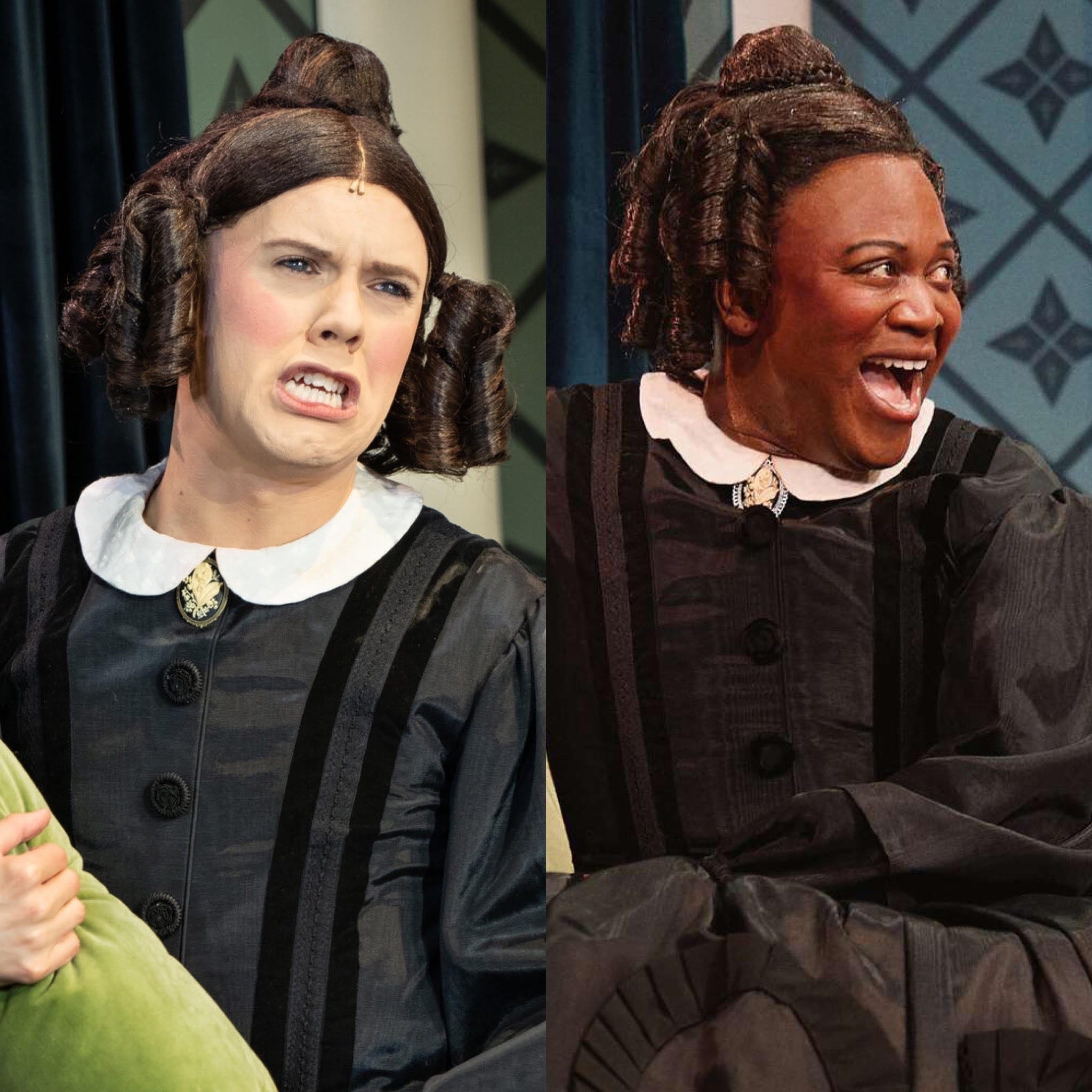
I thought the show was a riot. At that point, it had already become the toast of the town, which meant the audience felt almost evenly divided between gay men who are fans of Escola’s niche aesthetic and affluent senior-to-middle aged straight couples who bought tickets after the wife noticed it was a Critic’s Pick in the NY Times. To my side, there was a group of cheery bears abuzz with excitement to be seeing the first masterwork of their generation’s Charles Busch or Charles Ludlam, whose work they absolutely want you to know they know. They howled with laughter just as hard as my friend Buck and me.
But to Buck’s side, there were the NY Times subscribers. They laughed, but not with the same unadulterated enthusiasm.
So, I left wondering if Oh, Mary! really was a great play, or if it was only great to fellow gays and theys…which then made me wonder if a play even has to appeal to a wide variety of audiences to be truly great…or if that was just heteronormative patriarchy trying to impose its values on my queer ass.
I’m still grappling with those questions, but after revisiting Oh, Mary! on Broadway earlier this week with its new principal cast, I can confidently say it’s even greater than I thought it might be after initially seeing it.
The impetus for my return visit was the inspired casting of Titus Burgess, who joined the production on March 19 for an allegedly sold-out three-week run in the title role. Burgess is a Broadway veteran whose talent and unique sensibility inspired Tina Fey to create the part of Titus Andromedon for him on The Unbreakable Kimmy Schmidt—a role that would emerge as one of the greatest television characters to come along in the 21st century.
As Escola’s bizzaro version of Mary Todd Lincoln, Titus is hilarious, just as anyone who knows his television body of work would expect him to be. Is he just as funny as Escola? No, not quite—and probably not just because it was only his fourth performance. My guess is that it’s more that Escola’s voice as a playwright is so incredibly unique and so specifically tailored to Escola’s voice as an actor.
However, some of those extra laughs came from Escola’s signature sense of detached ridiculousness, a quality that keeps you keenly aware that you’re watching an actor…and this one delulu actor specifically. You never forget Escola and so you never wholly invest in the character’s reality.
Burgess sacrifices those laughs to find unexpected moments of depth in Mary. He brings genuine pathos to the role, and thus crafts a full emotional arc with a more satisfying payoff for the audience. And with Burgess’ sui generis gifts as a singer, that payoff thrills in a way that it never could with Escola. To be clear, it still ain’t Chekhov. The play is designed to be—and remains—an exercise in absurdism. Now, however, instead of laughing 100% of the time, we laugh 96% of the time and spend that last 4% of the time actually feeling something. (Look at me with the MATH.[1] Maybe I should stop writing and do my own taxes next!)
The other newish additions to the cast—Phillip James Brannon as Mary’s Husband and Chris Renfro as Mary’s Teacher—are also very good. Brannon is a more imposing figure than Ricamora and even sexier (which is saying something because you know Conrad is my ex). His air of authority renders him a more believable president, which sprinkles another tiny drop of reality into the proceedings. Renfro is more boyish than his predecessor and more believably angsty when the character reveals his true motives. Both, like Burgess, elicit a few less laughs, and a bit more investment. Bianca Leigh and Tony Macht, the two holdovers from the original cast, continue to do delightful work.
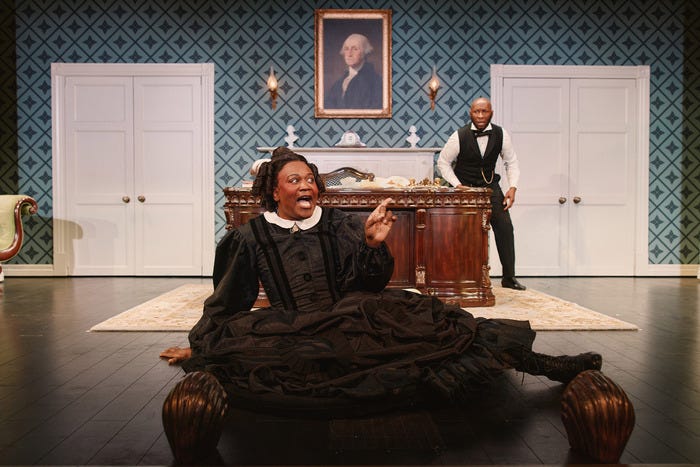
Although I’m still unsure where I stand on the necessity of a play’s widespread appeal in determining its greatness, I do now know that Oh, Mary! has passed a different test, one that is certainly required to determine a play’s strength. With the arrival of Brannon, Renfro, and especially Burgess, Oh, Mary! has proven it can work with a variety of actors in its starring roles; the play’s is not dependent on the involvement of its original stars, including and most importantly Escola.
In this moment, when queer lives are being viciously targeted by a president, laughing so hard at queer art at least obliquely about a president feels downright ecstatic and even a little bit healing. Oh, Mary: you couldn’t have come around the mountain when you came at a better time.
a guide to ticket-buying
Burgess’s brief three-week run in Oh, Mary! was reported to have sold out in days. However, Broadway shows tend to release unused house seats two to four days before a performance. So, on Monday, I checked to see what was available for Thursday, and was able to snag a pair of PERFECT seats—Orch. J101 and J102—through Ticketmaster for $225 each with fees.
[1] Are you reading this, Kaye? Are you proud of me?!
Now you're just blatantly writing for me. Math?!? OMG. I wrote this comment BEFORE I read your footnote. I GOT A FOOTNOTE!?!?!
And prior to math, this made me LOL: "...after the wife noticed it was a Critic’s Pick..."
"The wife" - classic Southern misogyny.
I'm happy to hear that the play also doesn't Hinge on the performance of Conrad Ricamora as Abraham Lincoln.