
Do you want the truth?
Though I worry my credibility can’t handle the truth, the reality is I rarely like Aaron Sorkin’s writing.
I’m hesitant to admit my aversion because Sorkin is so revered and decorated, most notably with an Oscar for his screenplay of The Social Network and five Emmys for The West Wing, including one for Outstanding Writing. Raving about Sorkin has, in some circles, become a way of telegraphing your intelligence and sophistication. Here’s the problem. In Sorkin, everyone sounds like Sorkin: quippy, combative, staccato, and hyper-articulate.
There are undeniable pleasures in the wit of some of those quips, and I understand how delicious it can be to savor a writer’s eloquence. In fact, I recently described it in my very favorable review of Jon Robin Baitz’s Other Desert Cities. I compared Baitz and Sorkin, conceding that, with both of them, “you sometimes hear the playwright more than the characters, and it can take actors of great facility to make the density of their text sound extemporaneous, human, and varied from role to role.”
When the characters share similar backgrounds, like the family in Other Desert Cities or the political animals in The West Wing, it’s defensible. When they do not, the uniformity of the characters’ voices undermines their believability and defuses any exploration of difference. The Social Network, for example, is ostensibly about a disruption of the old boys’ club. And yet—regardless of socioeconomic status, age, or gender—everyone sounds the same. They sound like Sorkin.
Similarly, in A Few Good Men, there’s extensive discussion of the characters’ varying backgrounds, belief systems, and levels of experience and education. And yet—shoddy dialect work aside—there’s no differentiation in how they speak. They speak like Sorkin. Early in the play, when one character asks another, “[D]o you always talk as if your dialogue was written by someone who’s not very good at it?”, it somehow feels both self-aware in an annoyingly cutesy way (look! our dialogue is about dialogue!) and profoundly lacking in self-awareness, because the character asking the question talks essentially the same way as the character he’s criticizing.
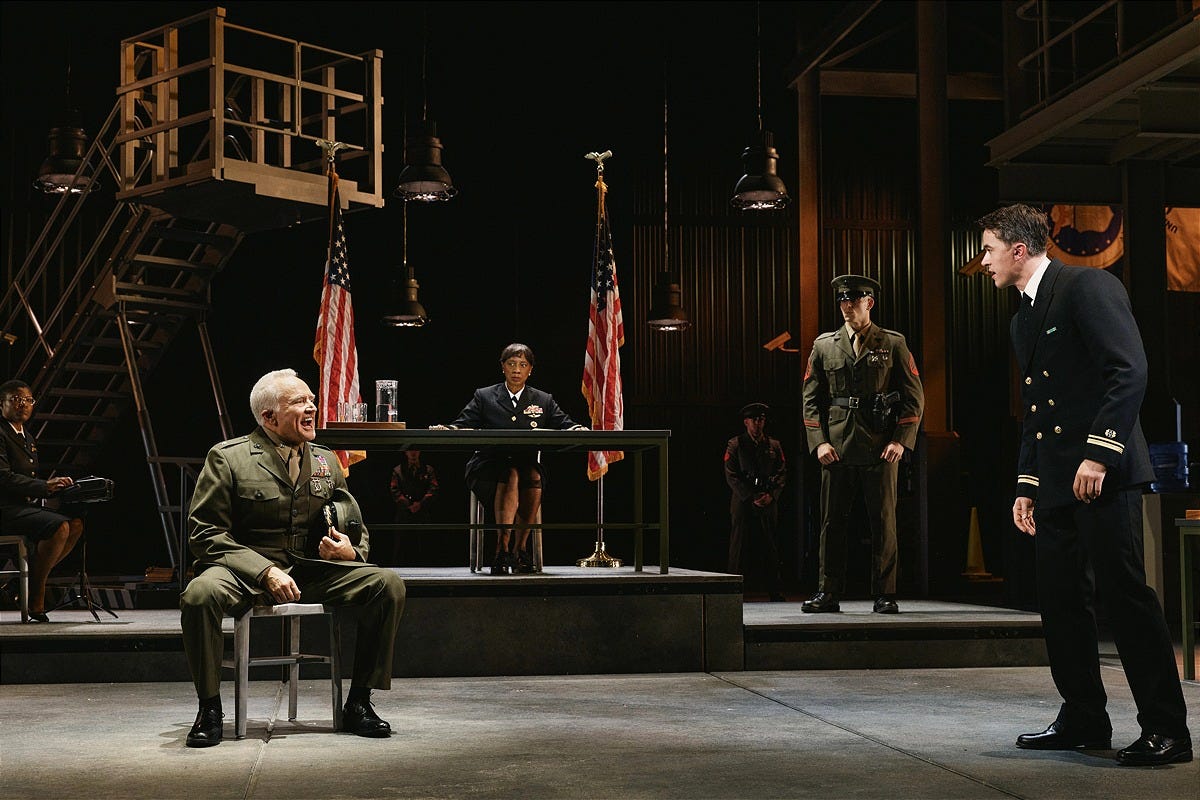
It doesn’t help that director Michael Arden overemphasizes the playwright’s cleverness by having his cast play for laughs more often than seems appropriate for their situations. If you’ve never seen the play or Rob Reiner’s 1992 blockbuster adaptation, here’s a brief rundown of those situations and who, in Lincoln Center’s current revival, has inherited the roles made famous on film by Tom Cruise, Demi Moore, and Jack Nicholson. Smart but complacent Navy attorney Daniel Kaffee (Tom Blyth) is assigned to defend two Marines charged with murder. His usual strategy of plea bargaining to avoid seeing the inside of a courtroom is interrupted by Joanne Galloway (Krysta Rodriguez), a “lady lawyer from internal affairs,” who suspects the young men acted on orders from domineering Lt. Col. Nathan Jessep (Bradley Whitford).
The large cast also includes Kaffee’s second chair Sam Weinberg (Nick Blaemire), who, we’re repeatedly reminded, is Jewish; Jessep’s subordinates, Matthew Markinson (Thom Sesma), who is former intelligence, and platoon commander Jonathan Kendrick (John Zdrojeski), who is religious; prosecutor Jack Ross (Michael Oberholtzer, but assured understudy Miles Fowler at the show I attended); and military Judge J. A. Randolph (Stephanie Berry). Given Broadway’s current economics, it’s hard to imagine anyone but a major nonprofit like Lincoln Center affording such a huge ensemble for a straight play.
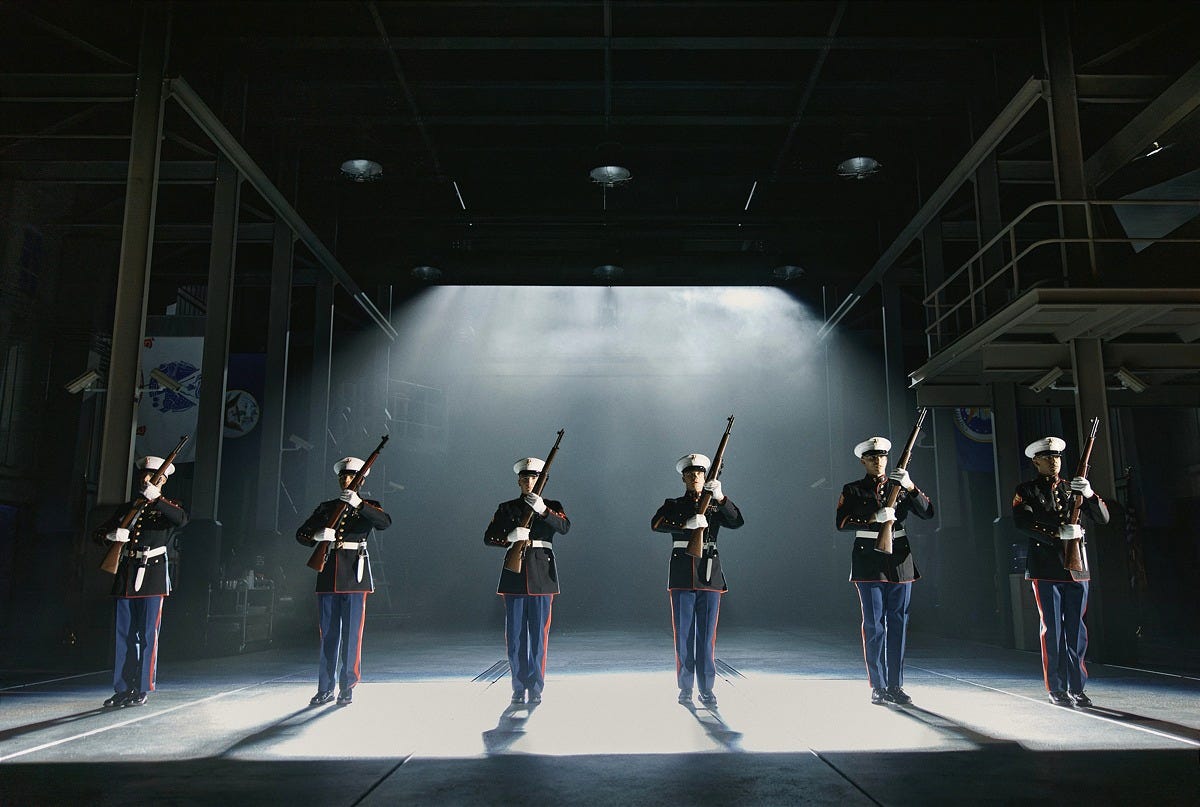
At the same time, the action is dominated by two- and three-person scenes, which makes the cavernous Vivian Beaumont stage the wrong venue, and neither Arden nor scenic designer Dane Laffrey does enough to fill it. That’s unexpected because their collaborations on Once on This Island, Maybe Happy Ending, and (the otherwise abysmal) The Lost Boys yielded some of New York’s most visually arresting productions in years. Worse, despite having beautifully staged the first of those three musicals fully in the round, Arden here shows little aptitude for, or interest in, directing for the Beaumont’s thrust space, treating the sides of the house as partial- rather than alternate-view seating. He also makes the mistake of rehiring Gabriel Mann, one of the composers of The Lost Boys, to write original music for the production. It’s a heavy-handed addition to Joshua D. Reid’s sound design, which has cringeworthy moments of its own.
Arden’s work here also departs from his impressive track record with actors. He has elicited career bests from consummate pros like Darren Criss, Shoshana Bean, and Ben Platt. Blyth (who apparently is a movie star?) is charismatic, gorgeous, and clearly skilled, but his interpretation is severely miscalibrated. He leans so constantly into Kaffee’s cockiness that we never see him begin to invest in the case, which prevents us from investing in him. At the performance I saw, Blyth was also surprisingly sloppy, stumbling over several lines and, in the climactic trial scene, initially stating his own character’s name when calling Jessep to the stand.
In addition to his high-profile work with Sorkin on The West Wing,1 Whitford actually made his Broadway debut in the original production of A Few Good Men as a replacement Ross and then Kaffee. It thus seems that he should have more comfort with the text than anyone. Disappointingly, Whitford can’t exorcise the ghost of Jack Nicholson and frequently appears unnatural, perhaps from the effort. Rodriguez wears her heart too overtly on her sleeve, lacking a certain toughness a woman would have needed to persist in the 1980s Navy. Among the principals, she and Blaemire are the most undercut by Arden’s overemphasis on the script’s comedy, although both have great comic timing, and Blaemire finds such gravitas in a couple of moments that he emerges as the production’s moral center.
One might assume Blyth, Whitford, and Rodriguez simply aren’t up to the complex tasks asked of them. That may be true; however, the consistency of subpar work in the supporting cast strongly suggests that Arden is the overarching problem. Sesma is dignified but unspecific. Zdrojeski is loud and devoid of nuance. Berry is in an entirely different play. As the defendants, Lavel Schley and Collin Kelly-Sordelet hammer the same notes so hard, it’s like they have a paid sponsorship with DeWalt.
There are still a few good ways in which A Few Good Men works. There’s genuine suspense in how Kaffee, Galloway, and Weinberg will prove their case.2 Plays have been weighing individual responsibility against collective order since Sophocles wrote Antigone around 440 BC, and the tension remains rich territory. The ethical question of what we will allow governments to do in the name of safety feels as relevant and complicated as ever. And, yes, it can be fun to hear that heightened and snappy Sorkin-speak.
Is that enough to make this messy revival worth seeing?
Maybe, to paraphrase Kaffee, I shouldn’t ask questions without knowing the answers.
the not-a-bottom line
🌈🌈½ (out of five)
a guide to ticket-buying
As mentioned above, sit center. Anywhere else, you’ll be excluded from a majority of the action.
And Studio 60 on the Sunset Strip. Anybody? Anybody?
That the latter two—the woman and the Jew—are the only characters Sorkin’s script refers to by first name is another conversation for another day. Also, please don’t DM me to say that Sorkin is Jewish. I know.
I owned Studio 60 on DVD, along with all 7 seasons of TWW. Very sad about this review as I love Bradley Whitford so much.
“…hammer the same notes so hard, it’s like they have a paid sponsorship with DeWalt.”
Walter Kerr found shaking.