
*Want to listen to this substack instead of read it? Scroll down for a link to audio!
There’s maybe nothing I want to love more than a brand-new musical, a wholly original creation with no connection to existing IP, whether a movie, book, or specific musician’s catalogue. Don’t get me wrong: I’m not one of those showmosexuals who will turn his doctored nose up to a show just because of its source material. Sure, I’ll admit there have been a few shows that I’ve had no interest in affording the benefit of my doubt (two from the recent past being Back to the Future and A Beautiful Noise), and even more that didn’t deserve my optimism. For example, when my friend “Lee” and I went to see Moulin Rouge and she chose to remain in a seat where her view was obstructed by a fake elephant’s truck rather than switch places to my full-view seat at intermission…I couldn’t blame her. Nevertheless, some of my favorite musicals are adaptations, including Gypsy, Chicago, Cabaret, Kiss of the Spider Woman, Hello Dolly!, Passion, Hello Again, Sunset Blvd., and Little Shop of Horrors.
All that being said, a truly brand-new musical is such an endangered species that when one is sighted in the wild of Broadway, I’m not just excited; I’m rooting for it to thrive. Sometimes, shows come along that remind you just how special and exhilarating spotting this rare breed can be. Think Next to Normal. Other times, these beasts will emerge so…untamed and afflicted, the best course of action, for the unruly fledgling and maybe even for you as its observer, is immediate euthanasia. Think Paradise Square. This season, and comparatively early in it, Broadway has born two totally original musicals—though, in one case, it might be more accurate to say “borne” (hahahhaha…spelling and semantics joke! the kids on social media love them!)—that epitomize the extremes in which their development can culminate.
In an effort to cultivate positivity, which all the self-help books that I read half of say I should do, we’ll start with the good. Maybe Happy Ending (“MHE”) is Definitely Excellent Theatre. I was raised on romantic comedies, but they’re right up there with new musicals as a genre I desperately crave that more frequently disappoints than sates me. Much to my surprise, MHE is both a fantastic original musical and the best romantic comedy I can remember seeing in any medium during the 2020s. It accomplishes this feat by simultaneously invoking classic tropes that audiences demand and will swoon over, and offering originality with something powerful to say.
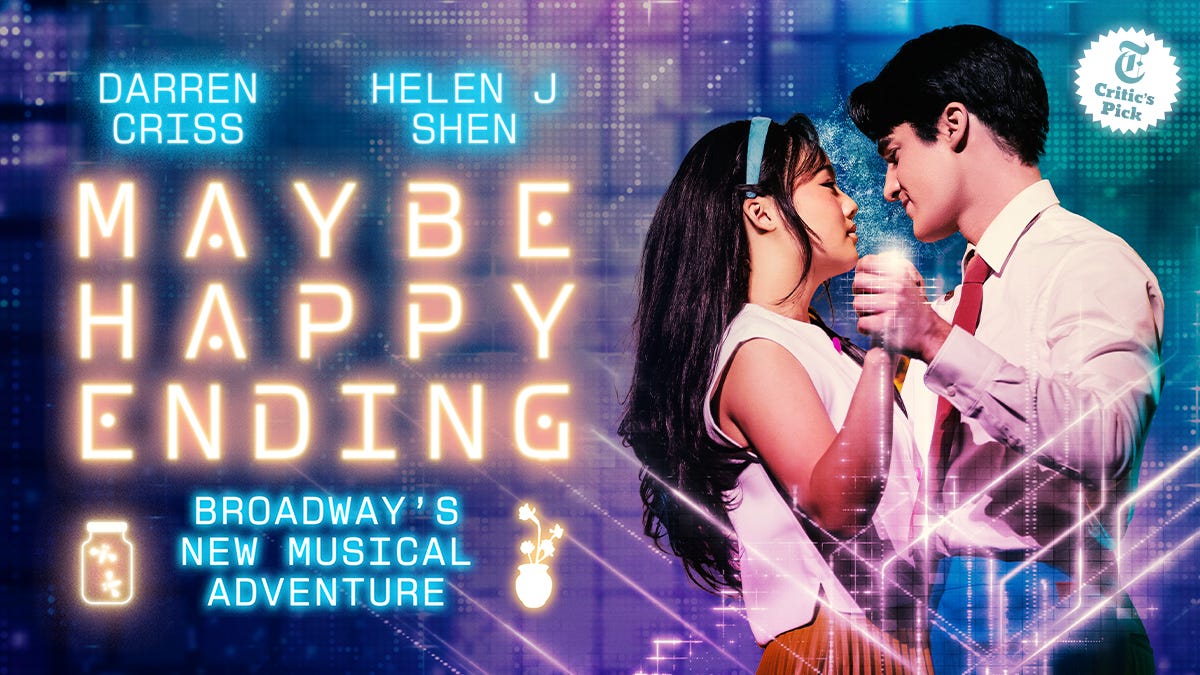
MHE tells the story of Oliver and Claire, two helper bots (think personifications of Siri and Alexa if Siri were an aging twink) who now live in a sort of retirement home for obsolete technology. Oliver is longing to see his former owner, whom he thinks of as a beloved friend, while Claire is confronting the imminent reality of having to permanently power down because of her dwindling battery life. They embark on a road trip to give Oliver the reunion he’s dreaming of and Claire one last glimpse of the fireflies she found so beautiful before being retired.
Remarkably, the journey of these two robots becomes one of the most moving and honest explorations of human love and mortality to hit Broadway in years. Librettists are often the unsung heroes of musical theatre, too often singled out only when books are problematic. The poignance and perceptiveness of MHE’s book, which is coauthored by Hue Park and Will Aronson, provide a great example of just how integral a libretto is to a musical’s success. Aronson’s music may not reveal its power as immediately or obviously, but its pleasures become more apparent on repeated listening and it never fails to serve the story and its characters.
Director Michael Arden brilliantly builds the MHE world with all the visual acuity he applied to his lush staging of Once on This Island (for which he should have won a Tony) and all the emotional intelligence that informed his heartbreaking revival of Parade (for which he did win a Tony). For the visuals, Arden is aided by an exquisite design team. Among them, two strike me as deserving special mention: firstly, scenic designer Dane Laffrey, who has created spaces that somehow feel futuristic and familiar, and cleverly uses an iris effect to assure that intimate scenes in this small four-person musical are not swallowed up by a big Broadway stage; secondly, makeup designer Suki Tsujimoto, whose look for Oliver quickly communicates that he’s not human without ever making him look creepy or, really, anything less than adorable. For the emotional intelligence, Arden has assembled a small but mighty cast.
In supporting roles, Dez Duron offers the most velvety-smooth vocals you’re likely to hear on Broadway, delighting the audience every time he makes one of his sporadic and brief appearances as a jazz singer, and Marcus Choi, playing a variety of parts, proves himself not only to be the perfect protean for the piece, but also highly capable of emotional heavy lifting when the scenework requires it. Helen J. Shen brings such a sense of ease and confidence to the massive role of Claire, it’s hard to believe it’s her Broadway debut. Although her singing is always pleasant, it’s not ever really exciting enough to make her musical numbers an event. At the same time, she acts with refreshing sincerity that suggests she could have a great career on television or film.
Delightful as these three performers are, Darren Criss outshines them all, delivering a true tour-de-force as Oliver. It’s a credit to his talent and skill that Criss’s performance often seems effortless because his physicality alone is so specific, fully realized, and, in all likelihood, taxing, it must be the product of extensive work. Having not been a Gleek and only watched the first episode of The Assassination of Gianni Versace: American Crime Story (which struck me as prurient in the Ryan Murphiest of ways), my previous experience of Criss was largely limited to his replacement turn as the title character in Hedwig and the Angry Inch. He was terrific. Now, on the same stage, he is terrific in entirely different ways while still demonstrating an equally impressive depth of gifts as an actor and singer. Criss’s superb performance is a microcosm of MHE itself: they will both make you laugh, break your heart, and imbue with you hope.
Next time, I’ll discuss the second wholly original Broadway musical I’ve seen this season and finally answer the age-old question: if a tree falls in a forest and no one is around to hear it, would it still be more dramatically satisfying than Redwood?
a guide to ticket-buying
I first saw MHE at a Sunday matinee, spending $42 on a center standing room tickets at the box office a couple of hours before the show. The Belasco isn’t a huge theater, so I still had a solid view of the actors from the back of the orchestra; furthermore, the show is only 100 intermission-less minutes, which made standing room was fairly painless. However, the mezzanine overhang cuts off some important video projections. As fair of a price as $42 is, rightfully, standing room at MHE should be sold as partial view.
The second time, I was invited at someone’s guest and sat in Orch L8. The view was absolutely fine, but, because of the show’s extensive use of projections, I’d say front mezz is probably preferable to anything behind orchestra row J, which is where the mezzanine overhang begins.
a key to the pictures
Here, I’ll focus only on the originally Broadway production, though it’s possible to track down video of MHE’s previous iterations, including in Korean.
The Rainy Day We Met: Promotional video of full song with production footage
Hitting the Road: Promotional video of full song with production footage
When You’re in Love: Promotional studio video of full song
Why Love?/When You’re in Love on The Tonight Show With Jimmy Fallon