
*Want to listen to this substack instead of read it? Scroll down for a link to audio!
It's hard to know where to start with Redwood, a musical that seems to have at least a vague idea of what it wants to say but no idea how to say it. There is probably some metaphoric value in its physical production, which is defined by beguiling projections, an imposing tree trunk, and an otherwise empty stage. Maybe it's that whatever meaning the creators are trying to transfer to the piece can actually be found only outside of a theater. Or maybe it's less of a metaphor and more a reminder that the visual does not necessarily equate to the theatrical.
Nevertheless, Redwood tries, for which reason I was really ROOTING (get it?) for it, even more than I typically WOOD (okay, I'll stop) for a wholly original musical because it has particularly lofty ambitions. It follows Jesse, a New York gallerist played by Idina Menzel, who flees the city and her wife (De'Adre Aziza) after their son (Zachary Noah Piser) unexpectedly dies in his early twenties. At first, she has no specific destination or goal in mind, but when she encounters two arborists, the skeptical Becca (Khaila Wilcoxon) and sympathetic Finn (Michael Park), she becomes determined to climb and sleep in the redwood tree they're studying.
In case my plot summary doesn't make it clear, Redwood desperately wants to continue the work of two of the most notable original musicals of the 21st century, Next to Normal and Dear Evan Hansen, as a serious exploration of grief, mourning, and how depression complicates human connection.[1] Unfortunately, Redwood's score and book are not a fraction as fully realized, intelligent, emotional, surprising, or honest as the score and book of those musicals. And, yes, I know they're problematic in their own ways, especially Dear Evan Hansen, but there's a difference between good construction and good moral/philosophical implications rendered by that construction; Redwood lacks both.
It reminded me of an assignment doled out by my British Literature teacher in eleventh grade. After reading a chunk of Paradise Lost, we all had to write essays on our personal vision of hell, which we read aloud with our desks arranged in a circle and the overhead lights switched off. Redwood feels just as derivative and self-indulgent as those essays, and is presented with the same sense of sadism, self-congratulation, and aspirational profundity that my teacher had when, on the day the assignments were due, she announced, "Today…will be a dark, dark day."
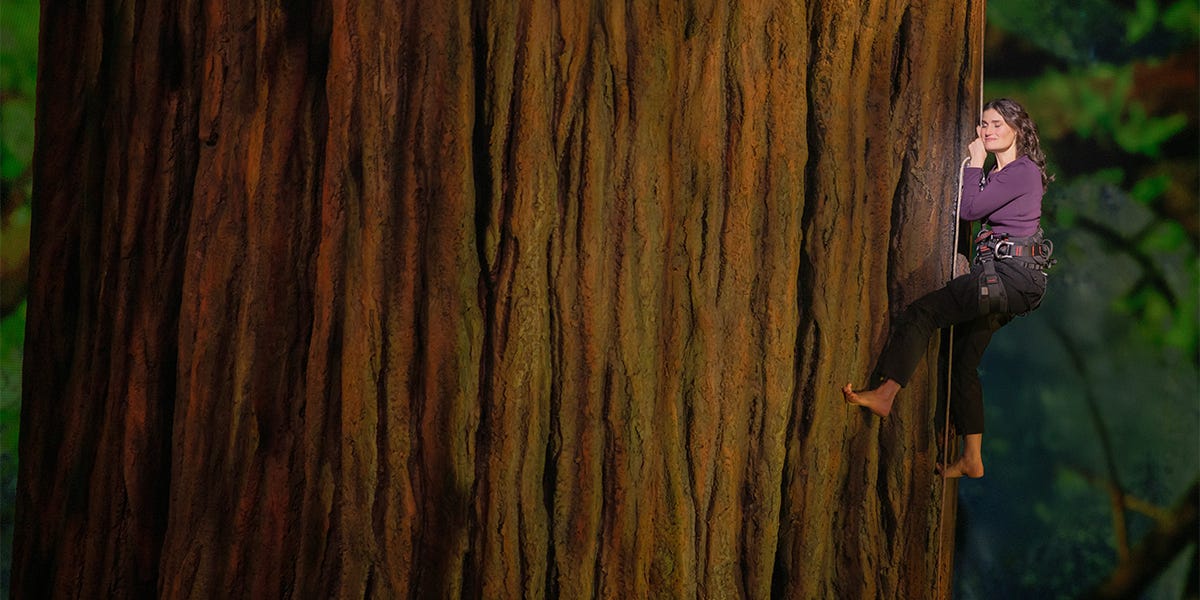
The very talented cast does their very best. Piser and Wilcoxon make particularly impressive contributions. They're both fantastic singers who infuse their performances with honesty and intensity; she delivers the evening's most exciting belting while he delivers its most heartbreaking scenework. Aziza and Park are never anything less than sincere, but are victims of the libretto's frustrating tendency to force its actors into playing the same scene over and over with only minor variations.
Then, of course, there's the entire musical's ostensible reason for existence, Idina Menzel. On paper, I should love her: I was a teenage theatre kid when Rent hit; I'm a gay man who saw the original Broadway cast of Wicked; and I have young nieces with whom I lovingly watched Frozen. But I never actually took to Rent, finding its score and many of its characters (especially Menzel's) abrasive; in an early harbinger of rainbow-hued criticisms to come, I took umbrage with its book for killing off a queer character with AIDS and having her act as a sort of guardian angel for a straight character with AIDS. I could—and maybe one day will—write a novella on all the ways I find Wicked exhaustingly mediocre and feel genuine embarrassment that it has become such a beloved work among fellow gay men. And though I think Frozen is probably the best use of Menzel's talents that I've encountered, I think its exceptional writing (the best in a Disney animated musical since the death of Howard Ashman) is far more responsible for its success than her casting.
I've often wondered how Menzel has managed to become arguably the biggest theatre star of her generation when her acting is amateurish and her singing devoid of technique, more or less landing on the theory that it is, in fact, these very rough edges that have endeared her to her fans. She represents a newish stage in the evolution of why audiences love Broadway belters. It began with singers like Ethel Merman and Patti LuPone who impressed people with superhuman vocals, seemingly effortless belting that excites because we wonder how they did or can do it. The next phase encompasses performers like Liza Minnelli and 1990s Alice Ripley. Their singing offered a musical equivalent of circus trapeze acts: you wonder if they'll be able to pull-off the daring feats they attempt; while part of the excitement comes from the fact that most of the time they do, it's also informed by the knowledge that some of the time they don't. The titillation isn't just about their athleticism; it's also about their risk. But with Menzel, a host of subsequent Elphabas, and 2000s Alice Ripley, the thrilling money notes seem to be, at the very least, equally matched by botched attempts at hitting them. Rather than turn fans off, these struggles seem to make the stars more relatable and their achievements more attainable. This sense of identification has propelled Menzel to the next level of stardom for "I'm not that girl" type audience members who are frustrated by "be[ing] the good girl [they] always have to be" while also feeling there's untapped power within them.
For all these reasons, Redwood comes close to giving the full Menzel experience, falling short because it does not have a "Defying Gravity," "Let It Go," "Take Me or Leave Me" or even "Always Starting Over" that audiences will leave eager to tackle themselves. Otherwise, though, it showcases all her strengths and all her shortcomings that have debatably become strengths. Her acting is, on one hand, unspecific and awkward; but, on the other, idiosyncratic and improved. Her singing is, on one hand, ragged from years of poor technique; but, on the other hand, rewarding when she successfully forces out a big note. It's a performance that will neither win over detractors nor turn away fans, but is undeniably charismatic and even interesting.
However, in the end, as the old adage goes, "if it ain't on the page, it ain't on the stage," and Redwood cannot overcome its writing. The tediously repetitive book does not offer us any new insights into relationships or mourning. It keeps telling us that "nature is healing" without ever really showing us how or why. Kate Diaz's amorphous score does not differentiate between characters or situations, and ends up sounding less like a musical and more like juvenilia from a singer/songwriter who's attempting to structure a highbrow album around a single concept.
Director Tina Landau also wrote the book, cowrote the lyrics with Diaz, and co-conceived the musical with Menzel. I can't help but wonder if she was too close to the material to elevate it with her unique vision. With director, writer, and star all wearing multiple hats, maybe there was no one who had enough perspective to see that their outfit wasn't really coming together.
Landau's last Broadway musical was SpongeBob SquarePants, such aggressively commercial IP that one might assume it's the sort of cash-grabbing dreck directors need to line their pockets so they can then tackle more artistically ambitious fare like Redwood. But the joke on theatre snobs everywhere—including me—is that Landau's endlessly imaginative staging of SpongeBob was so dazzling, it created a surprisingly artful production. Even its concept, a metaphor for the climate crisis that was also credited to Landau, provided more food for thought than anything in the unruly forest of her current production.
Consequently, as I watched Redwood, my mind repeatedly wandered to the closing words of Frank Rich's NY Times review of the legendary Broadway flop Carrie. Having eviscerated virtually everything in the production other than Betty Buckley's performance as the title character's abusive mother, he wrote, "After a theatrical decade that has taken her from 'Cats' to pigs, the time has come for Betty Buckley to receive a human musical as her heavenly reward." After a theatrical decade that has taken Landau from the Pacific Ocean to a redwood forest, I'd say she deserves the same.
a guide to ticket-buying
Orchestra Center D111 was a very good seat, but given the production's frequent use of large-scale projections, a couple of rows farther back would have been perfect. If you find yourself drawn more to visuals than acting in your theatergoing, then sitting in the first row of the mezzanine would probably give you the best vantage point for those beautiful projections.
a key to the pictures
Idina Menzel sings "In the Leaves" on The Today Show
Idina Menzel sings "Great Escape" at the Macy's Thanksgiving Day Parade 2024 on a Bronx Zoo float where she is rather embarrassingly surrounded by actors dressed as animals doing choreography that has nothing to do with the song or Redwood
[1] If the narrative and thematic similarities between these musicals don't convince you that Redwood wants to be a theatrical successor to Next to Normal and Dear Evan Hansen, consider this: in the latter musical, Park was an original cast member, Piser was a replacement Evan, and Jesse standby Jessica Phillips opened the tour and later replaced on Broadway as Heidi; Phillips was also the Diana standby for the entire Broadway run of Next to Normal, which was composed Redwood Musical Supervisor Tom Kitt.
At least we always agree about Idina...and genius Landau.