
It’s clichéd but true that one should never say “never.”
In the mid to late 90s, when I was in my early to mid-teen years, I saw the original Broadway production of Cats and thought, “Well, I never need to see that musical again.” (And, in 2016, when original director Trevor Nunn revived it on Broadway with new choreography from hot-off-of-Hamilton Andy Blankenbuehler, I did indeed stay home.)
In 2025, when I started this Substack, I told myself that I’d never center full-length posts on productions I’d already seen.
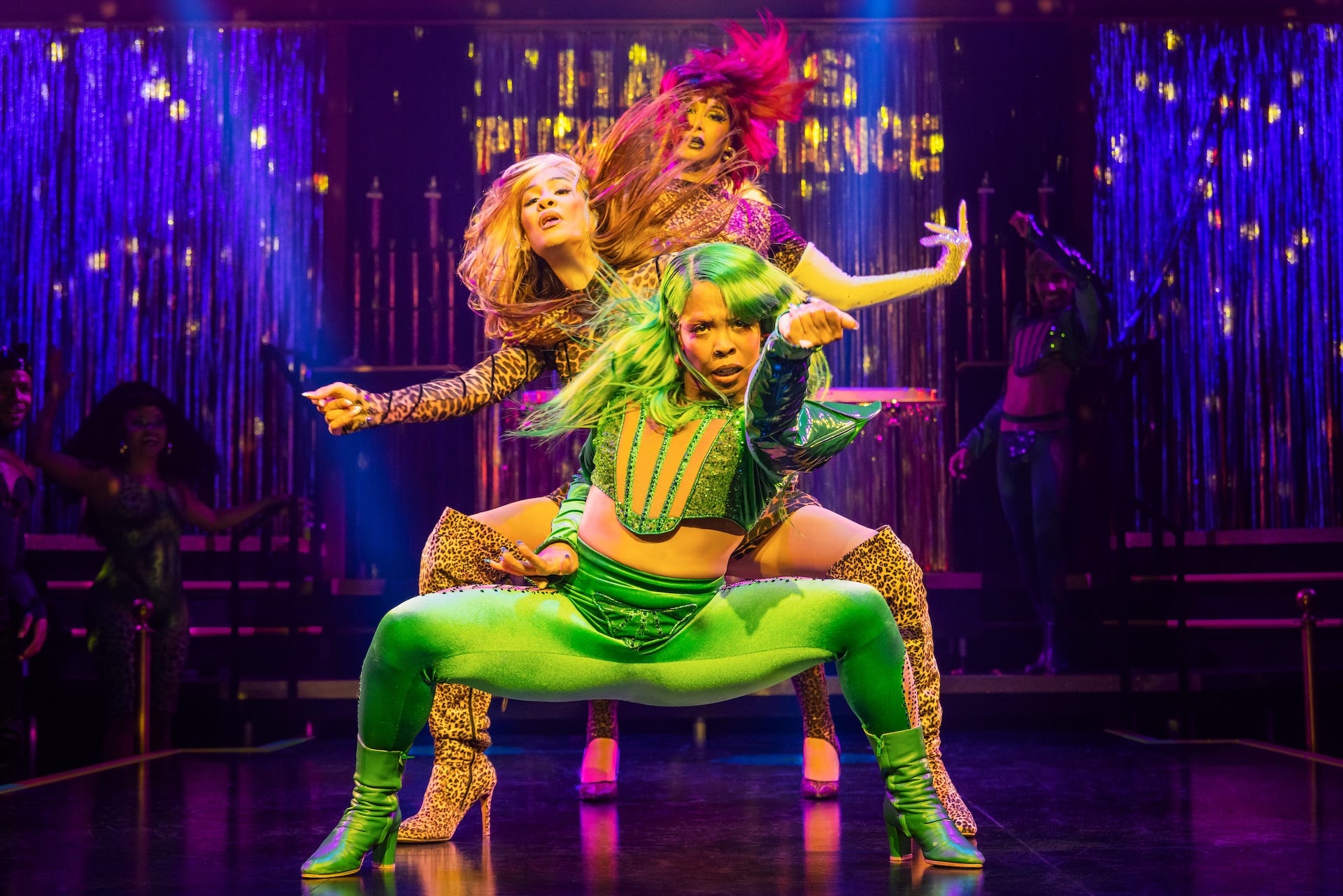
And, in 2024, when I first caught Zhailon Levingston and Bill Rauch’s brilliant reimagining of Cats as a ballroom competition during its initial off-Broadway run at PAC NYC, I said, “This is fantastic…and it will never transfer.” Or maybe I said, “It should never transfer.” Either way, I was wrong.
In October 2025—over a year after it had been a hot ticket downtown, but about six months before it would officially open—Cats: The Jellicle Ball announced it would transfer to Broadway. It’s a path that has felt increasingly inevitable for off-Broadway hits, even though the commercial successes (Hadestown; Dear Evan Hansen; Hamilton; Next to Normal; Avenue Q) are vastly outnumbered by the financial failures (Illinoise; Dead Outlaw; Here Lies Love; Be More Chill; Natasha; Pierre & the Great Comet of 1812; The Scottsboro Boys; [title of show]; Passing Strange; Caroline, or Change; A Class Act; James Joyce’s The Dead). These days, it seems rare for a production that becomes popular off-Broadway to stay there.1
Nevertheless, from a commercial perspective, I hadn’t expected Cats: The Jellicle Ball to move, especially after so much time had passed since it was the toast of the town. The previous revival underperformed; its 2019 film adaptation was a notorious flop; and the cost of reproducing its environmental setting, which felt crucial to the action, seemed especially risky given the economically disastrous consequences of doing the same for Here Lies Love and The Great Comet. Furthermore, the Great White Way (pun intended) has a history of engaging with communities of color, who are inseparable from ballroom, that has been inconsistent at best.
Artistically, it appeared equally ill advised. At PAC NYC, the set was almost entirely a long runway, flanked by large portions of the audience on each of its sides, suggesting the immersive experience of being at a packed ball. Much of the cast was populated by mesmerizing experts legitimately from the ballroom scene and gender-nonconforming singers who don’t sound like Broadway babies. I feared they’d be replaced with talent who has more regularly “trod the boards” and their invaluable contributions would be lost.
I should have trusted that Levingston and Rauch—directors who were imaginative enough to reconceive Broadway’s longest running punchline into an electrifying celebration of queerness and people of color—would also be smart enough to remain connected with everything that gave their vision its charge. The vast majority of the spectacular off-Broadway cast was retained. Although Rachel Hauck’s set still features a runway (albeit a much smaller one), and onstage seating for a small chunk of the audience evokes a ballroom crowd, the predominantly proscenium space actually works in the production’s favor, creating superior sightlines and a more guided focus for the explosive choreography from Omari Wiles and Arturo Lyons. Qween Jean’s showstopping costumes look more opulent and audacious without losing grit when they need to grime. Adam Honoré’s lighting somehow feels more theatrical and more clubby. Kai Harada’s sound design induces both goosebumps and head bopping. Much to my surprise, everything about Cats: The Jellicle Ball is even better on Broadway than it was off (but it’s no surprise that Levingston, Rauch, Wiles, Lyons, and Jean all won Tonys for their work).
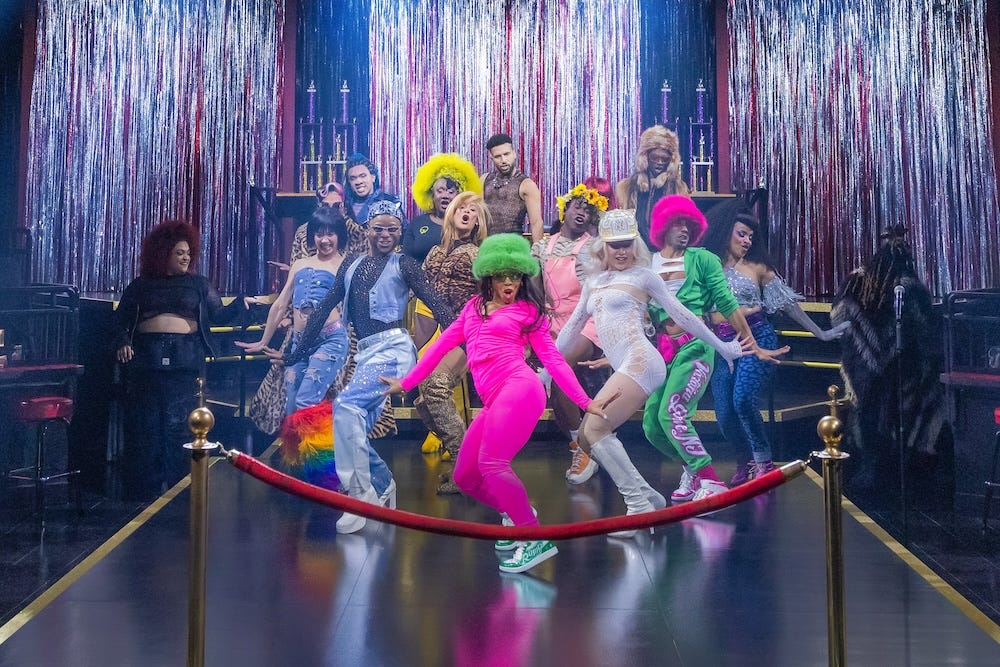
The entire company is outstanding, but there are a few I have to single out. Dudney Joseph Jr. emcees the evening with effortless command and infectious playfulness. Primo Thee Ballerino is a crackling ball of energy and precision, wholly captivating whether in his regular role of Tumblebrutus or understudying Mr. Mistoffelees. Then there’s the full-time Mistoffelees, Robert “Silk” Mason (they/them), who is as fearless as they are graceful, and as pristine a technician as they are a bravura showman. Watching Mason, you sense that you are seeing an early performance from someone who is bound to be a major force in the world of dance.
Jonathan Burke and Dava Huesca are endlessly delightful as Mungojerrie and Rumpleteazer, traditionally the musical’s most grating characters, but here irresistible scene-stealers, like a contortionist combination of Lenny and Squiggy, Chi-Chi Rodriguez and Rosie Perez, and Richard “Crazy Legs” Colón and Chita Rivera. As Gus the Theatre Cat, ballroom legend Junior LaBeija infuses the evening with decades of history, sly charisma, and genuine poignance. Nora Schell plays Bustopher Jones like the lovechild of Sophie Tucker and Ethel Merman whom you didn’t know you were dying to adopt. Sydney James Harcourt is so astoundingly sexy as Rum Tum Tugger, you might not realize how polished and versatile a professional he is. (At least I’m hoping he’s versatile.) And of course Broadway legend André De Shields is the production’s beating and badass heart as Old Deuteronomy, conveying more character before he even opens his mouth than Ali Louis Bourzgui—who incomprehensibly beat De Shields at this year’s Tonys—does in the entirety of The Lost Boys.
And yet…
While my artistic misgivings proved unfounded, my commercial concerns turned out to be spot-on. This past Monday, the production announced it will close on August 8, having eked out a run of just four months. The news triggered an uproar in the theatre community that I see as falling into two categories.
The first is theatre people, queer folk, and people of color who love this production, mourning the demise of what they rightfully see as an important piece of representation. To grossly oversimplify their/our reaction, it’s a more personal and sophisticated version of, “Why can’t we have nice things?!” Their reaction includes elements of disbelief (“How can this be happening? It’s so good!”), betrayal (“Sure enough, mainstream theatre can’t support a show like this!”), and sadness (“There’s such an embarrassment of talent on display; what will they do now? Where will I be able to catch their work?”). For some, I think there’s even a certain sort of transference occurring where the general population’s rejection of Cats: The Jellicle Ball feels like a rejection of who they are.
The second category of outcry comes with some thorny ethical complications. It’s been best articulated by Cats composer and King of the British Megamusical Andrew Lloyd Webber in an Instagram post that followed the closing notice. He wrote:
Ever since I was a kid, I’ve wanted to write musicals.
Even though I’m British, when I was young, Broadway meant musicals to me.
The first of my musicals to be staged was on Broadway, Jesus Christ Superstar in 1971. I premiered School of Rock on Broadway.
In short, I love Broadway.
What is happening in front of all who care about the Great White Way breaks my heart.
One of the last things Hal Prince said to me was that it broke his heart that it was impossible for new or daring work to be originated on Broadway anymore.
The truth is that, for any show, it makes practically no financial sense to come to Broadway with things as they are.
Creators, writers and directors have been forced to take minimal royalties from new shows, often surviving on a fixed weekly fee rather than a royalty. It makes it impossible for young creatives to make a living from theatre alone.
Investors count themselves fortunate indeed if they see a portion of their money back.
Of course, the established big hits are still profitable. But Broadway can’t survive because of three old shows.
As someone who is still as in love with Broadway as I was when I was a teenager, I beg the theatre owners, unions and producers to come together urgently to address what is a crisis coming to a head.
Broadway is in dire danger of rivalling Hollywood’s empty soundstages with increasingly dark theatres.
The sobering economic realities that Lloyd Webber describes are difficult to dispute. The majority of Broadway shows don’t recoup their investments. It’s gotten even harder as production costs have skyrocketed…but, then, so too have ticket prices. There’s clear truth in what he says about how impossible it has become to take risks in commercial theatre…but, then, there’s also clear self-interest. After all, critical acclaim and winning major Tony awards didn’t help Cats: The Jellicle Ball or the recent revival of Sunset Blvd. turn a profit, and it seems unlikely that an undertaking as massive as Masquerade will be able to close in the black.
There’s also irony in Lloyd Webber finally garnering the kind of raves that eluded him at the peak of his popularity, only to see them fail to translate into commercial success. There’s even more irony in Lloyd Webber—whose name was once synonymous with Broadway spectacle, pandering to the masses, and recycling melodies—positioning himself as a downtrodden risk-taker. His last new Broadway musical was Bad Cinderella.
Thorniest of all, though, is Lloyd Webber’s inclusion of unions alongside theatre owners and producers. I’ve seen them increasingly scapegoated for the economic woes of live theatre, and singled out as the reason why so many shows that are being commercially recorded film on the West End rather than Broadway. I don’t doubt that unions add to production costs, but they also offer necessary protections to groups of artists who face constant economic insecurity and job uncertainty. And, let’s be real, how many people have gotten rich off of Equity or IATSE contracts? I worry that pointing the finger at unions is part of a larger trend, especially in America, where folks at the bottom of the food chain are pushed to settle for less in order to have anything at all…while those at the top subsist on a diet of lobster, filet mignon, and Dom Perignon.
The business of Broadway clearly needs to change, though I’m not smart enough to know how. As it turned out, I was smart enough to know that moving Cats: The Jellicle Ball uptown was financially a step too far. However, as T.S. Eliot—who created the poems that provide the basis for Cats—once wrote, “[O]nly those who will risk going too far can possibly find out just how far one can go.”
Push producers and theatre owners to go farther. Go see Cats: The Jellicle Ball during its last three weeks on Broadway. Don’t go to save this production, which will never happen. (Damn, there I go again!) Go to create a memory. Go to understand what happiness is. Go because Broadway will never become all it can be if we don’t show up for the productions that dare to commit to something new.
the not-a-bottom line
🌈🌈🌈🌈½ (out of five)
a guide to ticket-buying
The onstage seats are catnip for people who love being part of the action, but the best sightlines for the thrilling choreography are in the house. Prioritize sitting center.
Some of this production’s detractors have been turned off by its highly vocal and responsive audience. Be warned that fan clacking, clapping, and whooping are all part of the experience.
The long-running revival of Little Shop of Horrors that has wisely remained at the Westside Theater is the exception that proves the rule.
I went to college with Jonathan Burke, and he was a very sweet kid, so I’m happy to see him singled out here. I will also add my voice to say that the fat cats strangling Broadway are absolutely the theatre owners, not the union labor that makes it possible.
I am SO glad I got to see this production! Inventive, unique, and a flat out great time. Honestly I don’t understand how it’s such a mystery when we talk about the rising costs of Broadway. Where does the money go??? Certainly not the actors. The whole system needs a reboot.