
Part II of a Pre-Tonys Ménage à Trois
Like a lot of gay men, I am perpetually unhappy with my body, which means I am perpetually on a diet…or at least trying to be.1 In the periods when I am more successful, I’ll regularly enter into negotiations with myself. “Okay, Darrin, if you eat two cups of leafy greens for dinner, you can have a Yasso frozen yogurt bar for dessert.” “Okay, Darrin, if you order your chicken sandwich grilled rather than fried, you can get a slice of cheese on it.” “Okay, Darrin, if you snack on grapes rather than kettle chips, you can Google your ex before bed.”
Buena Vista Social Club feels like the byproduct of similar bargaining. “Okay, creative team, if we add a scene about the sisters here, we can have Omara sing a song there.” “Okay, creative team, if we invent a ‘missed connections’ romance here, we can have a pas-de-deux there.” “Okay, creative team, if we pretend to care about the Cuban revolution here, we can have each member of the band perform a solo there.”
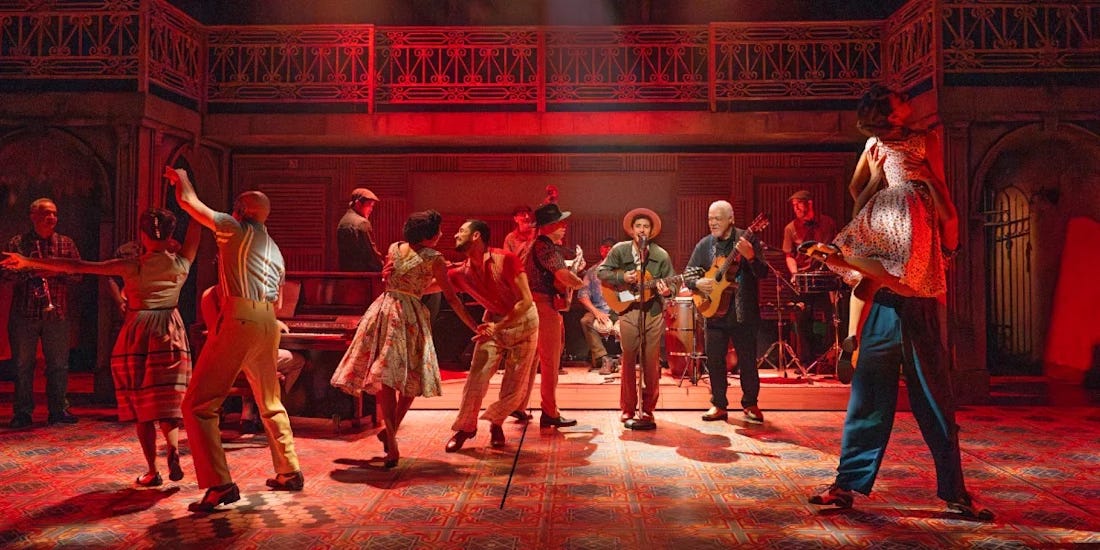
As each apodosis and protasis (in the words of Madonna, “look it up”) above insinuates, there are wildly different levels of investment in the book scenes and musical sequences in Buena Vista Social Club. The latter are—quite obviously—the piece’s raison d’être, and the former un-persuasively seek to justify their inclusion in the form of a fairly traditional musical. Whenever the musicians or dancers are center stage, Buena Vista Social Club comes alive. Whenever Marco Ramirez’s cliché riddled libretto takes over, the proceedings feel so DOA, I began to wonder why the creative team didn’t just opt to stage a revue using the catalog of the real-life Buena Vista Social Club musical ensemble, or a dance narrative akin to what Twyla Tharp crafted with Billy Joel’s songbook in Movin’ Out.
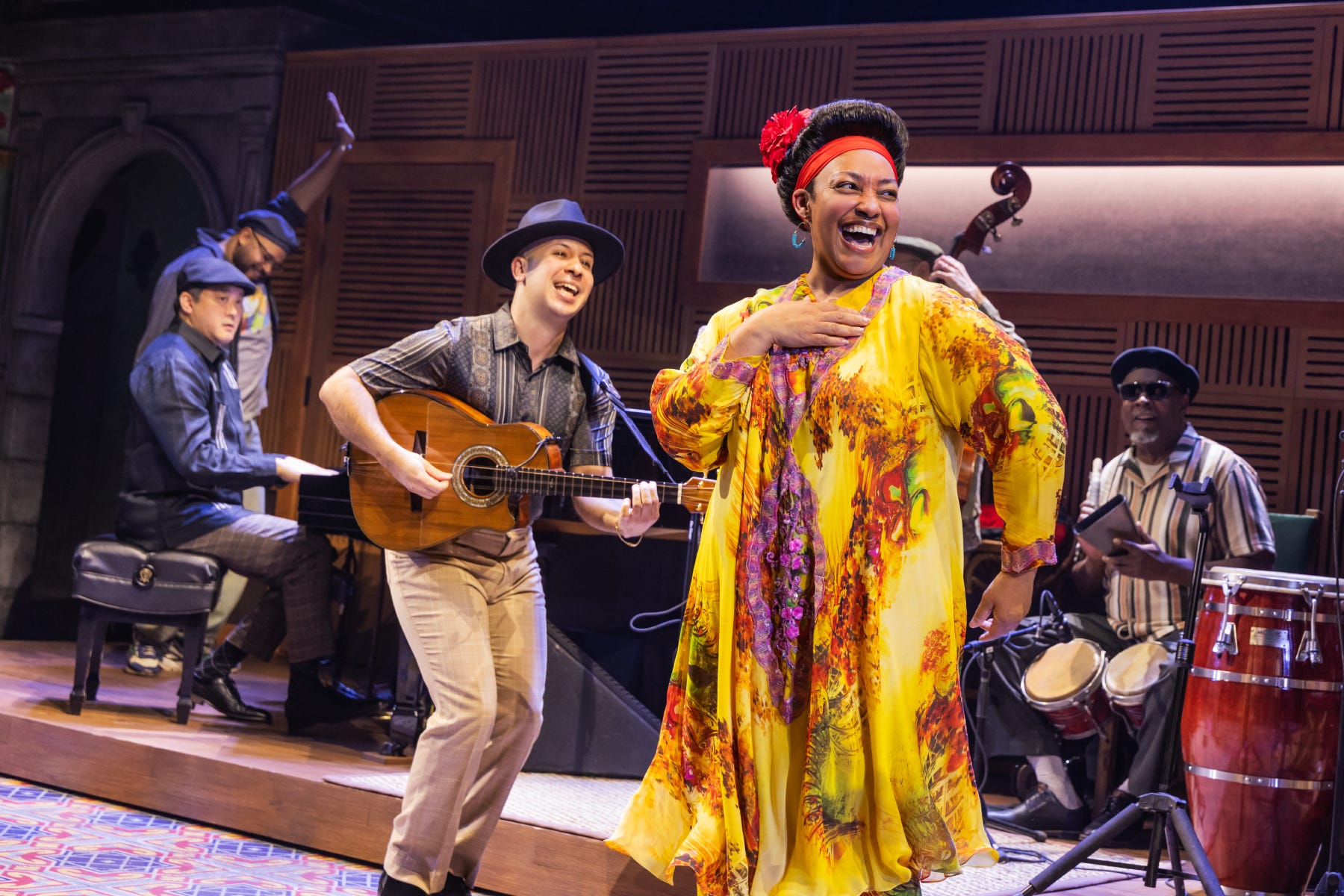
Instead, we’re subjected to a pseudo bio musical flashing between the efforts of Juan de Marcos (Justin Cunningham), a green record producer and musicologist, to record an album in the 1990s that preserves the Cuban music performed at the actual Buena Vista Social Club, and the lives of the artists who made that music in the days surrounding the 1959 Cuban revolution. Both de Marcos’s success and the musical’s story hinge on the participation of acclaimed singer Omara Portuondo (Natalie Venetia Belcon), who has retired from music for reasons that will soon be revealed, but can even sooner be predicted. She is haunted by memories of her younger self (Isa Antonetti) and the decisions that the revolution and music industry simultaneously forced her to make, specifically in relation to her sister and original collaborator (Ashley De La Rosa, but understudy Tamaira Sade Vazquez at the performance I attended) and love interest and new collaborator (Wesley Wray in the 1950s/Mel Semé in the 1990s).
Everything about Buena Vista Social Club’s treatment of life outside its music venues—especially and most importantly the Cuban revolution—feels half-baked and obligatory. The revolution is a side-note until it’s not, at which point it is suddenly the dramatic crisis. My genius friend Austin, who is an incredibly gifted book writer, described Buena Vista Social Club as “Cabaret without an Ernst,” referring to the way John Kander, Fred Ebb, and Joe Masterhoff’s masterpiece uses a supporting character to bring the horrors of the outside world into the safe space inhabited by the main characters. Those horrors are so sketchily drawn in Buena Vista Social Club, it’s borderline offensive.
The problems in the writing are significantly exacerbated by the casting of Antonetti, a goosebump-inducing singer who delivers dialogue like she’s politely voicing over potential side effects in a Lunesta commercial. Belcon, on the other hand, adds depth to every scene she’s in, conveying a rich internal life even when the script requires her to speak succinctly and evasively. Steely and aloof one moment, warm and the life of the party the next, it’s easy to understand how she won the 2025 Tony Award for Best Featured Actress in a Musical (although I would have voted for another powerhouse, whom I’ll discuss in an upcoming post).
It’s not surprising that the other Tonys won by Buena Vista Social Club reveal what the show does well: its prizes for Best Orchestrations, Best Sound Design, Best Choreography, and a Special Tony Award for the “Musicians Who Make Up the Band” speak to the level of excellence sustained by the musicians and dancers. It’s more surprising that that’s pretty much all the show does well. Even though the narrative ostensibly follows Omara, perhaps Belcon was placed in the featured category because everyone recognized that the evening’s star is, in reality, the band.2
Often, if I have a song stuck in my head, taking a moment to reflect on its lyrics will indicate something about my mood or thinking. Writing this review, I’ve repeatedly found myself humming the bridge of “Last Midnight” from Into the Woods. After pausing for consideration, I realized it’s because the bridge culminates in the phrase, “Oh, why bother?” And that’s the central question I left Buena Vista Social Club asking. Why bother creating a book musical around the Buena Vista Social Club if the storytelling is going to be so perfunctory? Why bother casting someone to deliver a large chunk of the dialogue if they’re only impressive when singing or dancing? Why bother addressing a topic as grave as the Cuban revolution if you’re not going to treat it with the appropriate gravity? There is an important story to be told here, but Buena Vista Social Club doesn’t actually tell it.
Many people who attend a musical will be content if the production includes memorable music, dynamic singing, or virtuosic dancing. They’ll probably have a great time at Buena Vista Social Club. However—and I genuinely don’t say this to throw shade at them—if you’re like me and want memorable music, dynamic singing, virtuosic dancing, and a story that makes a meaningful difference in your thinking and feeling…well, then, you’re likely to leave feeling disappointed, maybe even worried about the entire state of contemporary musical theatre, and asking yourself: Is it always “or”? Is it never “and”?
the not-a-bottom line
🌈🌈 (out of five)
a guide to ticket-buying
I redeemed my Audience Rewards points for a $48 ticket in the front row of the mezzanine, three seats from the leftmost aisle.
If you’re going more for the dancing, sit center, even if it means you’re farther back.
If you’re going more for the musicians, sit closer, even if it means you’re farther on the side.
If you’re going for the acting, don’t go.
a key to the pictures
Interestingly, I was not able to find the Buena Vista Social Club performance from the Tonys on YouTube. It only turned up in an annoying mobile aspect ratio on Facebook and Instagram.
The documentary that inspired the musical is available to rent or buy on all the usual platforms. A lower quality version is posted on YouTube.
The band and cast performed on NPR’s popular Tiny Desk Concert series.
This is very much a tangent, which is why I’m putting it in a footnote, but anyone reading this who’s as interested (or more) in queerness as they are in theatre reviews might enjoy this passage from Daniel Mendelsohn’s The Elusive Embrace. It is one of the most accurate yet poetic explanations of the relationship many queer men have to their bodies that I’ve ever read:
The well-muscled gay man’s body today seems…like something decorated, embellished. This is ironic because, in a way, this body seems clearly to be an attempt at recuperating masculinity, a visible sign of adequacy and power and legitimacy to be displayed proudly by those who, as children, may have been taunted for being too thin or too weak or too clumsy.…
Gay men’s bodies are the bodies of men who do not want to feel shame before their fathers. But there is no way to get one of these bodies without assiduously working at it, which is of course something our fathers never would have done.
As wonderful as she is, am I the only person bothered by the fact that Belcon is not actually Cuban?