
A WARNING ABOUT STYLE AND SPOILERS: I assume most folks interested enough in theatre to read this Substack are familiar with Arthur Miller’s Death of a Salesman, so I will not take the time to summarize its plot, introduce its characters, or avoid spoilers. Just in case someone who doesn’t know the play is reading, I will also offer the CONTENT GUIDANCE that the play and this review involve suicide.
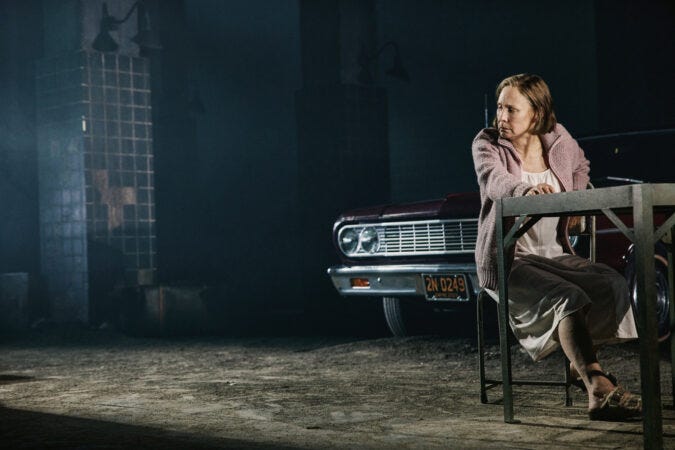
By the time I got around to seeing Broadway’s current revival of Death of a Salesman, which was actually the night before this year’s Tony Awards, countless people had told me it was fantastic, offering especially rapturous reports of Joe Mantello’s direction. One trusted friend referred to it as “the crowning achievement” of his storied career.1 What no one had told me—and what really set this Salesman apart from other productions I’ve seen—is that Mantello stages much of Miller’s classic as if it were a thriller.
For starters, there’s Chloe Lamford’s eerie and abstract unit set. It’s not clear if it’s a garage, warehouse, or some other dilapidated industrial space, but it’s crystal clear that it’s crumbling and foreboding. There are no walls separating the Lomans’ house into rooms, which also heightens the sense of impending danger: they inhabit a space without boundaries, and anyone could overhear what everyone else is saying at any given moment. Then, there’s Mikaal Sulaiman’s chilling soundscape of ghostly echoes and ghoulish cackling.
Finally, there are the actual Lomans. Mantello departs from the tradition of having the actors who play Biff and Happy appear as younger versions of their characters in flashbacks, returning to a conceit Miller included in earlier drafts of his play by casting an entirely different set of actors. Young Biff and Young Happy appear in warm, saturated light—a dramatic contrast to the stark cool tones designer Jack Knowles uses elsewhere—suggesting not just a dream state, but the sort of romanticized utopia we see in horror movies before “the big bad blank” causes everything to go awry. The disparity between the idealized past and the ominous present is further accented by a persistent threat of violence, particularly from adult Biff but even from Willy, that I don’t remember being quite as constant in any other production. All these elements combine to create an unrelenting tension that raises the stakes and keeps the audience as on edge as the characters.
Mantello has shared (including as part of his Tony acceptance speech) that the impetus for this revival was his desire to direct Nathan Lane as Willy Loman. Ironically, Lane struck me as the production’s biggest liability. To his credit, the boisterousness and command—and, no, that is not code for effeminacy or flamboyance—that have defined the “Nathan Lanest” of his iconic performances are nowhere to be found. On the contrary, his Willy seems too deflated from the very start. Perhaps that’s part of Mantello and Lane’s concept: the staging could easily be interpreted as Willy replaying the action of his life in the moments before he kills himself. But if Willy’s demise is a foregone conclusion, it creates a narrative imbalance. The play’s driving question shifts from whether Willy can escape defeat to how his imminent downfall will affect the family fighting so desperately to save him, diminishing some of the drama’s suspense.
Lane also comes across as too analytical and voluble—and, okay, maybe there is a hint of code there—to be believable as someone who was only “a happy man with a batch of cement,” who put “more of him[self] in [the Loman house’s] front stoop than in all the sales he ever made.” He does not seem like someone who “had the wrong dreams” and “never knew who he was,” ignoring his truest self to pursue a white collar, capitalist version of success that would always elude him. As a result, Lane’s Willy is not the convincing cautionary tale he needs to be to trigger Biff’s new understanding of himself.
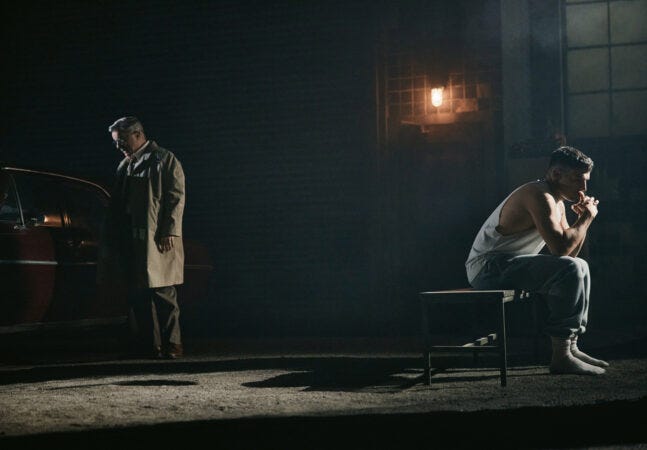
Nevertheless, the production still makes a considerable impact. How could it not given the brilliance of Miller’s script, singularity of Mantello’s vision, and powerful performances from the rest of its cast? Christopher Abbott and Ben Ahlers each grasp the important dualities that define the Loman brothers. Abbott is riveting as Biff, infusing the role with both frightening volatility and tender protectiveness toward his family. Ben Ahlers captures both Happy’s suave charm as a ladies’ man and the painful yearning that underpins it. Jonathan Cake—a physically imposing, highly accomplished classical actor who understudies Lane and would be fascinating in the role—is slick and threatening as the brother Willy idealizes. Playing “the Woman,” Tasha Lawrence shrewdly adjusts her performance as Willy’s experience of her changes. K. Todd Freeman and Michael Benjamin Washington are luxurious casting for the comparatively minuscule roles of neighbor Charley and his son Bernard, but bring so much to their fleeting appearances, they personify the old saying that “there are no small parts….” It is, in fact, the third consecutive role I’ve seen Freeman play that made me think, “This man is a master.”
However, there’s no greater master of their craft in theatre today than Laurie Metcalf who, as Linda, somehow manages to exceed the high expectations created by her history of excellence. It’s the rare performance that harnesses the intensity of manic energy without compromising laser-like focus. She possesses the even rarer ability to make famous lines of dialogue that are etched in our collective consciousness (“attention must be paid,” “free and clear”) sound like spontaneous, new thinking. Metcalf’s accessibility, vulnerability, and flawless comic timing illuminate new meaning in the choices we know Linda is going to make. It may be the finest work of her incredible stage career.
One quality that makes Miller’s play a masterpiece is how it has seemed to be in conversation with every era in which it’s been staged. That remains painfully true. I was surprised by how much this Salesman reminded me of the debate around the “college for all” movement that raged when I began teaching secondary school. Its proponents believed that framing college as an expectation for young students was the key to opening access and equitable opportunities for them later in life. Arguably, they envisioned success along the same lines as Willy. The movement’s detractors argued that “college for all” ignored different skill sets, interests, and realities and undermined the value of trade schools or other pre-professional training programs—an ideology more similar to Biff’s. I marveled at how a play that debuted over 80 years ago could feel as relevant as it does now. At the same time, given the grotesque income disparity and mounting class tension in America, it seems appropriate that Salesman has never felt as scary. For many, like the Lomans, the American dream has become a nightmare.
the not-a-bottom line
🌈🌈🌈½ (out of five)
a guide to ticket-buying
The show’s a hit and tickets are expensive. I paid $172, avoiding fees by purchasing directly from the box office, for the last row of the orchestra center. The view was fine, but I do wish I’d been a little closer to enjoy the detail in the acting.
If you can’t sit center, choose house right.
a key to the pictures
Lee J. Cobb and Mildred Dunnock, who originated the roles of Willy and Linda, reprised their performances in a 1966 telefilm that also features George Segal as Biff and Gene Wilder as Bernard. The adaptation is aggressively cut, but it’s wonderful to have a record of Cobb and Dunnock’s performances.
It was the second chance Dunnock had to preserve her performance, as she was also in László Benedek’s 1951 feature film, which got Oscar nominations for her, Fredric March as Willy, Kevin McCarthy’s Biff, and Alex North’s score. North had also composed the music for the original Broadway production.
The 1985 telefilm, a sort of recreation of the 1984 Broadway revival, follows the play much more closely. Dustin Hoffman and John Malkovich won Emmys for their performances as Willy and Biff, with Hoffman widely credited for reinventing the role.
A 1996 BBC adaptation features Warren Mitchell as Willy Loman, Rosemary Harris as Linda, Iain Glen as Biff, and Owen Teale as Happy. Teale would now make a fantastic Willy himself.
The 1999 Broadway revival was captured for broadcast on Showtime in 2000. It had won Tony Awards for Best Revival, Best Actor for Brian Dennehy, Best Featured Actor for Elizabeth Franz, and Best Director for Robert Falls. Dennehy and Franz were also both Emmy nominated for the broadcast, which includes the great journeyman stage actor Ted Koch2 as Happy (disclosure: I’ve worked with him) and replacement Biff Ron Eldard.
I’m biased because this revival was my introduction to the play and it made a profound impression, but if you only watch one of these linked adaptations, this is my recommendation.
My proofreader thought it was hyperbole to refer to Mantello’s career as “storied.” I disagree. This is a man who began as an actor, originating the role of Louis in Angels in America, but, as a director, has helmed the original productions of major plays like Love! Valour! Compassion!, Other Desert Cities, and The Humans, as well as the Broadway debuts of Frankie and Johnny in the Clair de Lune and The Boys in the Band. Along the way, he picked up two Tony Awards—for Take Me Out and Assassins—and financial security for life thanks to a little show called Wicked. Mantello won a third Tony for his work on Salesman the night after I saw it, just as many prognosticators (including me) predicted he would. Plus, he still makes the occasional journey back into the spotlight, such as his Tony nominated turn in the Broadway revival of The Normal Heart and playing Tom opposite Sally Field’s Amanda in The Glass Menagerie. STORIED.
Full disclosure: during my years as an actor, I worked with Koch.