
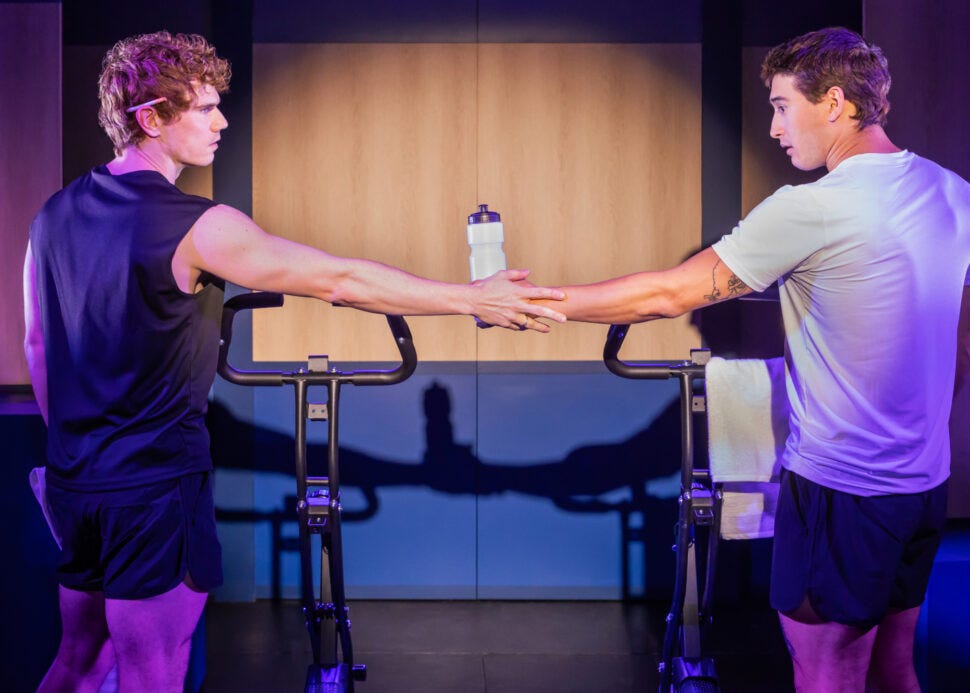
Despite the significant role “Camp” plays in their consumption of culture, I’m willing to bet that most gay men haven’t thought much about how it’s defined. The typical understanding of Camp could, in fact, be articulated with the exact words that Supreme Court Justice Potter Stewart famously used in his opinion on identifying pornography: “I shall not today attempt further to define the kinds of material I understand to be embraced within that shorthand description; and perhaps I could never succeed in intelligibly doing so. But I know it when I see it . . . .” Of course, if a gay man actually used that wording, it would be a quick swipe left situation.
The most seminal work of scholarship on Camp remains Susan Sontag’s 1964 “Notes on ‘Camp.’” Today, when people are pushed to define Camp, they often land on some variation of its being “over the top” and/or “failed seriousness.” The DNA of those descriptions is easily traced back to Sontag, who wrote, “In naïve, or pure, Camp, the essential element is seriousness, a seriousness that fails. Of course, not all seriousness that fails can be redeemed as Camp. Only that which has the proper mixture of the exaggerated, the fantastic, the passionate, and the naïve.” Here, Sontag’s reference to naïve/pure Camp, which strives for the seriousness it lacks and becomes Camp unintentionally, is contrasted with deliberate Camp, which “knows itself to be Camp.” Mommie Dearest, for example, would be classified as naïve/pure Camp while Death Becomes Her would be labeled deliberate Camp.
Subsequent exploration of Camp often reads as a response to Sontag, even when it proffers a different definition. The Politics and Poetics of Camp (1994), a collection of essays edited by Moe Meyer, uses a quote from Notes on “Camp” as its epigraph before arguing that Sontag’s conceptualization represented an “erasure of homosexuality from the subject of Camp.” Meyer instead described Camp as the “strategies and tactics of queer parody,” with its ultimate goal being “queer . . . social visibility.” For Meyer, if it’s not queer, it’s not Camp.
I recognize that this post may be starting to feel less like a review of Heated Rivalry: The Unauthorized Musical Parody and more like an undergraduate term paper for a course that’s cross-listed by the departments of Performance Studies and Gender & Sexuality. Nevertheless, before I move on to the production in question, there’s one more theory on Camp that I should discuss. In his 1977 essay “Camp and the Gay Sensibility,” Jack Babuscio argued that Camp is the byproduct of the gay male experience of living outside of social norms. Meyer’s analysis thus feels like an extension of Babuscio’s. However, unlike Meyer, Babuscio believes Camp can exist outside of queer spaces, even though that’s where he sees its distinct sensibility as having developed.
Babuscio identified four basic qualities of Camp: irony, aestheticism, theatricality, and humor. The irony is generated by “an incongruous contrast . . . between an individual/things and its context/association.” In other words, Camp savors mismatches—whether they are between appearance and reality, intention and effect, or expectation and experience. Aestheticism refers to Camp’s emphasis on style and “evocation of mood.” Babuscio ties theatricality to “the gay sensibility’s preference for the intensities of character, as opposed to its content: what the character conveys tends to be less important than how or why it is conveyed.” Humor is fairly self-explanatory, though Babuscio contextualizes “[l]aughter, rather than tears” as queer culture’s “means of dealing with a hostile environment.”
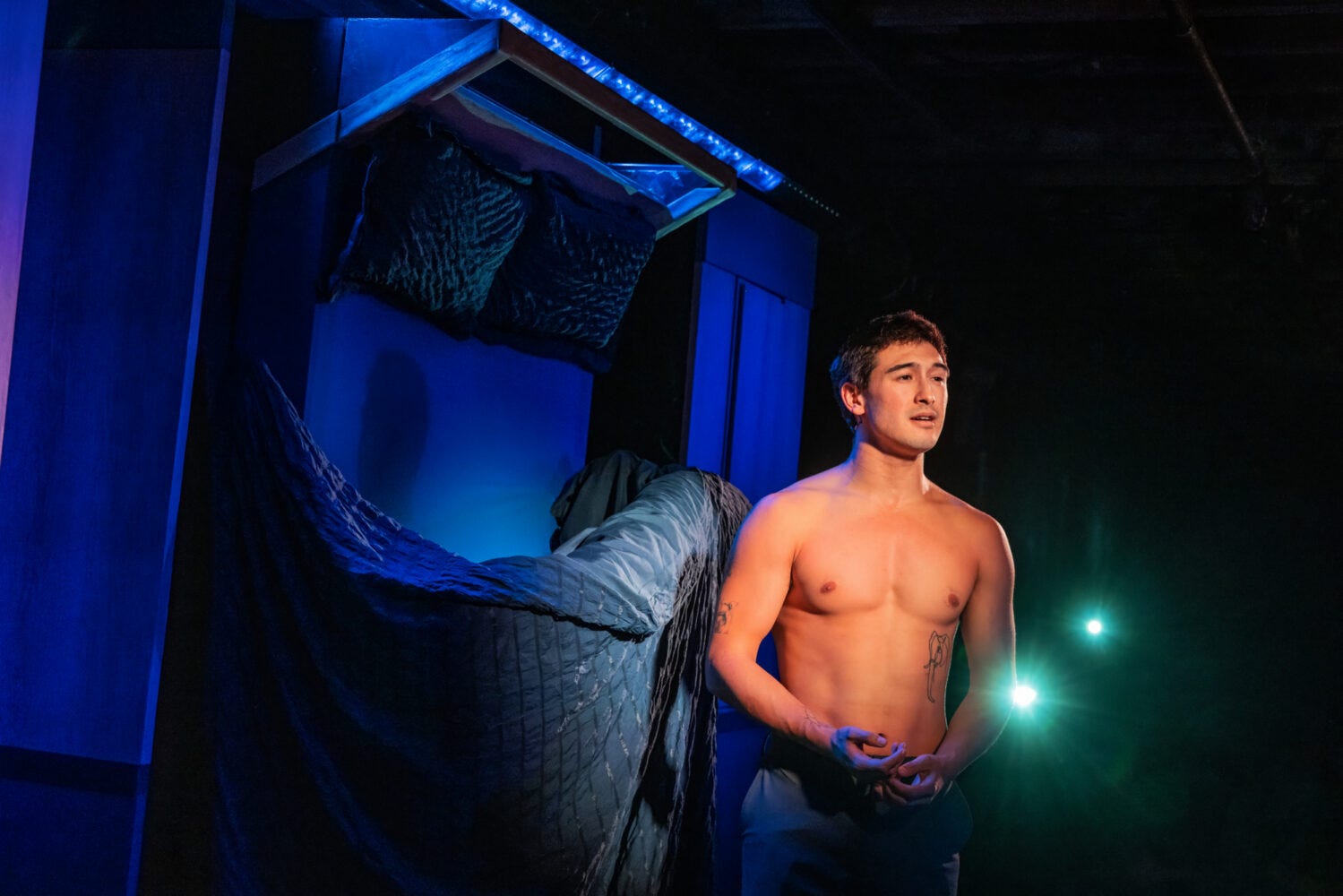
Heated Rivalry: The Unauthorized Musical Parody (“HR: MP”) desperately wants to be deliberate Camp. (Congratulations, reader, you’ve made it to the review.) As someone who generally loves Camp, I wanted to revisit the foundational texts on it to equip myself with language to describe why I found it so damn disappointing. To be fair, though, I should concede that HR: MP succeeds as Camp in at least some respects.
Based on the Crave/HBO series Heated Rivalry, itself adapted from Rachel Reid’s novels, the musical follows the love affair between hockey opponents Ilya, a surly Russian, and Shane, a sweet Canadian. As it traces the highs and lows of their relationship, we also meet hockey vet Scott, who falls into a whole Notting Hill situation with his local juice barista Kip. I’m trying to avoid spoilers, but it’s hard to imagine anyone finding the musical even vaguely amusing without having already seen the series.
Without question, HR: MP offers the queer parody and queer visibility that Meyer finds necessary for Camp. In terms of Babuscio’s criteria, as a parody, HR: MP is full of humor (or at least attempts at humor). It’s also undeniably theatrical—not only because people burst into song, but because the performances are often deliberately over-the-top, its sets and wigs are obvious fakes, and the production is full of metatheatrical flourishes that call attention to its own artificiality, including narration that explicitly mentions the show’s writer. It’s also quite clear that, stylistically, the cast and creators are trying to evoke a specific mood, one of self-aware silliness, which ticks the aestheticism box.
Where HR: MP flounders is in its efforts to be ironic, largely because the Heated Rivalry series is not plagued by incongruous contrast. There is no mismatch between its intention and its effect, or the expectations surrounding it and the experience of actually watching it. HR: MP may be deliberate Camp, but, as parody, it suffers because the material it’s sending up is not naïve Camp. Certainly, Heated Rivalry, the series, has its detractors, but I doubt even they could characterize it as failed seriousness. Some might describe its sex scenes as over-the-top, and yet I’d be willing to bet they ring true for most gay men. Furthermore, one crucial reason the series has amassed such a devoted following is that the performances, especially from Connor Storrie as Ilya and Hudson Williams as Shane, are so believable. Viewers are invested in the fates of Ilya, Shane, Scott, and Kip because they feel real.
That gives HR: MP little to work with. The first sign of trouble comes the moment the curtain rises and we’re introduced to the musical’s framing device: narration from a trio of “Live/Laugh/Love” moms who’ve become obsessed with the series. It’s as if the creators are admitting the show itself hasn’t provided enough material to parody, so they have to riff on its fanbase as well. Later, they further extend their purview to the YouTube videos Connor Storrie made as a noticeably effete child, which went viral after the series became a hit. It feels cheap and, frankly, a little mean.
The book, music, and lyrics were all written by Dylan MarcAurele. Given how recently the series became popular, it’s fair to assume his creative process was rushed so that he and director Alan Kliffer could capitalize on public interest. Despite a couple of catchy melodies (the moms’ opening number, Ilya’s lament about his butt), HR: MP definitely sounds and looks hastily thrown together. The crowd-pleasing choice to use an audience volunteer to play Scott feels, on one hand, like pandering and, on the other, like pure expediency, as if MarcAurele didn’t have the time or bandwidth to figure out how another role could be added to anyone’s track in the small, five-person cast. The overall effect is a production that feels like an entry in the New York City Fringe Festival: it’s kinda fun and has potential, but it also feels kinda slapdash and falls far short of what it could be.
There is one way in which HR: MP is not even the slightest bit rough around the edges, and that’s in its casting. Kliffer’s company is small but mighty with a professional sheen the rest of the production lacks. The major standout is Jimin Moon as Shane. Moon perfectly grasps “the intensities of character” integral to deliberate Camp without sacrificing a sense of real affection for Jay Armstrong Johnson’s Ilya. From his smooth vocals and sweet smile to his sexy physique and infectious sense of joy, everything about Moon’s performance announces him as a star on the rise. Armstrong Johnson’s work isn’t as interesting, but his confidence, capability, and comeliness are unquestionable. (Interestingly, he and Kliffer’s parents are credited as producers of the musical, suggesting the project benefited from personal attachments stronger than its level of development.)
The heated rivals are supported by a trio of delightful proteans who each play one or two major characters and a variety of more incidental ones. As the main narrating mom, Ryann Redmond commits fearlessly to the bit and elevates MarcAurele’s score with her powerful voice. The hilarious Ryan Duncan impressively fleshes out every role he plays, including Ilya’s Dad and Kip. And Cherry Torres makes a meal of sending up Kip’s coworker, one of the rare instances of naïve Camp in the series, and elicits major laughs with her changing delivery of one word. I wish I could see all five of them in a better show.
With my apologies to the excellent cast, any reader looking for a laugh out loud parody with some great singing should pass on HR: MP and instead hitch a ride on Titaníque. It is an ideal example of deliberate Camp—both a love letter to the excesses of Céline Dion’s vocal performances and a takedown of the naïve Camp in James Cameron’s bloatedly earnest film. HR: MP, by contrast, attempts to parody a property that is essentially too effective to parody. Deliberate Camp needs incongruity or failed seriousness to exploit. Titaníque can choose from a boatload of options, but HR: MP cannot subvert what doesn’t exist. Consequently, while Titaníque truly is a musical parody, Heated Rivalry: The Unauthorized Musical Parody is an overlong sketch.
the not-a-bottom line
🌈🌈 (out of five)
a guide to ticket-buying
If you are petite, be warned that the first few rows at The Culture Club are not raked, meaning they’re all on the same flat level. I recommend sitting in row A center, row B on the center aisles of the side sections, or row F center (which, I believe, is the first raised level).
So when you were talking about irony you called it mismatch. I immediately assumed the mismatch here is the hockey (that's a sport, for reference) and the queer relationships - obviously not a TRUE mismatch but seemingly one to those not in the know. The show itself brings this to the forefront in the beautiful moment where Scott outs himself publicly for Kip and himself. Does this add anything to your seeing irony in the HR: MP? Maybe not, but was surprised this mismatch wasn't mentioned at all - or hockey for that matter - but knowing you might not know what hockey is, I shouldn't be surprised ;) They do, however, call locker rooms dressing rooms and halftime is intermission, so you might be into it! This would also possible make the irony a bit more obvious... rambling now.