
What do you do when a person you like is working on a show you hate?
The difficulties that predicament creates are why I haven’t posted about House of McQueen sooner. Hell, to a certain extent, it’s why I didn’t start writing theatre reviews sooner. Notwithstanding my feelings about Redwood and Death Becomes Her, the old precept that “if you don’t have anything nice to say, don’t say anything at all” is a philosophy I genuinely try to follow…or at least consider…or at least feel guilty about.
Early in my career as an actor, I was given the opportunity to write reviews for Backstage. It was a tantalizing prospect that I eventually turned down because I was so afraid of alienating potential employers and colleagues. Now, doing the (corporate over)Lord’s work, I don’t have that concern—but I do still have a wonderful circle of friends who continue to work in theatre.
Jason Robert Brown once penned a fabulous confession of his experience insulting Stephen Sondheim. Brown, then an up-and-coming young writer, had been invited by the legendary composer to see a new musical of his that was frozen and being reviewed by critics. I encourage you to read Brown’s characteristically witty account of the anecdote yourself, but the gist of it is that Sondheim taught him this important lesson:
Once a creation has been put into the world, you have only one responsibility to its creator: be supportive. Support is not about showing how clever you are, how observant of some flaw, how incisive in your criticism. There are other people whose job it is to guide the creation, to make it work, to make it live; either they did their job or they didn’t. But that is not your problem.
If you come to my show and you see me afterwards, say only this: “I loved it.” It doesn’t matter if that’s what you really felt. What I need at that moment is to know that you care enough about me and the work I do to tell me that you loved it, not “in spite of its flaws”, not “even though everyone else seems to have a problem with it,” but simply, plainly, “I loved it.”…
Maybe next week, maybe next year, maybe someday down the line, I’ll be ready to hear what you have to say, but that moment, that face-to-face moment after I have unveiled some part of my soul, however small, to you; that is the most vulnerable moment in any artist’s life. If I beg you, plead with you to tell me what you really thought, what you actually, honestly, totally believed, then you must tell me, “I loved it.”
If I’m in the audience as a friend, I follow Sondheim’s advice without exception. And yet I’m now in the position of having created this Substack—as guidance for other theatergoers; a record of my own experiences; and, sure, a way of getting the dopamine hits that come with a new follower, like, or comment. Though I’ve reviewed productions that employed close friends in associate roles, I haven’t felt conflicted about being frank in my assessments because my friends’ responsibilities have, first and foremost, been to preserve the vision of the person they’re assisting rather than execute their own.
House of McQueen marks the first time I’ve sat down to discuss a piece in which someone I know plays a central role. To be honest, this person is not so much a friend as they are a friendly acquaintance. Let’s call them a “frienquaintance.” Regardless, they’re someone I like and respect and whom, as per the wisdom of the great Stephen Sondheim, I enthusiastically congratulated after the show. So, I’m conflicted about now sharing my honest, largely negative reaction. It feels duplicitous.
At the same time, I also have a growing audience of readers whose trust I won’t earn if I sugarcoat my reactions. I’m therefore going to do the honorable thing and write this review with my trademark candor, and…hide it from my frienquaintance on social media. If they come upon it another way, hey, then we can have an awkward conversation. However, I’m sincerely curious to know if folks feel that I should have handled this quandary differently; please let me know in the comments below what you would have done.
Which brings us to House of McQueen. A misconceived hagiography of the brilliant but troubled fashion designer Alexander McQueen, it desperately wants to be as provocative and original as its subject. Instead, it’s disjointed and diffuse, inspiring none of the emotion over its laborious two-hour runtime that McQueen himself could elicit with a single outfit.
On the most basic level, playwright Darrah Cloud fails her audience because she offers neither (i) a clear biography of McQueen, nor (ii) surprising or thought-provoking insights about him or anyone else in his orbit. Even an event as significant as McQueen’s suicide does not unfold intelligibly or with meaningful psychological exploration. In a seeming nod to the designer’s boundary-pushing aesthetic, Cloud plays a lot with structure, including non-linear storytelling and abstract sequences, like an extended dance marathon1 and a confounding water ballet that would have turned Esther Williams aquaphobic. The end result is somehow simultaneously overly experimental and riddled with clichés. There are a lot of problems with House of McQueen, but Cloud’s writing is the most serious and irredeemable one. As my mother often says, “You can’t make chicken salad out of chicken shit.”
Nevertheless, director Sam Helfrich and his talented cast try valiantly. Almost immediately, Helfrich successfully creates an ominous atmosphere that befits McQueen’s sensibility. He impressively aligns the production’s many design elements, including an extensive use of projections, to generate this menacing ambiance, but fails to shape enough peaks and valleys for it to pay off. At a certain point, the audience becomes desensitized to the tension, and it is no longer…well…tense.

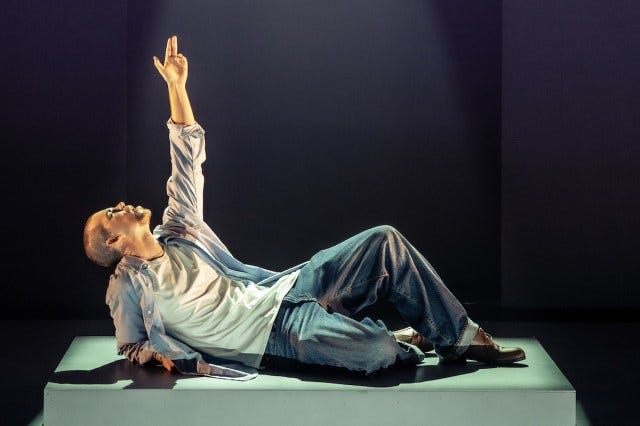
Based on how the play has been marketed, the ostensible draw in the cast is Luke Newton as McQueen. (Warning: he’s only in the production through September 28.) An alum of Bridgerton, which I’ve never seen and could not care less about, Newton comes off as charismatic and credible, but he’s denied any opportunity to make his performance a true tour de force. I was far more excited to see Emily Skinner as McQueen’s mother Joyce.
A longtime favorite of mine, Skinner has not had a star vehicle worthy of her prodigious talents since she broke through with Side Show. The closest she’s come was when she reimagined Jean Harlow’s role as a sort of rabid Anna Nicole Smith in Lincoln Center’s revival of Dinner at Eight; so, I was hopeful that this, being another straight play, might give her the showcase she deserves. Alas, it does not. While Skinner brings tenderness and warmth to all that she’s given to do, especially a recurring motif in which Joyce interviews Alexander on television, both her character and the entire mother-son relationship are woefully underwritten. You get the sense that their closeness is supposed to be the emotional linchpin of the story, but it’s too unspecific to have any strong effect.
Cloud seems far more interested in McQueen’s bond with his onetime patron and manager Isabella Blow, who’s dynamically embodied by Catherine LeFrere. To paraphrase my astute friend Steven, Blow is the only character who’s actually given a beginning, middle, and end—or, in other words, a dramatic arc. Though I would have appreciated seeing more of the character’s raw pain and less of her performative bravado at the end of that arc, LeFrere jolts the play to life whenever she’s onstage.
She also looks runway-model gorgeous in some exquisite attire by costume designer Kaye Voyce. Sadly, Voyce has the unenviable task of not being Alexander McQueen in a piece about Alexander McQueen. Presumably, intellectual-property issues prevented the play from incorporating more of his designs, but their absence ends up being a brutal metaphor for what’s wrong with the play: despite being McQueen’s story, the real McQueen is essentially nowhere to be found.
the not-a-bottom line
½ (out of five)
a guide to ticket-buying
I paid a $5 processing fee per ticket through a papering service that I belong to and was seated in the first elevated row (there is a row or two on the floor) almost all the way to the right.
This is a wide theater. If you feel strongly about seeing this play, it’s better to sit center, even if it means being farther back.
a key to the pictures
The production’s official trailer
A BroadwayWorld interview with Luke Newton
Some of my favorite Emily Skinner clips…just because…
“Who Will Love Me As I Am?” with Alice Ripley from Side Show on The Rosie O’Donnell Show
“My Brother Lived in San Francisco” from a 54 Below concert of Elegies for Angels, Punks, and Raging Queens
“Letter From Harry’s Mother” from Suffs
The dance marathon sequence is an allusion to McQueen’s spring/summer show in 2004, which itself referenced dance marathon movie They Shoot Horses, Don’t They?. Thank you to my friend Song for clarifying that for me!