
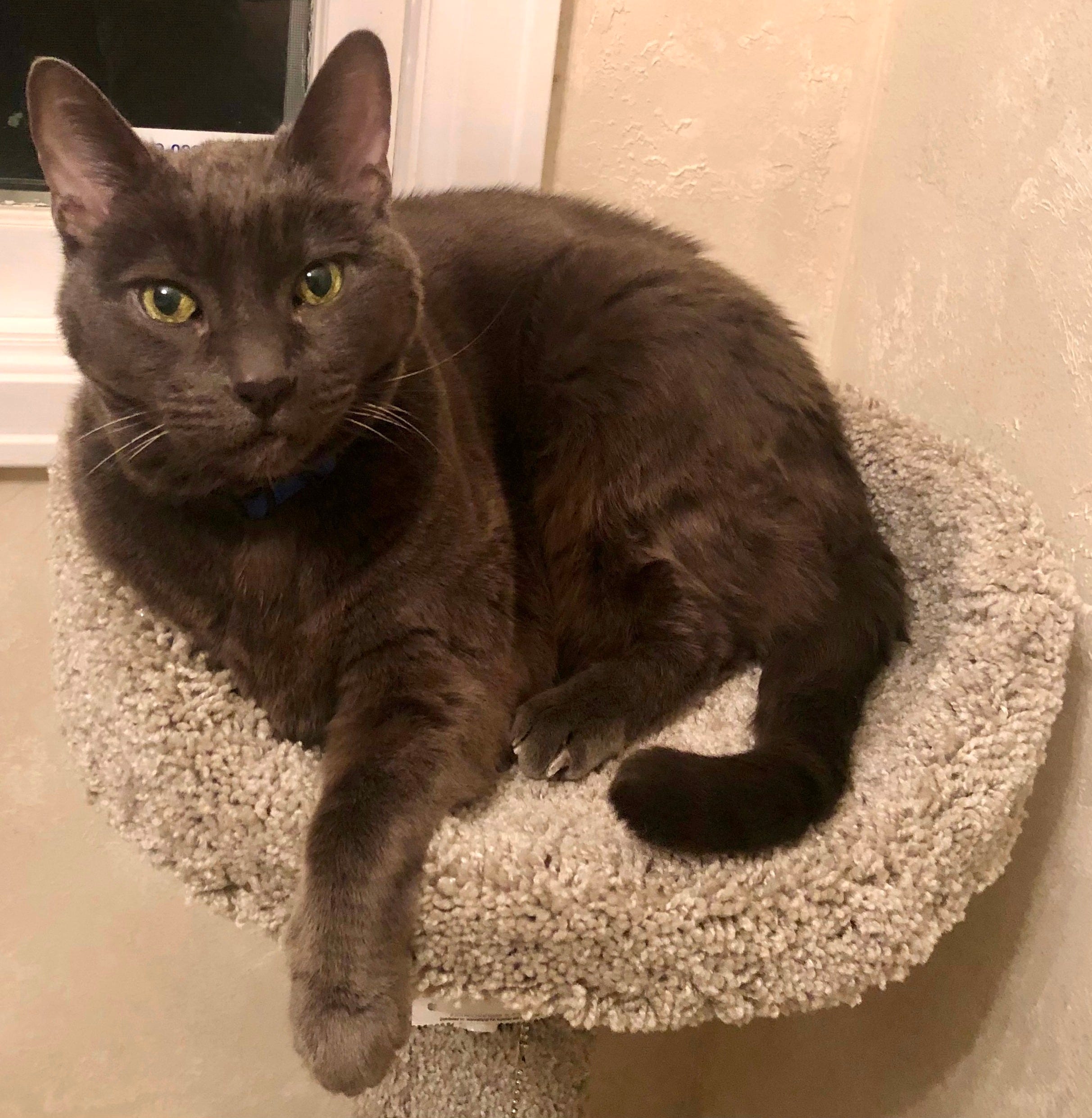
This week, I’m immersed in a professional conference while also grieving the loss of my beloved 17-year-old cat Dugan. Rather than post a review, I thought I’d share an academic paper from 2018 in which I explored the purported link between the queer community and musical theatre.
This is a dense and lengthy read that won’t be for everyone. However, if you’ve ever been curious to know whether there really is a special connection between LGBTQ+ audiences and musicals, you may enjoy reading the research I synthesized.
On the other hand, if you just tune in for some snappy theatre reviews (I mean…*I* think they’re snappy), we’ll return to our regular programming in early August, but you CAN skip to the very end to see a photo of my adorable kitty with an accompanying audio clip of us duetting on “Memory” from Cats. Yes. Really.
Showmosexuality:
Quantitative & Qualitative Analysis on Queer Interest in Musical Theatre
Willkommen! Bienvenue! Welcome!: An Introduction
There is little quantitative research to substantiate the widespread stereotype that musical theatre's most ardent fans are women and gay men, or to explain when or how the stereotype was formed. It is, however, an association that persists and, in the audience of any Broadway musical (and certainly over drinks at any piano bar), seems true. Qualitative analysis suggests the reasons for these subcultures' affection for the genre are at least partially linked. It stems from musical theatre's depiction of central female characters, the most beloved of whom reject women's traditional trajectories—such as the quest to be a wife and mother—and pursue their goals without regard for gender "appropriate" behavior. The actresses playing these roles further endear themselves to the queer1 community with performances that draw upon elements of camp and stylistic tropes traditionally associated with drag queens. Lastly, the texts of musicals, which are often created by gay writers, can be read as coded, reflecting the experiences of people who are historically unaccustomed to seeing their lives dramatized, and granting them access to the heteronormative stories from which they are typically excluded. I will first interrogate the scientific studies that exist on the connection between musical theatre and homosexuality. I will then briefly trace the development of the musical in an effort to identify when the connection began, drawing upon the work of musical theatre historians, like Ethan Mordden; queer historians, like George Chauncey; and the few historians who specialize in both, like John Kenrick and S.D. Trav. Lastly, I will examine and synthesize analysis on the musical theatre and queer audience–connection performed by scholars like Susan Sontag, John M. Clum, Stacey Wolf, Michelle Dvoskin, and Raymond Knapp.
I: Arithmetic With an Odd Key—Quantitative Research That Doesn't Add Up
It seems premature to ask why women and the queer community have a special affection for musical theatre without first examining if, in fact, they do. Unfortunately, there is a paucity of relevant and reputable studies investigating the topic. Most recently, University of Birmingham doctoral candidate James Michael Lovelock examined, for his dissertation, attitudes towards and levels of participation in musical theatre, identifying as the driving questions of his research:
[T]o what extent does a straight male audience connect to contemporary musical theatre in similar and different ways to a [sic] LGBTQ audience? Furthermore, if gay and bisexual men do connect to musical theatre in a unique way, then what is the nature of this connection and how does it link to sexuality? Are there any correlations between the responses of gay and bisexual men to musicals and the responses of women . . . ?
(2). Based on these questions, you might think Lovelock wrote this paper before I could. However, he dedicates far more analysis to the first question than the second or third; in fact, his dissertation reads like the academic equivalent of an eleventh-grade boy in drama club crying out, "Just because you like musicals doesn't mean you're gay!"
The methodology on which he based his analysis is also troubling. Lovelock conducted surveys and interviews with a sample that seems far from representative of a general population. Most obviously, it was comprised entirely of current university students—already a problematic selection because it excludes a wide-range of ages, including people who grew up before the gay liberation movement launched with the Stonewall Riots—at an institution that is so competitive, its coeds "are likely to be among the top achieving students in the country" (79). A whopping 90% of his sample identified as white British, which renders it essentially impossible to generalize his findings across racial and/or ethnic lines. Finally, 114 of Lovelock's 186 subjects were recruited from the school's drama and music departments. This large number of artists certainly must have skewed the numbers regarding participation in musical theatre, and—mercifully—there's no way that 61% of the world's population (or even Great Britain's) is comprised of dramatic artists and musicians. (79.)
Unsurprisingly, in response to his first question, Lovelock finds that "there is little variance in attitudes towards musical theatre between different sexualities" (93), and even that "there is evidence to suggest that the majority of men involved in musical theatre identify as straight" (267). In regards to his second and third questions, Lovelock's conclusions are less concrete, but, significantly—for reasons that I will discuss in Section III(A)—in a review of people's favorite musicals, he discovers "the most pronounced difference . . . is linked to the gender of the protagonists, since Wicked, Hairspray and Chicago [musicals with main characters who are mostly women] are all more popular with female and LGBTQ participants than with [men] who identify as 'straight' . . . . Similarly, West Side Story and The Phantom of the Opera [musicals with main characters who are mostly men] are more popular with heterosexual participants than with LGBTQ participants" (99). Clearly, for Lovelock's research to have more validity, his study should be repeated with a more diverse sample.
Another recent study, conducted in Belgium, looked at the individual musical preferences of LGBs. Sadly, researchers did not include musical theatre as a genre in their survey, so its findings are of limited relevance. However, their analysis of a question regarding their subjects' one favorite singer or band is germane. Although a total of 344 "favorites" were given, only 26 artists appeared three or more times in the men's responses. Many of these artists are the sort of strong female performers referred to as "divas." "While most of them," like Celine Dion and Beyoncé, "are renowned because of their vocal qualities, some of them," like Madonna and Lady Gaga, "also gained fame because of their extravagant, 'camp' appearances" (Dhoest et al. 212). As we will see in Section III(B), "camp" is often theorized to be an integral element in the appeal of musical theatre; so, empirical research proving its popularity amongst gay men is important to note. Interestingly, only 14 artists appeared three or more times in women's responses, and the only person to appear as one of the top five most popular artists on both men and women's lists was Madonna—a strong female performer who is known for her extravagantly theatrical and often campy performances, and who possesses significant ties to musical theatre, including a Golden Globe winning portrayal of the title character in Alan Parker's film adaptation of Tim Rice and Andrew Lloyd Webber's Evita (stage: 1979; film: 1996). Considering the common perception that musical theatre is a feminine genre, it's also significant that the researchers found "[m]usical preferences turn out to vary strongly according to gender, as they do in the broader population, but in the opposite direction: our male participants tend to prefer music which is culturally coded as 'feminine' (pop, commercial, mainstream), while our female participants tend to prefer music coded as 'masculine' (rock, independent, alternative)" (219).
While it's possible, to varying degrees, to extrapolate some data from both of the studies mentioned above and apply it to the questions posed here, more empirical research is needed to determine if queer and female interest in musical theatre truly is more pronounced than it is for straight men and/or the general population. A study must be conducted that examines the number of musical theatre fans and participants within each subculture relative to the total number of people in each subculture. Without such comparative data, all qualitative analysis on the subject will remain presumptive and devoid of the academic rigor expected in more firmly established areas of theatre scholarship. For the remainder of this paper, I will make the same assumption that my colleagues have made and proceed as if the stereotype is true.
II: I Can't Abide Romantic Notions of Some Vague Long Ago—Origins of the Queer Connection to Musical Theatre
When was the connection between the queer community and musical theatre first forged? Attempting to answer this question opens the can of worms labeled, "When was musical theatre created?" Richard Rodgers and Oscar Hammerstein's Oklahoma! (1943) is often credited as being the first piece to create and fit our contemporary understanding of a musical as a play that combines singing, acting (usually with dialogue), and dancing to tell its story (see, e.g., Savran 535; Brockett 486), despite some claims that it was Hammerstein and Jerome Kern's Showboat (1927) (see, e.g., Ellis 47; Mordden 125). Others look to the 19th century and name The Black Crook (1866) (Knapp 121). The truth is that the musical's development began even earlier and proceeded far too gradually for a single work to mark its inception.
Though he recognizes that ancient Greek and Roman plays used music, and that, in the Middle Ages, traveling performances like morality plays later involved music, musical theatre historian John Kenrick dismisses the influence of these earlier eras, arguing that to have had an impact, scores of these earlier works would had to have survived. Instead, he traces the origins of the musical to the 1700s with the appearance of burletta (brief comic operas); pantomimes; and English ballad operas, satires that incorporated popular songs of the day with lyrics rewritten to fit their stories. The next major touchstones came in 1800s with French and Viennese operetta, especially the satiric compositions by Jacques Offenbach and the romantic comedies by Johann Strauss II, which would give way to the even more directly influential comic operettas of Gilbert and Sullivan ("A History" 13-14). While these works were the most instrumental in shaping the musical's form, its "comic soul" was born out of the variety entertainments popular in America in the second half of the 19th century, specifically the "crude variety and minstrel shows [that] eventually gave way to the more refined pleasures of Vaudeville—and the rowdy spirit of Burlesque" (15).
So, at what point in this long evolution do we first see evidence of queer devotees and/or participants? Identity theoreticians would tell us we "cannot even talk about homosexuality before the term was first used . . . because men did not conceive of being defined by their sexual desire" (Clum 51). The word "homosexuality" was introduced by Hungarian sexologist Karl Maria Kertbeny in 1867—a mere year after The Black Crook debuted. This amusing coincidence opens the door for an argument that "the Broadway musical and the term 'homosexuality' were invented almost simultaneously" ("Our Love" 2). But, as a clearer starting point, Kenrick points to Gilbert and Sullivan's Patience (1881) and its scene-stealing character Bunthorne—a flamboyant fop who, in one song, confesses that his public activities, including his pursuits of women, are simply efforts to win social approval. Kenrick even cites (admittedly) questionable accounts that Sullivan himself was gay (2).
No such questions are necessary in regards to the fairly transparent and well-documented sexual proclivities of Noel Coward and Ivor Novello, Britain's two most prominent songwriters, playwrights, and actors of the 1920s and 1930s. Coward's influence on American musical theatre is especially clear in the witty lyrics of Cole Porter—and in their shared tendency to include gay references as double entendres in their writing. As Coward's partner, Graham Payne, wrote of Porter, "'Cole amused himself by pitching his words on two levels, so that the "coach party" audience was content with the obvious, while the "in" group relished the real meaning'" (Kenrick, "Our Love" 5). Such innuendo can be seen in Coward's work as early as the 1920s (3).
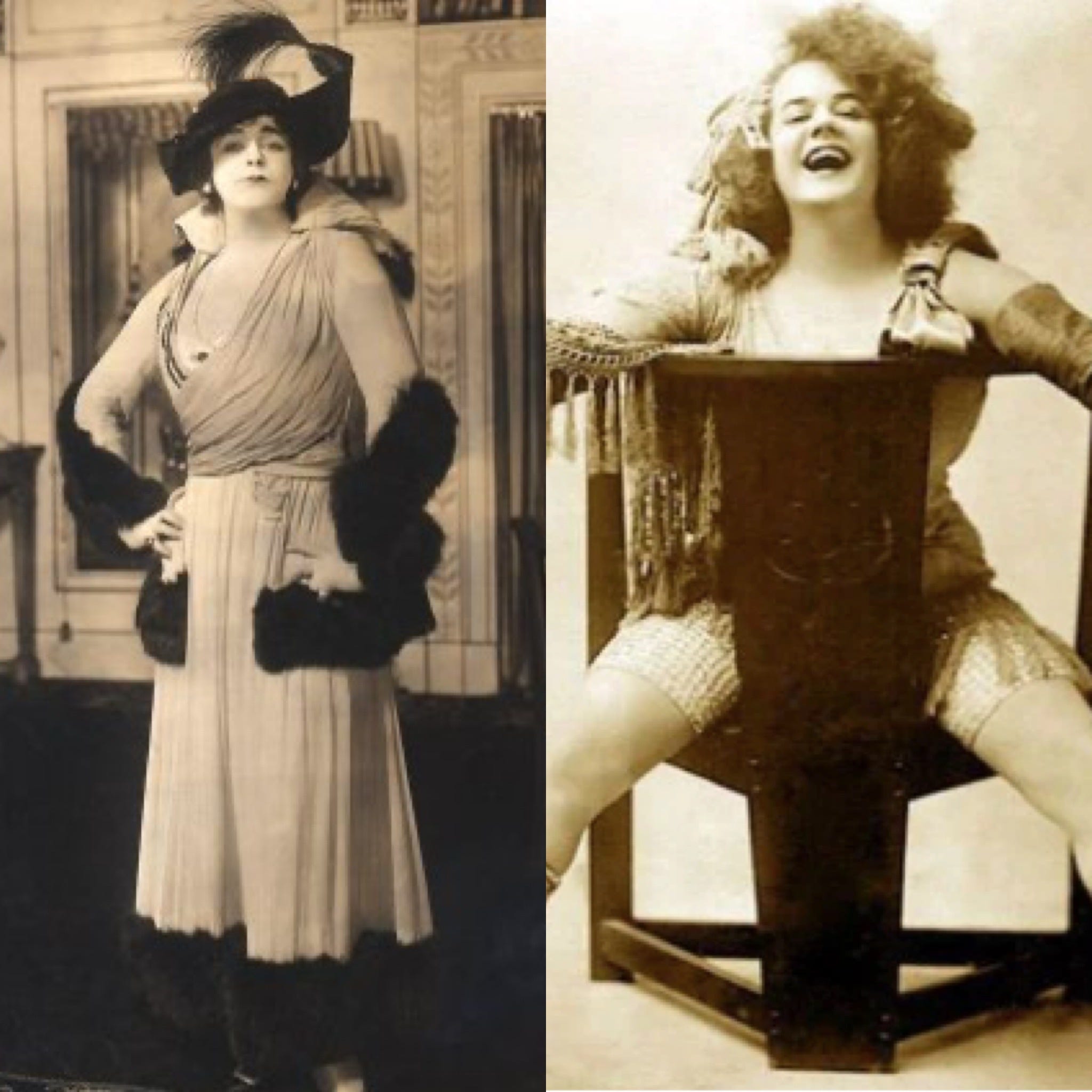
Around that time in America, female impersonation emerged as one of vaudeville's most beloved entertainments, infusing the world that would give musical theatre its "comic soul" with an overtly queer element.2 Two performers personified its different manifestations (S.D. 135). Julian Eltinge, the more popular of the two, was known to be "inoffensive" and built his act around actually passing as a woman, which he did so successfully that he eventually published a best-selling book of beauty tips. "[H]e was not primarily comic. His goal was to be convincing . . . and beautiful" (134). Bert Savoy, on the other hand, kept audiences roaring with his exaggerated, catty, and bawdy version of female impersonation that, for many, places him in the history books as show business's first drag queen. His physicality and catchphrase ("Come up and see me sometime!") would later be taken up and even further popularized by Mae West, whose shtick would, in turn, inspire more drag queens. Their offstage lives also give us telling insight into the era's attitudes towards LGBTs: Eltinge famously distanced himself from his onstage persona, adamantly—and belligerently—defending his heterosexuality, while the homosexuality of Savoy and Brennan (his onstage partner), though not discussed, was regarded as an open secret (133-136). In discussing his feelings for Savoy and Brennan, comedian Lou Holtz captures the predominant attitude of the era: "'Sure, I knew they were supposed to be fags. But who cared? . . . I knew women in this business who were lesbians. Again, who cared? So she's a lesbian one hour a day. The rest of the day she's charming, a great performer, and a pleasure to work with'" (238).
The importance of Holtz's sentiments should not be underestimated. In a detailed account of gay life in New York City from 1890–1940, queer historian George Chauncey suggests that the permissive and less judgmental demeanors of showfolk generated the link between the LGBT and theatre communities rather than the work that was performed onstage: "Homosexuality, along with other unconventional sexual behavior, was regarded in an unusually open-minded way by people who were themselves often stigmatized because of the unconventional lives they led as theatre workers" (302). Chauncey insinuates there was a sort of cycle: empathy for LGBs amongst theatre artists drew more queer professionals into the industry; so, the theatre district became a hub for gay cruising, creating more and more awareness of—and, eventually, curiosity about—the productions being performed; this curiosity morphed into interest that drew more LGBs into the profession, which further solidified the neighborhood's status as a place where LGBs could meet; and so on. So, yet again, we see a lot of theories, but scant concrete evidence. John M. Clum sums it up best when he says the stereotype of the homosexual and his adulation of the musical is "so prevalent and, for some, so true that a source becomes undetectable. One cannot possibly find patient zero" (37).
III: What Is This Thing Called Love?—Explaining the Queer Connection to Musical Theatre
Imagine a person who has never seen a musical, but has read countless of their texts. To such an unlucky soul, the queer affection for musical theatre might seem odd. After all, on paper, the dramatic action of most musicals is staunchly heteronormative:
While the principals in a musical may begin as rivals (Sarah Brown and Sky Masterson in Guys and Dolls) or as enemies (Eliza Doolittle and Henry Higgins in My Fair Lady) or as annoyances to each other (Maria and the Captain in The Sound of Music) or, at best, in mutual misunderstanding (Nellie and Emile in South Pacific), their differences of background or temperament signal that they will eventually form a couple. Indeed, the ideological project of musical theatre in the United States in the mid-twentieth century was to use the heterosexual couple's journey from enemies to lovers to stand in for the unification of problematic differences in American culture—between the city and the country, between work and leisure, between us and them, between whites and racialized Others.
(Wolf, "Defying Gravity" 9.) But for queer audiences, whose "daily spectating practices [have] taught them to see differently" (Wolf, Problem 26), there are hidden, subversive pleasures in these often formulaic, conservative stories.
A: In Praise of Women—The Power of the Diva
In Section I, we saw evidence from Dhoest et al. that queer men show pronounced interest in the music of strong female performers known as "divas." I suggest that interest carries over in their response to musical theatre, and that the most readily apparent of the aforementioned hidden pleasures is the genre's showcasing of such women. Here, too, we can explain its special appeal for female audiences. It may first strike readers as hyperbole when they read D.A. Miller's claim that "though male and female alike may and indeed must appear on the musical stage, they are not equally welcome there: the female performer will always enjoy the advantage of also being thought to represent this stage, as its sign, its celebrant, its essence, and its glory" (71). Then, if they take a moment to think of which musical theatre performers are most recognizable, most symbolize and/or personify the Broadway stage, the sheer number of female names that come to mind—Ethel Merman, Mary Martin, Carol Channing, Angela Lansbury, Gwen Verdon, Chita Rivera, Elaine Stritch, Patti LuPone, Bernadette Peters, Betty Buckley, Audra McDonald, Sutton Foster—renders it impossible to deny that musical theatre is the domain of the diva.
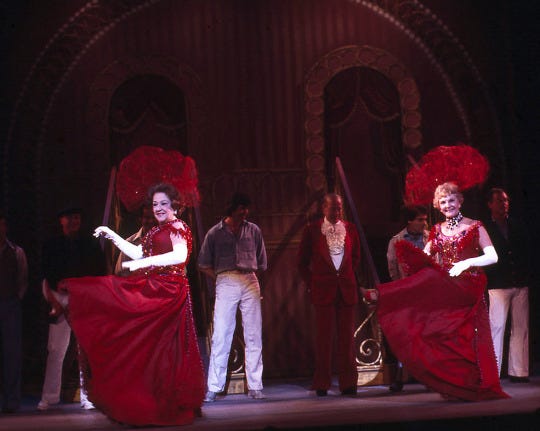
Musical theatre scholar Michelle Dvoskin identifies "two main components to what makes a diva: one, a female performer, often a vocalist, with an excess of talent and ambition (and often attitude as well); the other, an outsized, starring performance by a performer marked as female" (94). With their scores consisting of powerful, rangy, and/or sustained "money notes," and their incorporation of choreography that is often more athletic than beautiful, musicals with diva roles create for their stars opportunities to demonstrate acute strength that belies gender norms. Even when musicals tell traditional love stories that link a woman's fate to her relationship status with a man, it is frequently the diva's tour-de-force, solo performance that is memorable to audiences rather than any element of the show that involves coupling. Think, for example, of Funny Girl (1964): does anyone remember it as Barbra Streisand and Omar Shariff's musical? Is anything that the character of Arnstein does—with, without, or to Fanny—remotely as iconic as Fanny belting, "No, nobody—no, nobody—is gonna rain on my parade!"? For an example that is kinesthetic rather than vocal, we can look to Damn Yankees (1955). Its famous "Whatever Lola Wants (Lola Gets)" sequence may be a seduction, but audiences are much likelier to remember Gwen Verdon's dance—and the confidence with which she lyrically asserts herself—than whether or not Lola ends up with Joe. (She doesn't.)
It makes sense that, "[i]n a culture where normative femininity positions women as passive and located in the private sphere of the home," female audiences would find it liberating or, at least, stirring when a diva "sings loudly and demands attention in the public space of performance [and thus] challenges normative ideas of gender" (Dvoskin 95). But why should queer men? One comparatively concise explanation is that being attracted to one's own sex is itself a repudiation of gender roles; any public rejection of them—especially one that is celebrated and garners applause—is going to endow the queer man with a sense of joy, relief, and hope. Furthermore, the "diva's disruption of gender roles also implies a challenge to the heterosexual order that the traditional gender system supports (and is supported by)" (96). In other words, heteronormative society depends on its participants agreeing to play specific gender roles. By refusing to play the role prescribed to her, the diva creates a space in society where heteronormative rules don't apply—a space that queer men could comfortably co-occupy.
If the appeal of the diva in musical theatre rested only on her singing and dancing, one could argue that it is no different than the appeal she holds in the realm of music. But theatre adds the critical element of a narrative, which music alone generally lacks. Divas' trajectories in the stories of their musicals resonate with queer spectators because "the diva musical is about a woman's escape from the humdrum. . . . [T]he diva fights for liberation from stasis in a grim, everyday world. To [queer] men," and, of course, to women, "the diva heroine [i]s a figure of identification" (Clum 168).
Compare, for example, pre-integration musicals like The Wizard of Oz (1939); Golden Age classics like Gypsy (1959) and Hello Dolly (1964); concept musicals like Cabaret (1966) and Chicago (1975); crowd-pleasing British "pop-eras" like Evita (1979); niche, highbrow fare like Sondheim's Passion (1994); recent screen-to-stage adaptations like Hairspray (2002); and family-targeted blockbusters like Aida (2000) and Wicked (2003). Regardless of era, tone, or source material, in the plots of all these diva musicals, a woman seeks to free herself from oppression—often in the form of expectations based on her gender and/or social status—and instead realize her own ambitions of seeking adventure, finding celebrity, or (in the plots that are likely the easiest for LGBTs to see themselves in) partnering with a love of her own rather than a man chosen for her by someone else. Musicals offer their heroines and the female and queer audience members who identify with them an "escape from the provincial, where one is hated," to a world of "fabulousness, an antidote to grayness and . . . entrapment" with a journey that engenders "glamour and power" along the way (Clum 168). No wonder why, as Lovelock found, there is a preference amongst women and LGBTs for musicals with female protagonists.
B: Nothing's Better Than More—Musical Theatre and Camp
Dhoest et al. also recorded evidence of a heightened interest in camp performances amongst queer men—another finding that I believe we can transfer from the world of music to the world of musical theatre. But what is camp? When sorting through the countless essays on the subject, it quickly begins to feel like academics aren't just trying to analyze camp, but also suck the joy out of it. Scholars agree on very little about camp, except that it is difficult to define, but easy to recognize. "'Camp is a style that favors "exaggeration," "artifice," and "extremity"'" (Clum 7). Susan Sontag was arguably the first to legitimize camp in writing, and provides the definition that seemingly all others attempt to support or modify. She defines camp as a sensibility that favors style, artifice, and the unnatural (277). She describes two categories of camp: naïve or pure camp, which is sincere, unintentional, and so-bad-it's-good; and conscious camp, which is self-aware, intentionally funny, and knowingly performative (292).
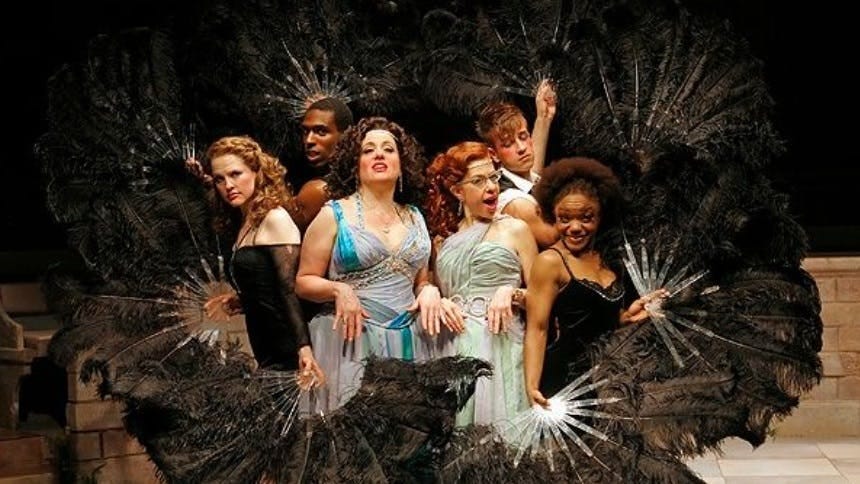
Musicals offer a plethora of examples of both types. The first category encompasses entries as outwardly different as early, earnest Judy Garland-and-Mickey-Rooney fare and the infamous musical version of Stephen King's Carrie (1988) that ran on Broadway for only five performances, but spawned a devoted cult following (see, e.g., Mandelbaum, 3-10). The second category includes over-the-top extravaganzas like The Rocky Horror Show (1975) and the stage adaptation of Xanadu (2007), a spoof of the flop 1980 movie that exemplifies naïve camp. As a work of conscious camp that sent up naïve camp, the stage Xanadu inspired some scholarship of its own. Don Shewey explains that the camp allure of the loathed source film "comes from homosexual defiance, identifying with what's been discarded and relishing what's been scoffed at by others," but also recognizes that the strength—and queerness—of the stage adaptation is anchored in a different form of camp . . . knowing, tongue-in-cheek satire. Shewey describes the unique effect of such multiple layers of camp as "the single gayest thing [he's] ever seen on Broadway" and endorses one of its character's comments that it's "like children's theater for 40-year-old gay people!'" ("So Bad.")
Despite the widespread complaint that Sontag is trying to "de-gay" camp when she writes that "even though homosexuals have been its vanguard, Camp taste is much more than homosexual taste" (290), queer scholars explaining the gay contribution to and affinity for camp tend to use as their starting point Sontag's assertion that camp's "metaphor of life as theater is . . . a justification and projection of a certain aspect of the situation of homosexuals" (291). Presumably, she is referring to the pressure queer people feel to perform a role, to be someone other than who they are, and/or to heighten behaviors to make their similarities to someone of another gender, style, and/or orientation more apparent. Jack Babuscio crystallizes this idea in an expansion of Sontag's work in relation to the gay sensibility, writing, "Camp, by focusing on the outward appearances of role, implies that roles, and, in particular, sex roles, are superficial—a matter of style. Indeed, life itself is role and theater, appearance and impersonation" (24). By incorporating elements of camp, just as it did with their featuring of diva performances, musical theatre challenges the gender norms that oppress LGBTs.
Later in his essay, Babuscio describes camp as "spring[ing] from the gay sensibility's preference for the intensities of character, as opposed to its content: what the character conveys tends to be less important than how or why it is conveyed" (46), which has crucial implications for demystifying the appeal of musical theatre to LGBTs. The structure of musical theatre hinges on extremity of emotion: characters become so full of feeling that mere words no longer suffice, so they break into song and/or dance. Of course, the transition from dialogue to music requires a suspension of disbelief because, in real life, most people don't just burst into song. In other words, artificiality is also built into the form (Ellis 58). Thus, two elements of camp—intensity and artifice—are built into the genre's design, making it inherently attractive to LGBTs.
Camp intensity is also relevant to the appeal of the diva. Knapp discusses how "exaggeration in performance" has given female audiences "a liberating model, a demonstration of how one might more aggressively control and challenge the boundaries that traditionally circumscribe one's own gendered, sexual self" (206). Given what we saw in the previous subsection, it's easy to see how this model would also prove liberating to queer men. But are there instances when exaggeration in performance would appeal to queer men, but not women?
Clum paints a clear picture of such an occasion:
Diva roles . . . either transgress conventional notions of femininity or expand them almost to the breaking point. Carol Channing is the paradigm of this sort of Broadway diva. The hair is obviously a wig. Like a clown's face, her face looks painted on. The delivery is extremely stylized . . . . Divas—or at least the personae divas choose—are cartoon women. They express in an exaggerated way parts of women . . .
(175) (emphasis added). In taking carefully chosen female traits to campy extremes, certain divas follow in the footsteps of Bert Savoy and all drag queens who continue his work, further queering the musical. "In other words, she [the diva] must model herself not on a biological woman, but on a drag queen" (Dvoskin 96). Here is an aspect of musical theatre where the responses of women and GB men often bisect, as female critics have derided such characterizations as "'disrespectful'" and "'a gay man's version of what a woman is'" (Lovelock 71-72). While conflating sexual orientation and gender expression is problematic, for queer men in an audience, the campy drag element of a diva's performance not only signals another challenge to gender norms, but also recognizes that queer contributions to society have value and are worth continuing, providing yet another way in GBTs can find empowerment in the musical.
C. Careful the Things You Say, Children Will Listen—Musical Theatre Lyrics
In Section II, we discussed how Cole Porter and Noel Coward would write innuendos in their musicals that could be noted as gay references by queer audiences, but would go unnoticed by everyone else. Porter and Coward were not, of course, the only writers to do so. Gay allusion can be found in a myriad of musicals from both before and after Stonewall—sometimes, yes, in clever quips reminiscent of Porter and Coward, but also in more substantive contexts.
Lorenz Hart stands out as a compelling contrast to Porter and Coward because he was their contemporary, but had a very different relationship to his sexuality. Not only was Hart more secretive about his orientation, by all accounts, he was riddled with shame over it. Though he indulged his desires with hustlers, at orgies, and in casual flings, he never had the sort of long-term relationships that Porter and Coward enjoyed. Only five feet tall and prematurely bald, Hart was also incredibly embarrassed by his appearance. Hart's self-loathing fed into his alcoholism, which would prove to be a major contributing factor to his early death. (Clum 55-68.)
Hart's lyrics "transmuted his unhappiness and loneliness into great art" (Clum 58). Listeners of his songs can immediately pick up on references to his loneliness and self-consciousness—think, for example, of "your looks are laughable/un-photographable" in "My Funny Valentine" or "All alone, all at sea!/Why does nobody care for me?" in "Ship Without a Sail." Queer listeners will clock references to his sexuality just as easily. Consider these words from On Your Toes: "'Mother warned me my instincts to deny./Yet I fail./The male is frail./The heart is quicker than the eye!'" (Gottlieb). Or these from "I'd Like To Hide It": "When I see John, reserve goes on the wing. Though I know I mayn't, I just want to faint./I'd like to hide it!/I'd like to smother down the flame inside!" (Clum 66). Confines of space prevent me from continuing with more examples, but the picture of a man wrestling with his sexuality is already apparent and repeatedly drawn. Lyrics like these hold incredible power for closeted gay men, especially pre-Stonewall, as it lets them know they're not alone.
Queer meanings can even be found in places where musicals' creators did not intend for them to be. A contemporary example can be seen in Wicked (2003), which imagines a backstory for Elphaba, the Wicked Witch of the West, and Glinda, the Good Witch of the North, from The Wizard of Oz, itself a work widely reread through queer hermeneutics. In "Defying Gravity," Wolf details at length how the story that Wicked dramatizes is a "queer romance" for those "who are willing to see and hear resistantly" (5). Similarly, in Lovelock's study, a gay male subject discusses how he sees Elphaba's first song, "The Wizard and I," a solo in which she imagines that the Wizard of Oz will embrace her despite her unusual appearance, as a metaphor for coming out because "gay guys hope one day that the thing that makes them different—their 'green skin'—will be accepted and not an issue" (214). With this perspective in mind, it's quite easy to read the lyrics of "The Wizard and I" as conveying a queer subtext:
Once I'm with the Wizard
My whole life will change
'Cuz once you're with the Wizard
No one thinks you're strange!
No father is not proud of you,
No sister acts ashamed
And all of Oz has to love you
When by the Wizard, you're acclaimed
And this gift or this curse
I have inside
Maybe at last, I'll know why
When we are hand in hand -
The Wizard and I!
(Id.). If, for you, like me, it's initially difficult to accept such a reading because the philosophy of Goethe—who said that an author's intentions must be considered when evaluating a work of art—rings in your ears, Wolf has an effective rebuttal: "That these deviant readings are generated through queer desire makes them no less valid. More conventional or 'straight' readings simply rely on different, if naturalized, assumptions about representational practices . . . ." (Problem 24).
So Who Cares? So What?: A Conclusion
I have endeavored to prove that there is a queer connection to musical theatre—one that sometimes intersects with the connection women have to musical theatre, but also sometimes branches off in its own direction. More quantitative research is needed to validate the connection from a scientific perspective. Though much more qualitative analysis exists than performed or reviewed here—and even more remains to be done—it seems clear the connection is a meaningful one. Too frequently the attachment queer men have for musical theatre is assessed as trivial. These assessments are often thinly veiled attempts to belittle LGBT people or dismiss the musical as a substantive form of art. But, to paraphrase Stephen Sondheim, "We're still here."
Works Cited
Babuscio, Jack. "Camp and the Gay Sensibility." Camp Grounds: Style and Homosexuality, edited by David Bergman, University of Massachusetts Press, 1993, pp. 19-38.
Chauncey, George. Gay New York. Basic Books, 1994.
Clum, John. Something for the Boys: Musical Theater and Gay Culture. St. Martin's Press, 1999.
Dhoest, Alexander, Robbe Herreman, and Marion Wasserbauer. "Into the Groove–Exploring Lesbian and Gay Musical Preferences and 'LGB music' in Flanders." Observatorio Journal, vol. 9, no. 2, 2015, pp. 207-223.
Dvoskin, Michelle. "Embracing Excess: The Queer Feminist Power of Musical Theatre Diva Roles." Studies in Musical Theatre, vol. 10, no. 1, 2016, pp. 93-103.
Ellis, Sarah Taylor. Doing the Time Warp: Queer Temporalities and Musical Theater. Dissertation, University of California: Los Angeles, 2013.
Gottlieb, Robert. "Rodgers and Hart's Dysfunctional Partnership." The Atlantic, Apr. 2013, https://www.theatlantic.com/magazine/archive/2013/04/words-and-music/309249/. Accessed 4 July 2017.
Knapp, Raymond. The American Musical and the Performance of Personal Identity. Princeton University Press, 2006.
Kenrick, John. Musical Theatre: A History. Bloomsbury Academic, 2010.
Kenrick, John. "Our Love Is Here To Stay: Gays and Musicals." Musicals 101.com: The Cyber Encyclopedia of Musical Theatre, Film & Television, 1996, http://www.musicals101.com/ourlove.htm. Accessed 8 July 2017.
Lovelock, James Michael. "Not Just for Gays Anymore": Men, Masculinities and Musical Theatre. Dissertation, University of Birmingham: Birmingham, UK, 2016.
Mordden, Ethan. Anything Goes: A History of American Musical Theatre. Oxford University Press, 2013.
Savran, David. "'You've Got That Thing': Cole Porter, Stephen Sondheim, and the Erotics of the List Song." Theatre Journal, vol. 64, 2012, pp. 533-548.
Sontag, Susan. "Notes on 'Camp.'" 1964. Against Interpretation and Other Essays, edited by André Deutsch, Farrar, Straus and Giroux, 1987, pp. 275–92.
Mandelbaum, Ken. Not Since Carrie: Forty Years of Broadway Musical Flops. St. Martin's Griffin, 1992.
Miller, D.A. Place for Us: Essay on the Broadway Musical. Harvard University Press, 1998.
Shewey, Don. "So Bad It's Good." The Advocate, 28 Aug. 2007. http://www.donshewey.com/theater_reviews/xanadu.html. Accessed 9 July 2017.
Trav, S.D. No Applause—Just Throw Money: The Book That Made Vaudeville Famous. Farrar, Straus and Giroux, 2006.
Wolf, Stacy. "'Defying Gravity': Queer Conventions in the Musical Wicked." Theatre Journal, vol. 60, 2008, pp. 1-21.
Wolf, Stacy. A Problem Like Maria: Gender and Sexuality in the American Musical. University of Michigan Press, 2002.
Section Titles
All sections have been titled with musical theatre quotes from queer lyricists.
The introduction quotes "Willkommen" from Cabaret (1966) | Lyrics by Fred Ebb
The title of Section I quotes "One Plus One Equals Three" from Side Show (1997) | Lyrics by Bill Russell
The title of Section II quotes "It All Comes Back" from Fun Home (2015) | Lyrics by Lisa Kron
The title of Section III quotes "What Is This Thing Called Love?" from Wake Up and Dream (1929) | Lyrics by Cole Porter
The title of Section III(A) quotes "In Praise of Women" from A Little Night Music (1973) | Lyrics by Stephen Sondheim
The title of Section III(B) quotes "More" from the film Dick Tracy (1990) and the Broadway iteration of the Sondheim revue Putting It Together (1999) | Lyrics by Stephen Sondheim
The title of Section III(C) quotes "Children Will Listen" from Into the Woods (1987) | Lyrics by Stephen Sondheim
The conclusion quotes "So What?", which is also from Cabaret (1966)
Scholars have a wide range of definitions for references to "queer" people, cultures, and/or hermeneutics. For purposes of this paper, I will use Stacey Wolf's definition of the term "queer" as "broadly applicable to any nonstraight [sic] reading or interpretation" (Problem 23) and expand it to include non-straight people. Similarly, I will use the LGBTQ (lesbian, gay, bisexual, transgender, queer or questioning) acronym that is most frequently invoked as an adjective as both an adjective and a noun, in the latter case meaning lesbian, gay, bisexual, transgender, queer, and/or questioning people.
"Pansy" and "nance" acts that exaggerated the effeminate behavior of gay men were also popular in vaudeville in this era. They can be seen as a sort of queer analog to blackface in (i) that they often employed straight actors to play gay men (just as, in blackface, white actors were often employed to black men) and (ii) the sheer offensiveness of their stereotype-based mockery (Chauncey 310-11). Perhaps this tradition explains why, despite its large queer following, it would take musical theatre so many years to feature a three-dimensional, fleshed-out gay character: the earliest that one could argue such a character appears is likely La Cage Aux Folles (1983), forty years after the debut of Oklahoma!.
In Loving Memory of Dugan
Thank you for sharing this fantastic piece! I was not expecting a Fun Home reference from you! (Side Show, of course. Fun Home, surprising)
Could there be any higher praise than "its sign, its celebrant, its essence, and its glory"?? I love it.
Thank fuck you included Passion! Even if it's "niche, highbrow," it is my soul.
All my love to you and perfect Dugan forever. My Jasper raised up from my lap and was very interested in Dugan's singing while I grabbed a tissue.