
A Critwink* from the Intelligent Showmosexual
*In case you missed it: “critwinks” are mini-reviews turned out in a single draft
I am an infamously bad sleeper. Well, to be more precise, I'm infamously bad at GETTING to sleep. It takes me hours and a cocktail of anti-anxiety meds to wind down, plus the grounding rituals of flossing, putting on my Mario Badescu anti-aging products, and watching what I refer to as "midnight mediocre mysteries." These are television shows that I've deemed less exploitative than, say, the Law and Orders or CSIs—where all that matters is crime, and not character—but also aren't as tense or emotional as top-tier investigative series like Prime Suspect or Broadchurch. They're engaging enough to hold my attention and prevent my mind from roaming to whatever I wasn't able to get done at work or the current Verstanding family drama, but not so stimulating that the synapses in my brain really start firing. A good 90% of the time, I can correctly predict who the bad guy is, but that remaining 10% keeps me from getting bored. Above all else, these shows almost always end with the perpetrator being apprehended, allowing me to head to bed (or at least the rewatch of a chicken soup sitcom like Cheers or The Golden Girl that typically finishes my ritual) with a soft sense of the world being just and logical.
John Proctor Is the Villain ("JPITV") is the theatrical equivalent to one of my midnight mediocre mysteries, albeit closer in quality to the higher end of the spectrum than the lower. Think more The Closer than Rizzoli and Isles. Its relentless predictability is offset by some snappy dialogue, excellent performances, and, perhaps most importantly, its reinforcement of a worldview that the play's target audience desperately needs confirmed at a time when a self-professed pussy grabber is serving his second-term in the White House.

Both a critique and a spiritual successor of The Crucible, JPITV invites us into an Honors English class in Appalachian Georgia that is studying Arthur Miller's classic amidst the reckoning brought about by the #MeToo movement in 2018. The small class is populated by a host of familiar types mostly played in familiar ways: Beth (Fina Strazza), the socially awkward but lovable overachiever; Raelynn (Amalia Yoo), the good girl daughter of a pastor who's beginning to yearn for change; Ivy (Maggie Kuntz), the quiet girl grappling with a family secret; Nell (Morgan Scott), new girl and resident truth teller/Black sage; Mason (Nihar Duvvuri), a dim jock with a heart of gold; and Lee (Hagan Oliveras), Raelynn's ex who's determined to win her back after having cheated on her with her best friend, the conspicuously absent Shelby (Sadie Sink). The class is presided over by kindly Cool Teacher Mr. Smith (Gabriel Ebert) with the occasional visit from cub guidance counselor Miss Gallagher (Molly Griggs). If you suspect you can guess how the story unfolds after reading this paragraph, you probably can; if you don't, you still probably can.
What the writing lacks in sophisticated plotting and, with maybe one or two exceptions, nuanced characterizations is somewhat disguised, or at least offset, by playwright Kimberly Belflower's uncanny knack for capturing the way teenagers speak. Most of her dialogue lives in that sweet spot of sounding wholly true to life…when life is at its absolute cleverest. It's so entertaining to hear what Belflower's characters are saying that you might not realize—or perhaps even care—that Belflower isn't saying much at all, or at least not much that is new or particularly insightful. Even its analysis of The Crucible, which is positioned to feel current and cutting, feels more like the conversation my Honors English class was having back in 1997.
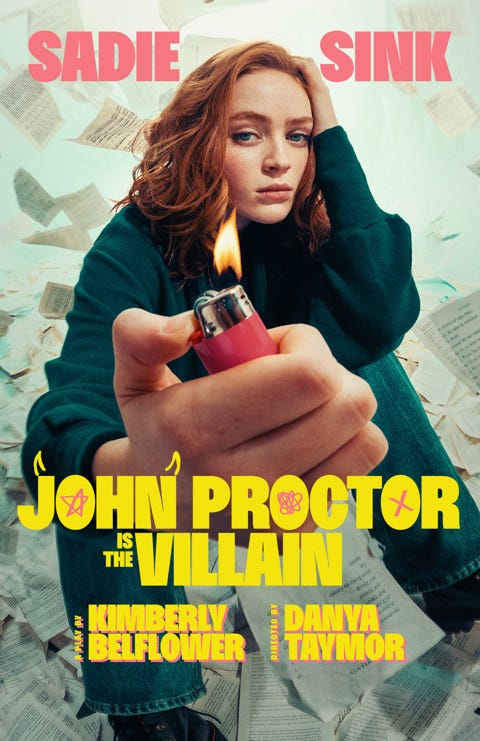
It's appropriate that the production's poster features Sink with a lighter because she sets the stage ablaze from the moment she steps foot on it. I'm mostly unfamiliar with her work on Stranger Things, but, here, she announces herself as one of the major talents of her generation to watch. She is capable of playing even the most hackneyed contradictions ("tough, but vulnerable") dynamically and honestly. Wildly charismatic and incredibly sincere, she manages to come across as a total original while also summoning qualities of some of the most singular teen stars of yesteryear. She has the savvy grit of Jodie Foster, the raw vulnerability of Jennifer Jason Leigh, and the acerbic wryness of Winona Ryder. Common sense suggests that Sarah Snook's Tony win for her showy tour-de-force in The Picture of Dorian Gray is virtually inevitable, but if I were a voter—and we all know I should be—I'd cast my ballot for Sink.
Although Ebert and Straza also both earned Tony nominations, I much preferred the work being done by Yoo and especially Scott. Ebert's performance is the latest example of his garnering acclaim for indicating to the audience what they should think of his character. Crowd-pleasing Straza is funny and endearing…much in the way that Molly Shannon was as Mary Catherine Gallagher. They belong equally in the world of this play. Yoo fails to make the highs and lows of her arc as powerful as they could be, but she is present and listening and genuinely communicating with her castmates in a highly refreshing manner. Scott, whose role is significantly smaller, knocks every punchline out of the park without ever compromising the reality of being the new kid—and the only Black kid—in class. I'm excited to see what she does next.
As she did with her Tony winning direction of The Outsiders, director Danya Taymor manages to infuse fairly conventional material with a renegade spirit, shrewdly using music and spotlighting individual characters during scene transitions to provide a glimpse into their inner lives. Like everything in JPITV, it's not as deep or edgy as it thinks it is or wants to be…and nevertheless still feels kinda cool. As a former teacher, though, I couldn't help but wish that Taymor and her designers had put more of that thought and effort into the reality of their physical space. The world they've created has all sorts of clever nods to contemporary schoolrooms while also revealing a shallow understanding of them. For example, there are tennis balls on the legs of the students' desks, not their chairs, even though every teacher I've ever known would—if given a limited number—put them on the latter as a way to minimize noise because chairs are moved around more frequently than desks. Similarly, a very realistic "mindset matters" hanging decorates one wall, but is followed by only one example of a suggested language shift. And don't get me started on the way Mr. Smith's schedule is posted.
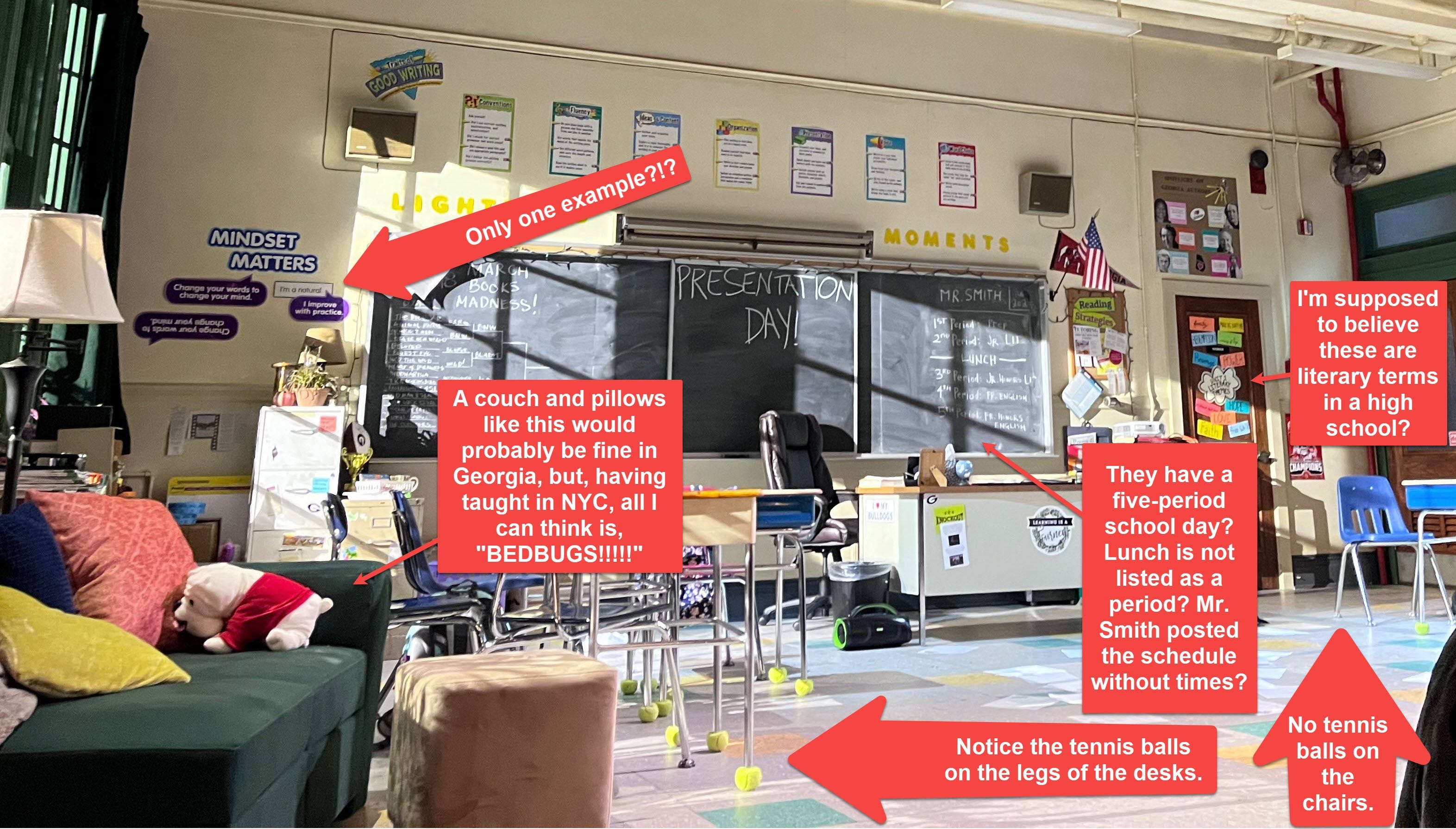
While these details are likely too "inside baseball" to bother (or even register for) individuals outside the world of education, they reflect a tendency to only skim the surface that afflicts the play and production as a whole. Seemingly thoughtful choices—like the tennis balls on the desks or, more crucially, insider knowledge that Miss Gallagher discloses at a pivotal moment—don't make sense if held up to further scrutiny. They're all excuses to reveal details we can already predict and deliver a message we already believe. But…maybe that's okay? Maybe, right now, we're a choir that needs the comfort of being preached to. Maybe JPITV is too mediocre to actually inspire its audience to take action, but maybe, at a time that feels increasingly dark, it's good enough to engender a little bit of hope. And, for that, I suppose I should quote Deputy Chief Brenda Leigh Johnson and say, "Thank you. Thank you so much."
the not-a-bottom line
🌈🌈🌈 (out of five)
a guide to ticket-buying
I got a digital rush ticket through Telecharge at around 3:45 PM on a Tuesday for a 7 PM show for $40. I was sat center in row E of the mezzanine. Although I usually prefer to be closer for straight plays to get a better view of the actors, my view was perfectly fine…and it’s hard to argue with the price.
Sorry, there's a typo. You were not in high school English in 1997...
Went to school in NYC and I've never seen a couch or such a small class size (outside of private schools, even there the class would be at least ten students). I enjoyed the play, it would have made a great double bill with Liberation.