
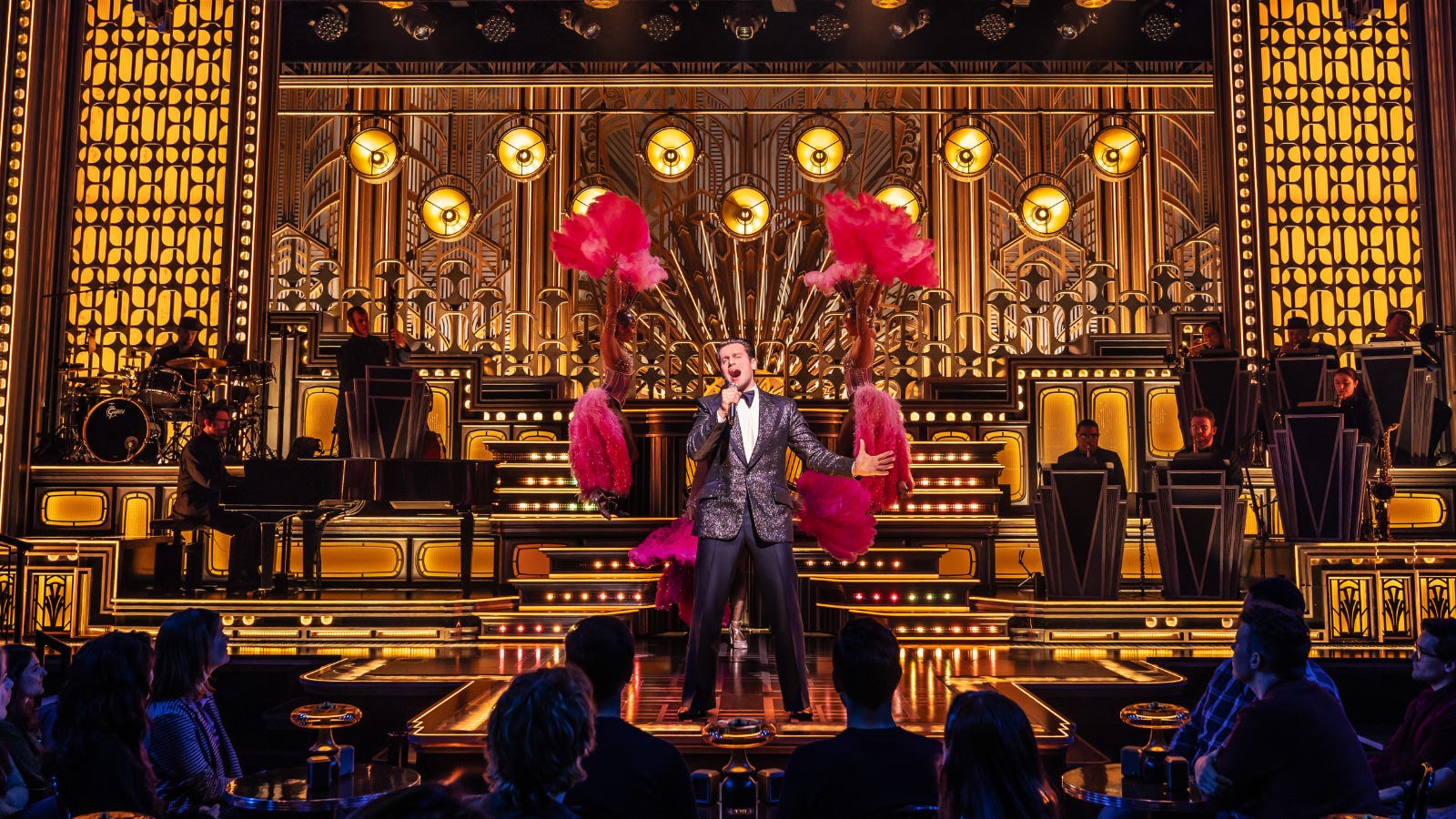
While watching Just in Time, I found myself thinking a lot about my experience seeing Hugh Jackman in The Boy From Oz. These days, Jackman’s talents as a singer/dancer/greatest showman have become so intertwined with his celebrity, it’s easy to forget that there was a time American audiences only knew him as Wolverine. Many people had no idea that he rose to prominence playing Gaston and Joe Gillis in Australia, and that his performance as Curly in Trevor Nunn’s revival of Oklahoma! essentially got him the X-Men franchise, which would make him a household name.
But back in 2003, the excitement of seeing a big A-list movie star live in a Broadway musical was substantially heightened by the astonishment that a big A-list movie star could handle the demands of a Broadway musical so expertly. In other words, the fun in seeing Hugh Jackman sing and dance with such panache did not just come from seeing someone sing and dance well; it came from seeing Hugh Jackman, specifically, sing and dance well. And the joy he seemed to feel entertaining all of us was infectious. It was a real Roxie Hart “and the audience loves her” and “And I love the audience for loving me and they love me for loving them and we just love each other” situation.
Nearly everything that’s entertaining in Just in Time works along the same lines. Despite his beginning in theatre, Jonathan Groff has become a legitimate television and film star, steadily building a fan base with roles in Glee, Looking, Frozen, Mindhunter, and The Matrix Resurrections. After Disney’s quarantine-era release of the pro-shot Hamilton, the countless memes inspired by his sweat and spit added to the notion that seeing Groff perform live qualifies as an “event,” buzz that only intensified following his terrific—I would argue, production-making—Tony-winning turn in Merrily We Roll Along.
Just in Time rode that buzz to Broadway…well…just in time. It has become an unexpected box office hit because people want to see Groff. The Bobby Darin song catalog certainly adds to the experience audiences have once they’re in their seats—it’s hard to resist “Splish Splash”—but I don’t think it, alone, would have gotten that audience in those seats. (It certainly didn’t help Kevin Spacey’s Darin biopic Beyond the Sea.) Groff is the draw here.
And he delivers. Big-time. It’s an ebullient and showy star-turn that, like Jackman’s, is as defined by a polished skillset as it is by charm and charisma. Whereas Jackman was sexy, Groff is adorable…but, in both cases, it’s genuine talent that allows them to seduce their audiences so fulsomely.
Neither actor disappeared into his role nor did it seem he was supposed to: the chief pleasure vehicles like Just in Time and The Boy From Oz offer is not in seeing a performer you love transform; it’s in seeing a performer you love do things that will make you love them even more while they wear the persona of someone else you love (or will/should love by the end of the evening). It’s as if they’re donning one of those “Lone Ranger” masks that only covers someone’s eyes, thus allowing us to understand they’re in disguise without ever obscuring who they actually are or, by extension, our adoration of them.
The creators of Just in Time aggressively lean into this conceit, starting the show with a nightclub-like announcement introducing Groff and then having him tell the audience, “I’ll be your Bobby Darin tonight.” He then launches into some twee patter that would even induce eyerolls on the stage at Don’t Tell Mama. As smoothly as Groff sells the bit, it all feels beneath him, and still farther below one-time Pulitzer Prize finalist Warren Leight who co-wrote the musical’s book with Isaac Oliver. (I had to double-check that I was correctly remembering their collaboration on Just in Time because it’s hard to believe that it took two people to write its book.) Leight used to be a real playwright; what he and Oliver have put onstage here feels more like a Wikipedia entry annotated with songs.
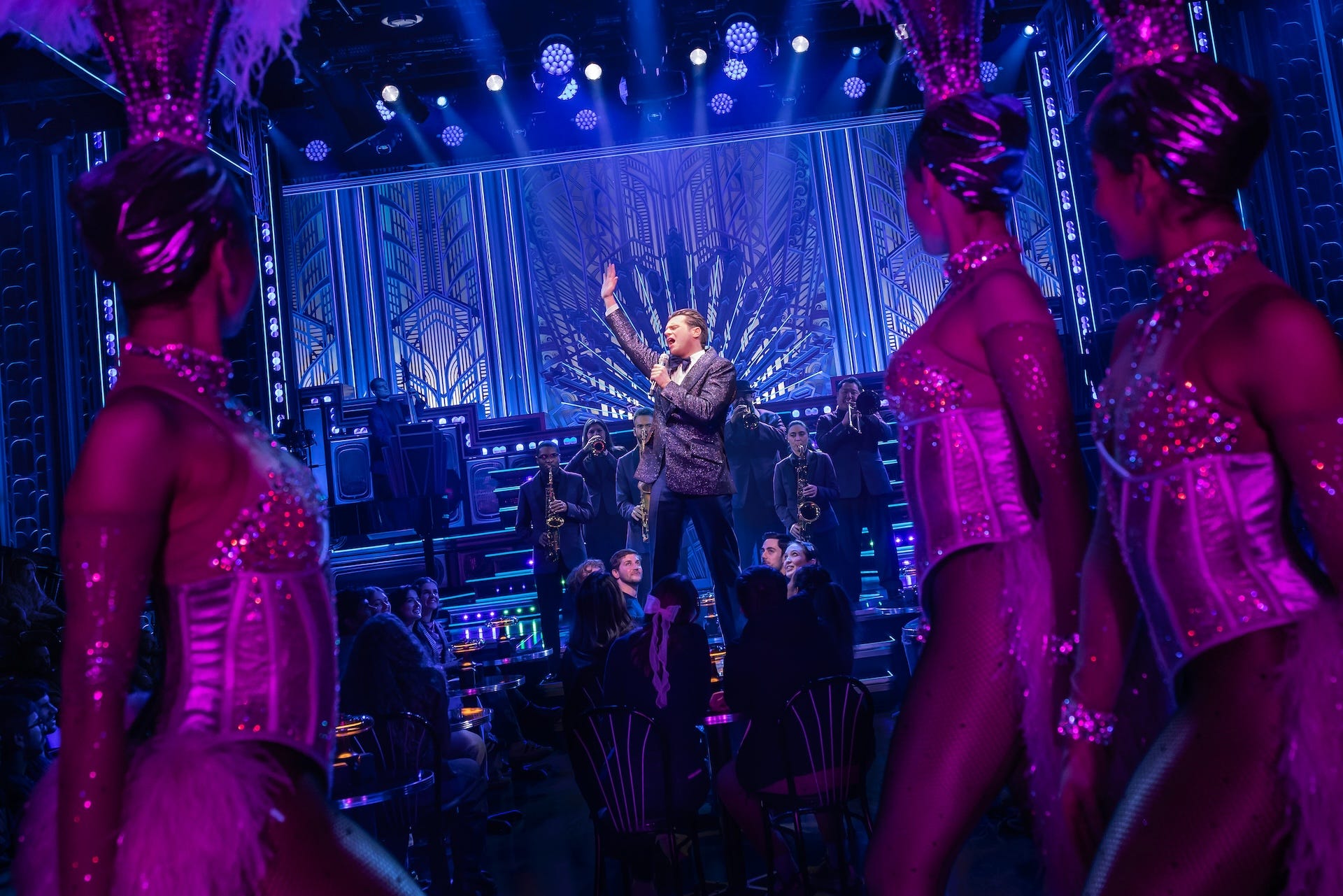
Their reliance on Groff’s direct address to the audience, which continues throughout the performance, is, in part, an easy way to dispense with exposition (i.e., lazy storytelling), but it’s also tied to director Alex Timbers’s half-baked conception of the whole musical as the sort of nightclub act for which Darin was famous. Given what I know of the director’s other work—including Bloody Bloody Andrew Jackson, Peter and the Starcatcher, Rocky, Here Lies Love, Beetlejuice, and Moulin Rouge! The Musical—I increasingly see Timbers as being to theatre what Ryan Murphy is to television: a savvy creativepreneur with lots of sexy ideas that are often inconsistently realized; someone whose pitches are full of promise…and whose products are full of problems.
Timbers’s direction of Just in Time is no exception. The underdeveloped nightclub concept stands out as particularly problematic. On one hand, he effectively uses it to underscore Darin’s reciprocal relationship with the audience; and, if I want to be really generous, I can connect Darin’s need for that immediacy to his short life-expectancy due to a heart defect. On the other hand, because Timbers fails to make any meaningful use of the nightclub device in telling the stories of the romances that define each act, it begins to feel like a gimmick. Furthermore, it’s haphazardly picked up and put down, mostly used for the easy exposition I already mentioned, with cheap jokes next in line.
And if the old adage is true that 90% of a director’s job is in casting, Just in Time may represent the messiest work of Timbers’s career, as the cast that supports Groff misses the mark as much as he hits it. Michele Pawk has demonstrated her unusual versatility with standout performances in musicals like Hello Again and Cabaret, and straight plays like Hollywood Arms and Heroes of the Fourth Turning, which respectively earned her Tony and Obie Awards. Sadly, as Darin’s mother and mentor, the woman who once introduced Michael John LaChuisa’s rangy “Mistress of the Senator” and assuredly navigated Sondheim’s rhythmic complexities in Bounce seems totally lost whenever she’s called on to sing, barely phonating, struggling with pitch, and frequently behind-the-beat. More surprisingly, in terms of acting, it’s a lazy performance, built on broad “showbiz-broad” cliches.
Most of the other original cast members don’t fare much better. Emily Bergl has an ethereal weirdness about her that has worked to her advantage in striking performances on stage (e.g., The Ferryman), screen (The Rage: Carrie 2), and television (Desperate Housewives), but it’s totally at odds with her role as Darin’s working class worrier of a sister. Playing a wider variety of characters are Caesar Samayoa, who was brilliantly protean in Come From Away, but barely makes an impression here; Lance Roberts, who seems to be in an entirely different show; and Joe Barbara, who, in his largest part, coasts on cliches as much as Pawk, but at least does some solid celebrity impressions. Three “Sirens” act as backup in Darin’s nightclub act, two of whom (Julia Grondin and Valeria Yamin) have been with the show since opening while the third (Claire Camp) is a replacement. All three are great, enlivening the proceedings with seemingly inexhaustible energy and showgirl precision whenever they dance Shannon Lewis’s fun choreography.
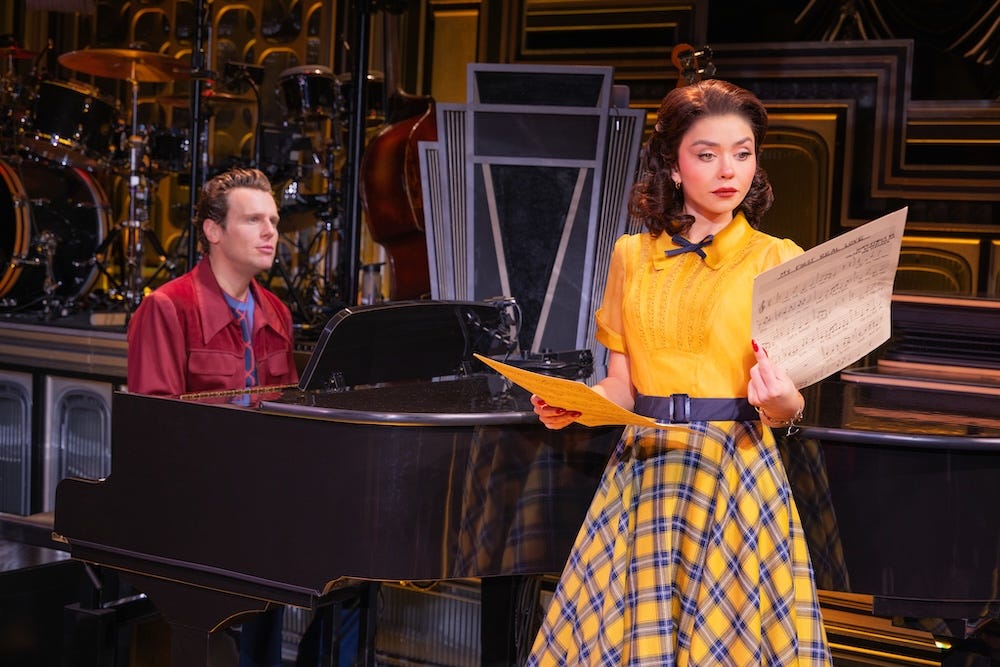
The pivotal roles of Connie Francis and Sandra Dee have been assumed by Sarah Hyland and Sadie Dickerson. Their casting is best described as puzzling. Hyland was a Broadway kid before gaining a more national profile as Haley on Modern Family, so she’s not without stage chops. But the preternatural poise that made her a perfect young Jackie Bouvier Kennedy in Grey Gardens does not fit with the way Leight and Oliver have envisioned Francis, which is essentially as a member of the Sopranos family. Plus, her singing voice, though powerful, is not particularly beautiful, and it’s hard to think of someone with a more mellifluous voice than Francis. Newcomer Dickerson acts very well. In fact, a visit Dee makes to Darin when he’s going through a reclusive period is the only scene in the show that carries real dramatic weight. However, her singing voice is even less pleasant than Hyland’s, and it doesn’t make sense that she’s playing such a central role in a musical, particularly when her name won’t sell tickets.
Another replacement will be joining the cast soon, as Groff has announced a departure date of March 29. It’s rumored that his successor will be Jeremy Jordan or Matthew Morrison, both of whom are highly capable. Will they be capable enough to make Just in Time worth seeing? I’m skeptical, but it remains to be seen. Until then, Groff’s dynamic performance is the only saving grace that elevates the show from “Just a Crime” to “Just Is Fine.”
the not-a-bottom line
🌈🌈 (out of five)
a guide to ticket-buying
There’s a line in The Producers where Max Bialystock, the hack theatre producer originated by Nathan Lane on Broadway, is bragging about his accomplishments and says, “You’ve heard of theater in the round? You’re looking at the man who invented theater in the square. Nobody had a good seat!” Man, oh man, that sure is true of Just in Time, which combines the worst parts of three-quarters in the round staging with the worst parts of proscenium staging.
If you’re a really big fan of Groff and have thousands of dollars to spend, yeah, spend thousands of dollars to be at one of the cabaret tables on the floor. Your proximity and potential involvement in the action will probably be worth your having to constantly shift around to watch the action.
Otherwise, I’d recommend sitting in the 100s section, ideally in the first few rows. It’ll give you the best view of the entire playing area.
a key to the pictures
Interestingly, performance clips from the 2025 Tony Awards are not available online, which is a shame because it was a very flattering representation of the show. You can however see…
“Beyond the Sea” — Jonathan Groff and the Broadway Company of Just in Time Live on The Late Show With Stephen Colbert
“Mack the Knife” — Jonathan Groff and the Broadway Company of Just in Time Live on The Tonight Show With Jimmy Fallon
And just for good measure, here’s Hugh Jackman and the company of The Boy From Oz performing “The Boy Next Door” at the 2004 Tony Awards
A REQUEST FOR FEEDBACK
How do you feel about my sharing video clips in the “key to the pictures” section of this substack? Useful or something you glaze over? How would you feel if it went away?
Sound off in the comments or DM me!
"someone whose pitches are full of promise…and whose products are full of problems." You should be presented with a Pulitzer for this, post haste!
I enjoy the clips! The value is your curation, guidance, and commentary about them. But if they’re bogging you down, maybe only add them if you have a strong POV about them.