
A soupçon of memoir, as promised by my site’s subtitle: When I was a freshman in high school, I was thrilled to be cast as one of the leads in the school play. However, for some incomprehensible reason, the school play was Tennessee Williams’s Camino Real. Arguably the most sprawling and least accessible play in the Williams canon, it’s notoriously hard for even professional actors to pull off, so you can imagine how well 14- to 18-year-olds landed the plane.1
As Gutman, the play’s nasty narrator, I introduced each scene or “block,” as Williams called them. “Block 14 on the Camino Real,” I’d snark, modeling my delivery on Raquel Welch’s in the short-lived soap CPW for maximum bitchiness (GAYYYYYY). My mother loves to tell the story—though I can’t say I’ve loved hearing it, proud as I was to have landed the role—how, one night, another parent suffering through the tedium leaned over to her and whispered, “Uh…how many blocks are there?”
That poor man popped into my head while I watched the second act of Todrick Hall’s Midnight. As the new musical approaches its conclusion, which I guess occurs at midnight? (the storytelling is so muddled, it’s hard to know for sure), the ensemble starts a sort of countdown. “Nine o’clock!” they’ll announce with breathless excitement. And there I was, calculating how many more “hours” I still had to sit through, just as that father must have been doing with my “blocks.”
Midnight is not without its merits. But those merits are not enough to earn, or remain engaging throughout, its self-indulgent three-hour runtime. That self-indulgence extends beyond Hall; nevertheless—as the musical’s director, choreographer, composer, lyricist, librettist, and star—he is its most conspicuous example.
Hall, like many Black and gay public figures, is the target of grotesque hate online, so I want to be clear that Midnight makes his talent undeniable in every aspect of his extensive work on the project. However, it would be significantly better if he’d had collaborators, not because he does any of the aforementioned tasks ineptly…because he’s doing too many of them. The piece, like all musicals, needed creative checks and balances.
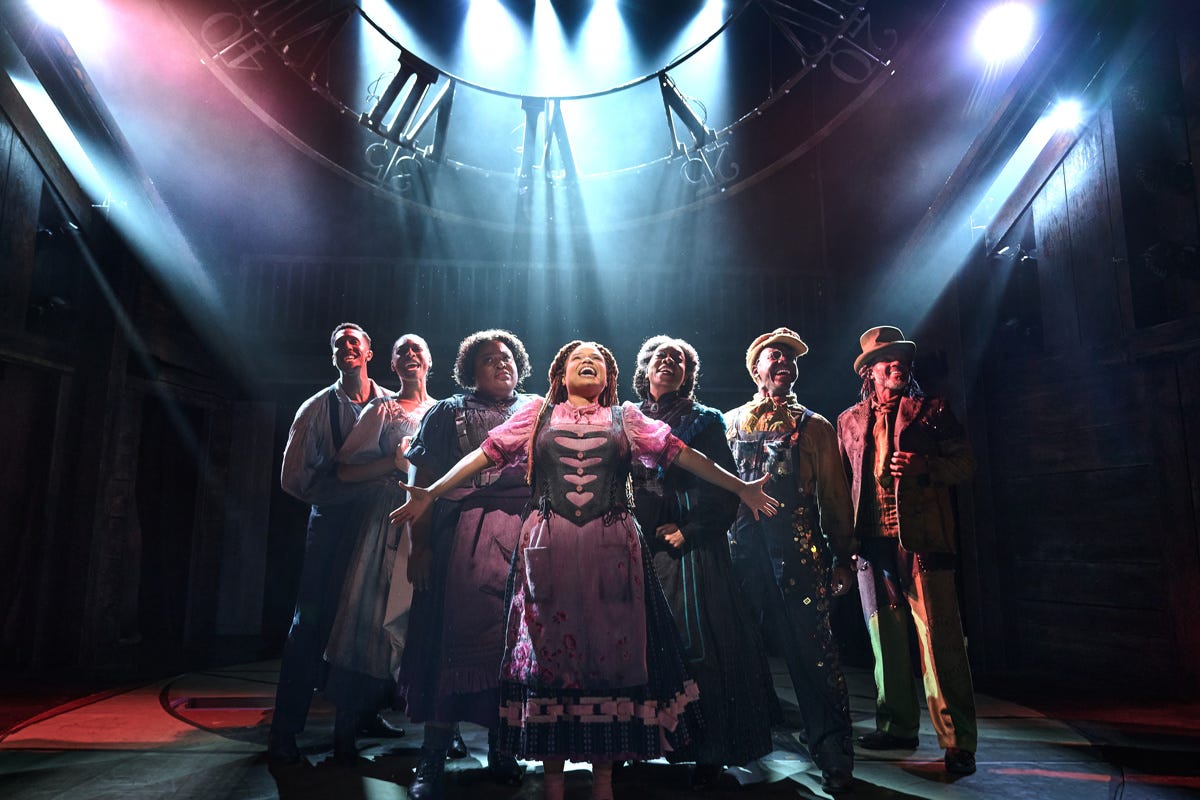
Flashes of what Midnight could have been come through in a stirring melody, a relationship that elicits investment, a genuine laugh, and especially Hall’s dynamic choreography, which a powerhouse ensemble executes with ferocious commitment. A moving “story-song” in the first act, tenderly sung by MJ’s Ayana George, demonstrates that Hall is a more versatile composer than his showy persona may suggest. The production is also visually impressive, with especially striking costume and lighting designs from Beck Jones and Jake DeGroot, respectively. As a metaphor, Morgan Large’s set suffers from the same clumsiness and lack of subtlety that plague the writing, but as spectacle, it’s gorgeous to behold.
Sadly, Midnight’s redeeming qualities are overwhelmingly overshadowed by its flaws. It is narratively confusing, tonally capricious, and, though conceptually ambitious, underdeveloped. It’s all over the place, and multiple perspectives could have helped ground it. It left me eager to see a Todrick Hall production that he only directs and choreographs, a Todrick Hall–penned musical that someone else directs and choreographs, or a Todrick Hall performance that’s a different writer’s material. You get the idea…
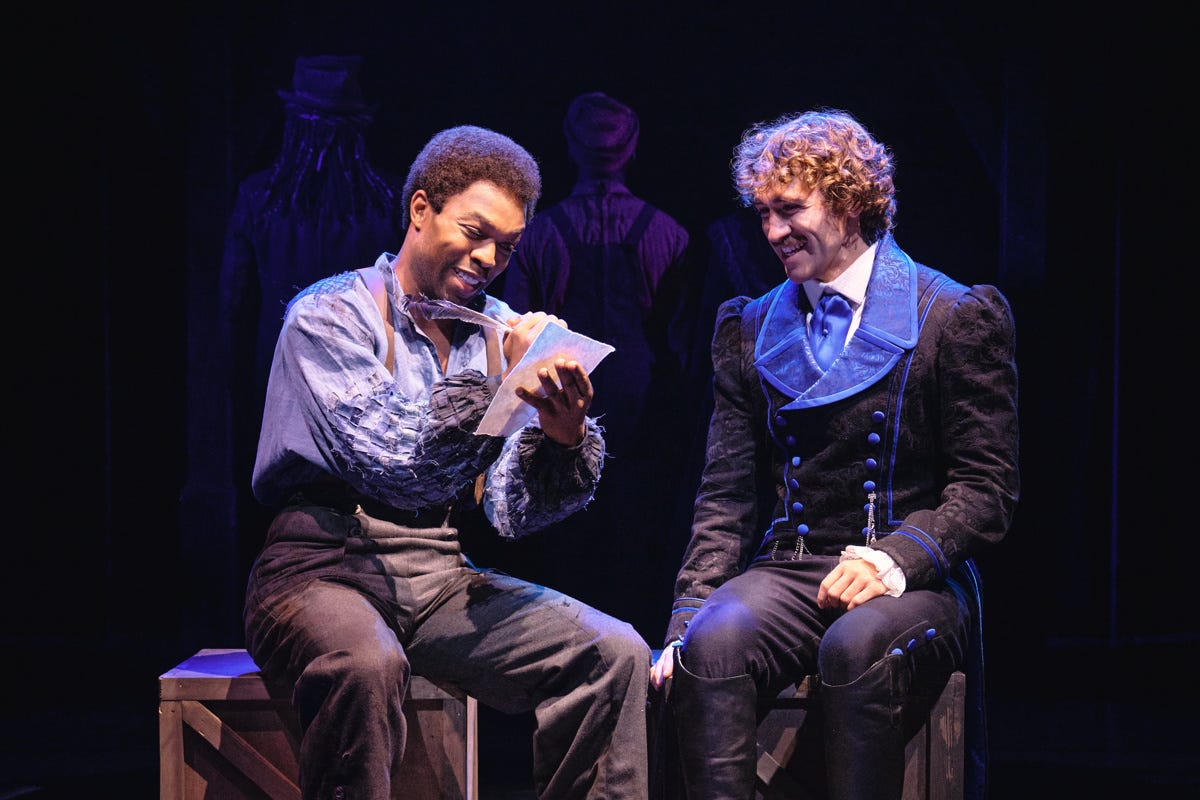
As it is, Hall plays Rail, who was stolen from his parents at birth and enslaved by the sadistic Sylvester (Ciarán McCarthy). Rail becomes a man of the utmost integrity under the watchful eye of his surrogate mother Ethel (George), whose enslaver is Sylvester’s equally cruel sister Charlotte (Autumn Hurlbert). She’s greedily trying to marry off at least one of her daughters, the entitled Scarlet (Kennedy Caughell) and the more sensitive Violet (Bella Coppola), to well-moneyed brothers, the more sensitive Richard (Jeremy Beloate) and the entitled Harry (Jimmy Brewer). Meanwhile, Rail has caught the attention of Lily Rose (Charlotte Odusanya), a woman of the utmost innocence protected by her surrogate sister Happy (Kolbi Jordan). Squeak (Sidney DuPont) and Horace (Dwayne Clark) join Ethel in narrating the tale, but otherwise seem to have little function besides bringing the number of principal characters to 12. Like midnight. MIC DROP. Almost literally—because Lawrence Schober’s sound design vacillates between indecipherable and deafening.
The singing is pretty consistently great, as you might expect from a cast that includes a former Elphaba and finalists from The Voice and American Idol. The acting is a lot more uneven, as you might expect from a cast that includes a former Elphaba and finalists from The Voice and American Idol. Odusanya is the major standout: she’s funny, touching, and vocally capable of seemingly anything. Odusanya and George have a specificity in differentiating the different characters they play that I wish more people in the cast possessed, including Hall, who’s written himself a dramatic reversal that he doesn’t satisfyingly pull off. Perhaps he could have if someone else had directed him. Coppola and Clark get less to work with but make strong impressions with everything they are given.
Whoopi Goldberg delivers a recorded pre-show announcement. She emphasizes that Midnight is an entirely original musical, clearly implying that it’s special because it’s not a revival and it’s not based on a movie or similarly plebeian source. The audience obediently claps in response.
In a way, she’s right. Hall’s efforts should be applauded. However, when the curtain rises—and certainly by the time it falls (especially if it’s three hours)—I’d prefer a well-written musical based on a film, like Hairspray or A Little Night Music, over something original that’s so sloppy. Still, Hall’s ambition is admirable. As Lord Byron says in Camino Real, “Make voyages! — Attempt them! — there’s nothing else…” Midnight attempts quite a voyage. Without co-pilots, it never lands.
the not-a-bottom line
🌈🌈 (out of five)
a guide to ticket-buying
Don’t sit on the floor at the Daryl Roth Theater. You want a better view of the dancing.
If you’re a Williams fan and wonder if that’s a reference to the Fugitivo, you are correct. I see you.
The perfect motto for an undergraduate theatre program
I was hoping you’d review this! Funny tuing about Camino Real. I don’t know anything about ot other than (1) it’s a Tennesse Williams play and (2) my college did it a few years before I started and painted the back wall with the phrase “Where the straight way was lost” as part of the set design—and I’m pretty sure it stayed up at least until I graduated.