
The last month or so has been unusually busy, so I’ll spend the next month or so posting reviews of three productions I saw before this year’s Tony Awards.
I have a confession that may significantly undermine my snob cred: I don't "get" a lot of contemporary British humor; to be honest, I find a lot of it downright grating. My ex insisted on showing me countless YouTube videos of Mr. Beane and episodes of Keeping Up Appearances, and with each one, I loved him a little less. (Kidding.) (Kind of.) Gays clutch their pearls when I admit that I've never gotten into Absolutely Fabulous. Theatre folk judge me when I suggest Noises Off is overrated.
I therefore braced myself for an experience at Operation Mincemeat where I would fail to grasp the charms enjoyed by a seeming majority. Initially, the broad performances suggested my worst fears would be confirmed. The actors came across like RADA students presenting their summer final after a sketch comedy intensive at Second City. The battery of British references felt like inside jokes that were accessible enough to understand, but not relevant or clever enough to be funny. Even the mildly amusing ones lost their luster as they were repeated incessantly. After all, how many times can I chortle at people finding Ian Fleming's ambitions to publish a spy novel ridiculous?
Just when Operation Mincemeat's exposition began to feel like an uneven skit from The Catherine Tate Show, the musical's inciting incident recaptured my attention: at the height of WWII, a top-secret mission is launched to mislead the Nazis by disguising a corpse as a British soldier carrying fabricated documentation. The ensuing complications epitomize the old adage that the truth is stranger than fiction.
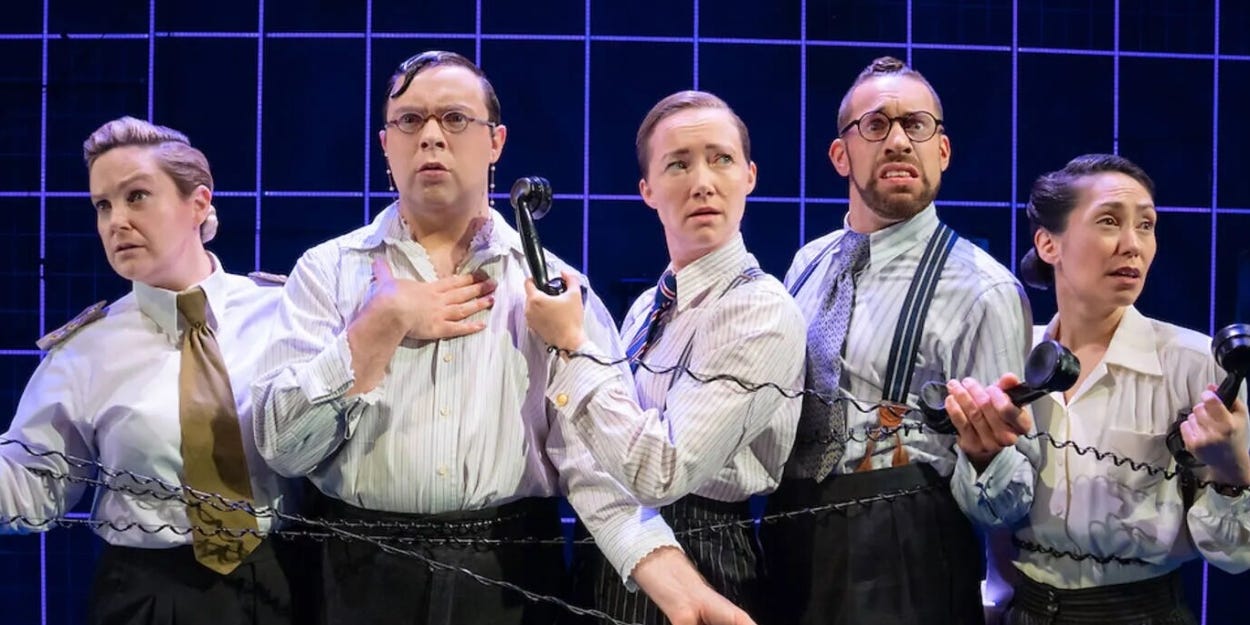
Back in high school, Mr. Clark, my AP European History teacher, was less interested in lecturing than he was in flirting with Heather Hill, the school's star field hockey player, so I was worried that I might lack sufficient pre-existing knowledge of the real-life incidents that inspired Operation Mincemeat to follow it. However, the musical's direction and libretto do an excellent job of not only clearly telling a story that's packed with twists and turns, but also sustaining a tone of madcap farce throughout events that don't seem to be a natural fit for comedy or musicalization. In fact, part of what makes the show fun is discovering the myriad of ways that the writers manage to make this story "sing." Alas, it would be even more impressive if the score, which lands somewhere between pleasant and serviceable, were stronger.
The few jaunts Operation Mincemeat does make into the land of sincerity are unexpectedly impactful, one significant exception being a quasi-epilogue that feels forced…a byproduct of conscience without creativity. The standout among the more solemn moments is the score's only tearjerker, "Dear Bill," which has won its performer, Jak Malone, much acclaim—including the 2025 Tony award for Best Featured Actor in a Musical. His heartfelt delivery is full of integrity and refreshingly understated.
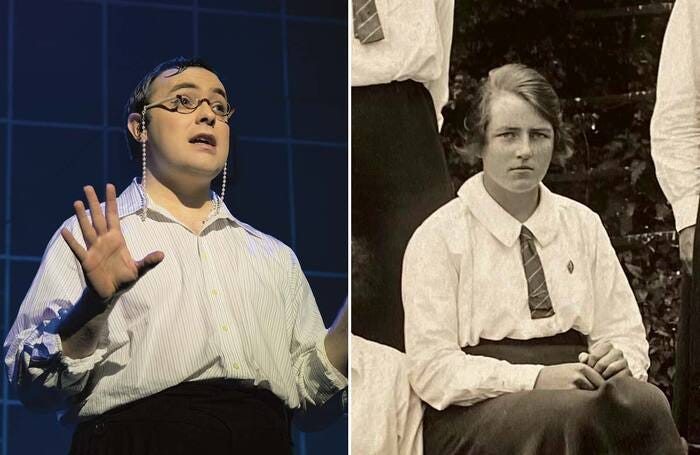
Another highlight is the depiction of trailblazing female operative Jean Leslie, played without sentimentality or self-importance by Claire-Marie Hall. She and, to a slightly lesser extent, Malone have a professional sheen to their musicality that the rest of the ensemble lacks; I suspect they're the only performers in the company who'd be hired for a West End musical that they didn't write and tailor to their own talents. (The book, music, and lyrics are all by the four-person musical comedy troupe SpitLip, three of whom comprise the remainder of Operation Mincemeat's cast.)
One last confession: while writing this review, I've noticed how frequently I've countered praise with qualifications…to the extent that I worry I haven't accurately conveyed just how much I enjoyed Operation Mincemeat. It was a joy to be surprised again and again—by the story itself, definitely, but also by the inventive ways in which it was told. (Ben Stones's ingenious set design was a key contributor to this experience and was wrongfully overlooked during awards season.) It felt uniquely special to move from so much silliness to unanticipated and thoughtful seriousness. As an evening of theatre that's more ambitious than it's being credited for, Operation Mincemeat may not win all of its battles, but it definitely wins the war.
the not-a-bottom line
🌈🌈🌈 (out of five)
a guide to ticket-buying
A couple of weeks before the Tonys, when I was trying to see the major awards contenders, I used the Theatr app to buy a ticket for Operation Mincemeat at 6 PM for a 7:30 PM Saturday night curtain.
I was right in the middle of Orchestra Center Row G, and I cannot imagine a more perfect seat.
The originally buyer paid $299 for the seat; I paid $155, including Theatr's service fees.
Because this is a smaller show with minimal choreography, I'd recommend being closer, even if it means sitting on the sides, than being farther back and center.
a key to the pictures
At this year's Tony Awards, the company's performance of "Born to Lead" was marred by horrible sound issues. Check out the same actors' rendition of it from last year's Olivier Awards.
I strongly recommend waiting to see Malone sing "Dear Bill" in context—outside of the story, it simply doesn’t have the same effect. If that's not an option, you can watch a studio version of it thanks to Broadway.com.
I saw it in London last year and adored it - but of the original cast, only Claire Marie-Hall remained, and I think that was to the show's advantage.