
A critwink* from the Intelligent Showmosexual
*In case you missed it, critwinks are smaller reviews turned out in a single draft.
CONTENT GUIDANCE: Pre-Existing Condition discusses domestic violence.
In A Director Prepares, one of the wisest books about theatre as a whole and not just directing, legendary director and academic Anne Bogart writes, “Inside every good play lives a question. A great play asks big questions that endure through time.”
It’s hard to imagine a bigger and more enduring question than this: How, after you’ve experienced a trauma, do you continue living without letting it define you?
That’s the question at the center of Marin Ireland’s gut-wrenching—and great—play Pre-Existing Condition, now playing at the Greenwich House Theater after a more skeletal iteration elsewhere in 2024. Ireland and director Maria Dizzia are both best known as actors, but Pre-Existing Condition suggests they may be destined for even greater triumphs behind-the-scenes. The dramatic tension that Ireland, Dizzia, and their pitch-perfect ensemble of actors are able to sustain for 80 minutes is a rare and remarkable feat.
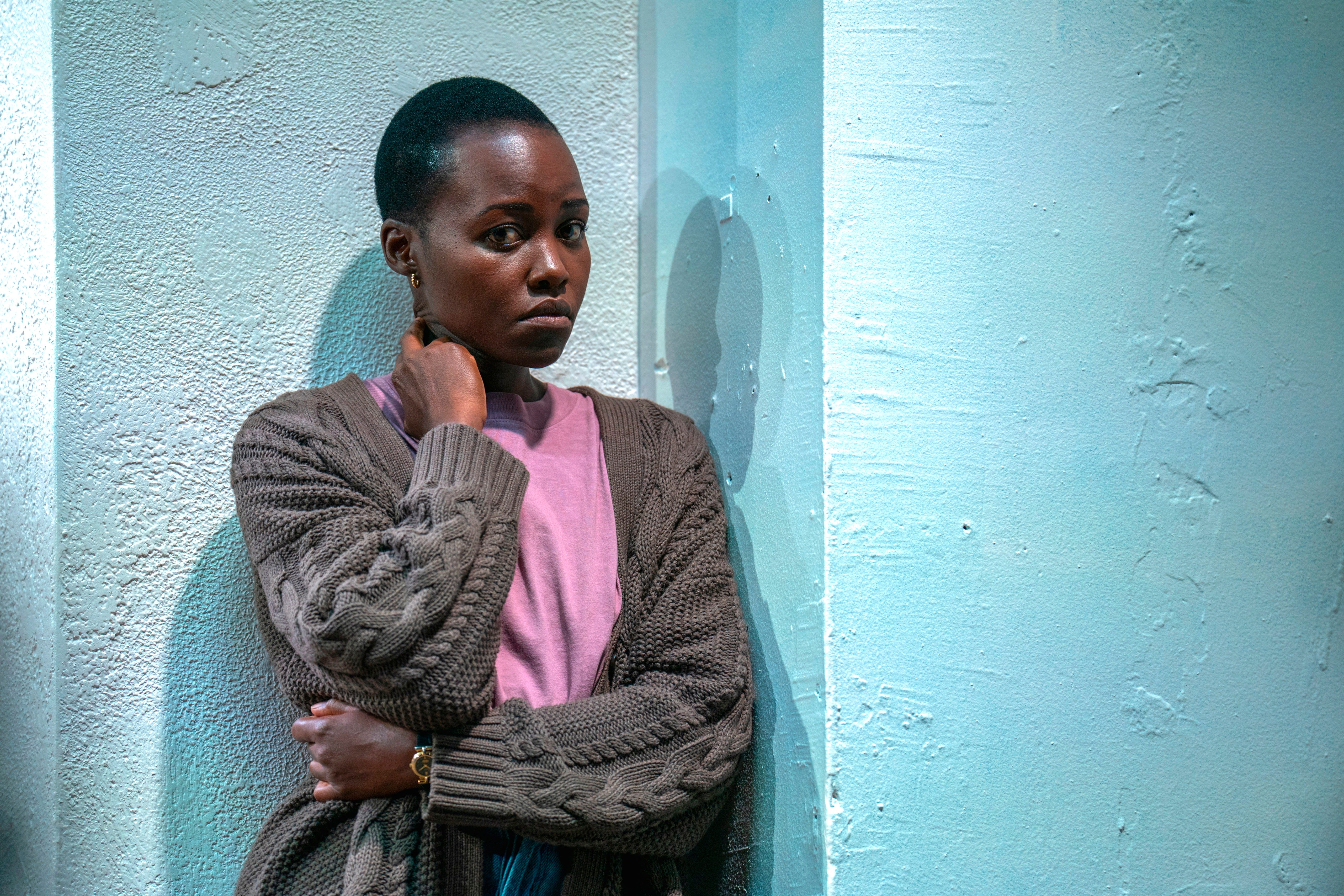
Pre-Existing Condition introduces us to “A,” played through Sept. 26 by Academy Award winner Lupita Nyong’o and then by a starry succession of actresses, like Phillipa Soo and Edie Falco, in similarly limited engagements. Seven months before the action begins, A’s boyfriend assaulted her. Now, having broken up, she “want[s] to move forward.” As she tells one counselor, “I don’t want the big task of my life now to be ‘dealing with this,’” but the more she tries to deal with it, the clearer it becomes that there is no clear way forward.
At first, the production seems unfussy and low-concept. Greg Keller, Dael Orlandersmith, and Sarah Steele step into a variety of roles as the friends, relatives, and professionals whom A encounters. Dizzia has expertly guided her entire cast in the seemingly simple but incredibly complex task of listening and responding to each other. I was repeatedly surprised by how refreshing it was to see people onstage who genuinely seem to be talking to one another.
Part of what makes Pre-Existing Condition so intelligent, though, is that Dizzia and Ireland are subtly and consistently destabilizing you. You’re dropped into the middle of scenes, sometimes before it’s obvious that the previous one has concluded. There are no costume changes, so you have to figure out if an actor is playing a character you’ve already met. The dialogue hints that you’re meeting one person in A’s life when it turns out to be another.
It would be trivializing to say the effect is that the audience ends up as on-edge as A, but it does heighten your identification with her. To further achieve that goal, Ireland has cleverly struck the balance between writing an everywoman and creating a character who’s specific enough to seem real. You can see yourself or someone you love in her, and yet she is not a blank slate. Interestingly, Nyong’o leads with a raw vulnerability that could not be more different than the cool compartmentalizing of Julia Chan, whom I saw as A in 2024, but both worked equally well.
Speaking of that previous incarnation, although I very much enjoyed it, I was relieved that this new version feels more fully produced. Certainly, it’s possible to be minimalistic and highly effective, but I’m also growing weary of bare-bones productions where the choice for sparsity is motivated by economics rather than creativity. More and more, we’re seeing producers try to pass off staged readings as fully realized theatre, and it’s not fair to audiences or artists.
The affect of “staged reading” was particularly pronounced in the 2024 iteration of Pre-Existing Condition because the actress playing A performed with script-in-hand. That production also used a rotation of stars in the part. Allowing performers to remain on-book may have been necessary to get them to sign on or compensate for brief rehearsal periods.
Nyong’o was fully off-book at the performance I attended. I hope her replacements will be as well. The absence of a script allowed me to surrender more fully to the reality of the world of the play. That being said, in the last moment of the previous staging, the script was used as a prop with strong symbolic meaning. It brought the action to a satisfying close that this otherwise superior production lacks. Fumbling one moment has disproportionate consequences when that moment is the final one.
It does not, however, change the fact that, for the preceding 79 minutes, Pre-Existing Condition successfully kept my stomach tied in knots. As Bogart writes, “We enact plays in order to remember relevant questions; we remember these questions in our bodies and the perceptions take place in real time and space.” I will not soon forget the questions Pre-Existing Condition asked, the reaction it triggered in my body, or the reality of its characters’ time and space.
the not-a-bottom line
🌈🌈🌈🌈½ (out of five)