
Continuing the plan I described in my last post, this week’s Substack contains two reviews. One might even call them a royal pair: Prince F*ggot, running off-Broadway at Studio Seaview, and The Queen of Versailles, running on Broadway at the St. James. One lived up to its pedigree; one was more dreck than royal flush. Read below and join the conversation to let me know your thoughts.
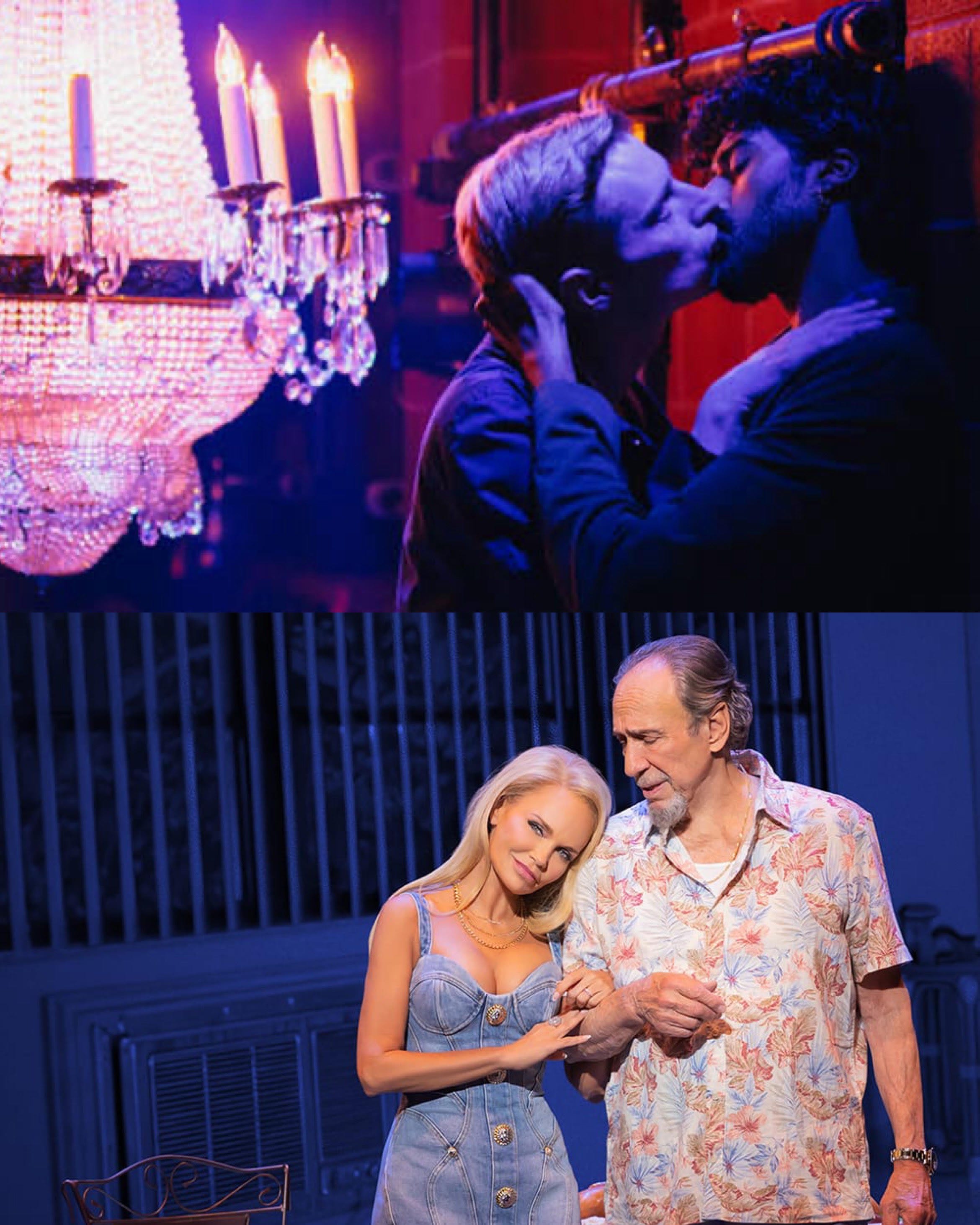
Prince F*ggot
When you see a lot of theatre, it’s rare that a play can surprise you. Even if you’re enjoying yourself at a solid production, you can usually form a pretty solid idea of where it’s going. To be clear, an unexpected turn doesn’t guarantee a compelling evening, and the long history of successful revivals reproducing original productions indicates that a compelling evening doesn’t necessarily require surprise.
Last June, when the provocatively titled Prince F*ggot debuted at Playwrights Horizons as a coproduction with Soho Rep, much of the talk around town about the piece focused on its explicitly staged sex scenes. And, yes, it contains some R or maybe even NC-17–rated sequences with gorgeous men. But when I finally got around to seeing it earlier this month at Studio Seaview (where it has transferred for a limited commercial run through December 13), what I found most exciting about Prince F*ggot was my inability to get out in front of the action—narratively, structurally, even tonally. Playwright Jordan Tannahill demonstrates an uncanny and thrilling ability to continually subvert our expectations; what may be even more impressive is that he does it in a way that feels organic.
The play takes its inspiration from the online uproar that ensued in 2017 when a photo captured then-four-year-old Prince George of England in a pose that many interpreted as…well…choose your euphemism: fey, effete, effeminate, flamboyant, etc. Tannahill uses a highly meta structure to make it clear that he’s envisioning a universe where there is a gay Prince George (John McCrea). Mercifully, though, this is not a play revolving around whether he should come out; rather, it’s the story of what happens when, after coming out to his loving and accepting parents, a Prince William (K. Todd Freeman) and a Princess Kate Middleton of Wales (Rachel Crowl), George brings home his boyfriend, a South Asian schoolmate from Oxford named Dev (Mihir Kumar), and their relationship must survive public scrutiny.
If that setup strikes you as the stuff of a twee rom-com, it sort of is…until it isn’t. Tannahill extends a small love story into an examination of what we owe our families and each other versus what we owe ourselves, while also drilling down from the supposed divine anointment of the world’s most famous monarchy to the value with which we endow ourselves. Great dramas tend either to use the individual to get to the universal, or the general to inform the specific. Here, Tannahill manages to do both. And, to the play’s further credit, it still works damn well as a rom-com (infinitely better, I might add, than the hackneyed but infuriatingly popular Red, White, & Royal Blue).
Along the way, it also explores fetish, race, trans representation, and a handful of other hot-button topics. Here, too, Tannahill achieves an incredibly impressive balance, addressing many elephants in the room without ever losing his focus, or, to mix metaphors, serving up enough food for thought that his audience is left neither hungry nor surfeited. Only his cursory treatment of addiction within gay sexual culture could be better handled; if the rumor mill is correct and a Broadway transfer is in the play’s future, I’d love to see him give this section of the play another look.
Of course, many of the play’s transitions between these weighty subjects, as well as its shifts between comedy and drama, work because of Shayok Misha Chowdhury’s expert direction. He seems equally adept at making cerebral discussions accessible, savoring sentiment without transforming it into treacle, and creating striking visuals with the aid of his first-rate design team.
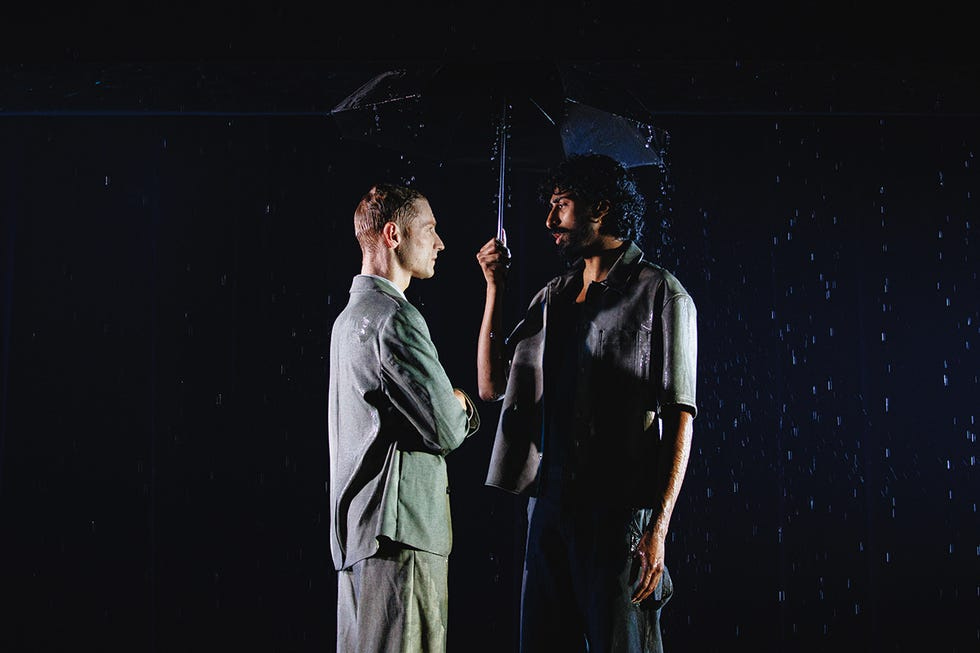
All the actors but McCrea—who is so unbelievably perfect in his extremely tricky role, it’s hard to imagine anyone else in it—play multiple parts and/or directly address the audience. With one important exception, the company is fantastic. Off-Broadway favorite David Greenspan gets some of the night’s biggest laughs as the royal press secretary, but just about breaks everyone’s hearts with a monologue about fisting. Crowl expertly combines Middleton’s poise and respect for the crown with great compassion and maternal warmth. N’yomi Allure Stewart, who spends much of the piece as a relatable Princess Charlotte, proves to be its secret weapon, its Benz in the garage, but I would spoil too much if I elaborated on why. And Freeman is so damn brilliant, I wish I could bring every acting student in the country to see him work. As we left, I turned to my friend Sally and said, “After Downstate, Airline Highway, and The Intelligent Homosexual’s Guide…, I think he’s my favorite actor. Him and Glenn Close. Glenn Close is the only actor working at K. Todd Freeman’s level.”
Only Kumar does not meet the high standards set by his castmates and collaborators. He is gorgeous—seriously, his is the kind of jaw-dropping beauty that opens countless doors in the entertainment industry—but excruciatingly mannered as an actor. One week after I first saw Prince F*ggot, I went back to see it again, not just because I loved it, but also because Kumar’s understudy, Keshav Moodliar, was scheduled to perform and I wanted to see how it changed the show. It was significantly better. Moodliar was able to listen and respond to the other actors with a humanity that Kumar lacked. Passages that felt stilted or contrived took on new life and resonance. Reservations I had about some of Tannahill’s more ideological writing were allayed. It was a great reminder of how a single person can change an entire system.
And that’s sort of what Prince F*ggot is about. Along with a lot of other things. The buzz is accurate. It’s sexy. For me, though, and I’d guess for a lot of people who don’t see theatre to get their jollies, what was even more titillating than any of the flesh on display was the experience of leaving a show that made me both think and tear up. All hail the Prince.
The Queen of Versailles
Kristin Chenoweth, the beloved Broadway diva who plays the title character in The Queen of Versailles, has often spoken about her deep Christian faith. And yet as I watched her new Broadway musical, which features a book by Lindsey Ferrentino and music and lyrics by Stephen Schwartz, I was reminded of what a different grande dame of the arts had to say about piety: Martha Graham famously stated, “The only sin is mediocrity.” If she was right, Chenoweth better start praying.
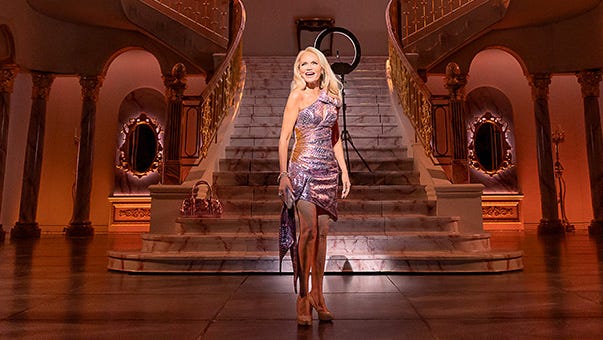
Versailles arrives on Broadway with a majestic pedigree that includes not only Chenoweth and Schwartz in their first collaboration since mega-hit Wicked, but also director Michael Arden, hot off his nearly back-to-back Tonys for Parade and Maybe Happy Ending, and Oscar-winning leading man F. Murray Abraham. Furthermore, it’s an adaptation of a much lauded documentary, which told the surprisingly riveting story of Jackie Siegel (Chenoweth), a beauty queen turned trophy wife who, with her timeshare mogul husband David (Abraham), was building the largest private residence in America, a supposed replica of the Palace of Versailles, when the 2008 financial crisis hit. It’s clear that the musical’s creators think their show has something profound to say about the income inequality and obsession with excess currently plaguing our country; unfortunately, it’s not clear what that message actually is.
The book expands the documentary’s focus to both Jackie’s humble beginnings, where she watches Lifestyles of the Rich and Famous and sings of her “Champagne Wishes and Caviar Dreams,” and the Siegels’ lives after the film turned them into media figures. Its muddled storytelling alternately celebrates and condemns Jackie’s ambitions. It asks us to root for her to complete her Versailles while also judging her for being materialistic. It doesn’t really invite us to hold seemingly contradictory truths about Jackie, which might have been interesting; instead, it waffles between perspectives on her character and priorities. Even worse, it’s boring. Although millions of dollars are on the line, and the plot literally involves life and death, it never feels like there’s much dramatic tension.
Schwartz’s largely forgettable score does little to raise the stakes. A particularly high-concept country-western number that tries to explain subprime mortgages is admirable in concept, but, like the entire show, it’s so mangled in execution, you wonder, “How did all these talented people allow this to happen?!?” Despite having been written for Chenoweth, too much of Schwartz’s music sits right in her passaggio. There’s one satisfying moment in an otherwise dreadful framing device that showcases her coloratura soprano (which is delightful to hear, but also far more about Kristin than Jackie), and a few more that allow her to comfortably belt. Too frequently, though, the music requires her to place her voice in the thinnest part of her mix.
Schwartz’s best song, an indictment of our obsession with beauty called “Pretty Wins,” goes to one of the musical’s more sympathetic characters, Jackie’s eldest daughter Victoria, who’s played with endearing earnestness by Nina White. She is, however, also (1) saddled with what may be the worst song of his career, a duet that plays the death of a family pet from neglect for laughs; and (2) ill served by Ferrentino’s book, which fails to adequately chart Victoria’s course to the evening’s most tragic development. Again, you’re left wondering how a musical built by so many masters of their craft could have gone so wrong.
Abraham is pretty much wasted. (He was far better, albeit more vocally tentative, in his only other Broadway musical, 1997’s short-lived Triumph of Love.) Chenoweth pushes herself more as an actress than she probably ever has before, which is commendable, but also exposes her limitations. This performance is further confirmation that, in the lineage of great Broadway divas, she is far more a descendant of a Carol Channing or Ethel Merman—stars who, much to their audiences’ delight, always played versions of themselves—than, say, a Donna Murphy, someone who can disappear into a role. Nevertheless, Chenoweth’s charisma and comic timing are unimpeachable. Even in the moments when she can’t quite rise to the demands the story makes of her as an actress, she remains thoroughly captivating.
An interesting thing about the three women I mentioned above: they all played the title character in Hello, Dolly! on Broadway. While promoting Versailles, Chenoweth has said that, throughout her career, people have asked her what her dream role is, regularly mentioning Dolly as a possibility. She would respond that her dream role hadn’t yet been written—until now…because the Queen of Versailles is her dream role. After seeing the show, I wish I could tell her to dream bigger.
the not-a-bottom line
Prince Faggot
🌈🌈🌈🌈 ½ (out of five)
The Queen of Versailles
🌈½ (out of five)
a guide to ticket-buying
Prince Faggot
The stage is wide and the house has a lot of depth. The acting is great. Try to sit near the center in the front half.
The first time I went, I bought two tickets in Row F via the Theatr app at a discounted price of $135 each. They were pretty perfect.
The second time I went, I was in the second row, just a little right of center. For the significantly lower price of $69 (seriously), it was well worth it. If you’re on a budget, I’d recommend a seat like this over one in the back.
The Queen of Versailles
With my TDF membership, I spent $63/ticket and ended up in row C of the front mezz, on the center aisle of the right section.
Unless you’re a HUGE Kristin Chenoweth fan, don’t spend more than that.
a key to the pictures
Prince Faggot
There’s not that much footage out there of the play, but an interesting Spectrum News story, which includes interviews with McCrea and Stewart, is posted to YouTube.
Not exactly a video clip, but if anyone knows John McCrea, can you Dolly Levi us?
The Queen of Versailles
On Kristin Chenoweth’s YouTube channel, you can find a video of her singing “Caviar Dreams” in its entirety during a concert.
Stephen Schwartz accompanies her.
I think you can see what I mean about the score sitting oddly in her voice despite its having been written for her.
The Queen of Versailles YouTube channel has lots of performance clips and promotional videos. You’re better off watching…
…the original documentary, which is streaming on lots of platforms, including several for free.
Thank you for the great reviews. I will go see Prince F*ggot asap. And yes, I agree. Ms Chenoweth is a very odd bird. She’s best at portraying a single-minded nsrcissist (like Glinda, like the ‘Charlie Brown’ character), bit she can’t pull off being a human being that we can identify with. Mary Martin, Julie Andrews, even the somewhat mannered Lupone, Peters, and Verdon exhibited sufficient vulnerability so you could identify w their characters. Not Chenoweth. It also may hurt her that her face is so pulled and stretched you can no longer feel her through her face.
She could probably pull off Dolly (but Dolly has to be really there for ‘Before the Parade Passes
By.’). I don’t know if there’s a role in the canon that fits her well. Maybe the arch Lili in “Kiss me Kate.’
When you compare Chenoweth with Judy Garland, it’s easy to see what’s missing.
But she is a delight, in her own performative way. I can see where they thought the venal Jackie in Versailles might’ve worked. Maybe she should play J Pierrpont Finch.