
Let’s just get this out of the way: I believe Proof is a perfect play.
I saw the enthralling original production multiple times, first with Tony winner Mary Louise Parker and then the late Anne Heche, who was somehow even better. In college, my classmates and I worked on literally every scene from it as part of an acting exercise where we dissected a script and then performed it modularly. I even included the Pulitzer and Tony winning play as part of my curriculum when I taught theatre in the New York City public school system, seeing firsthand how it invigorated teenagers who usually tried to appear apathetic.
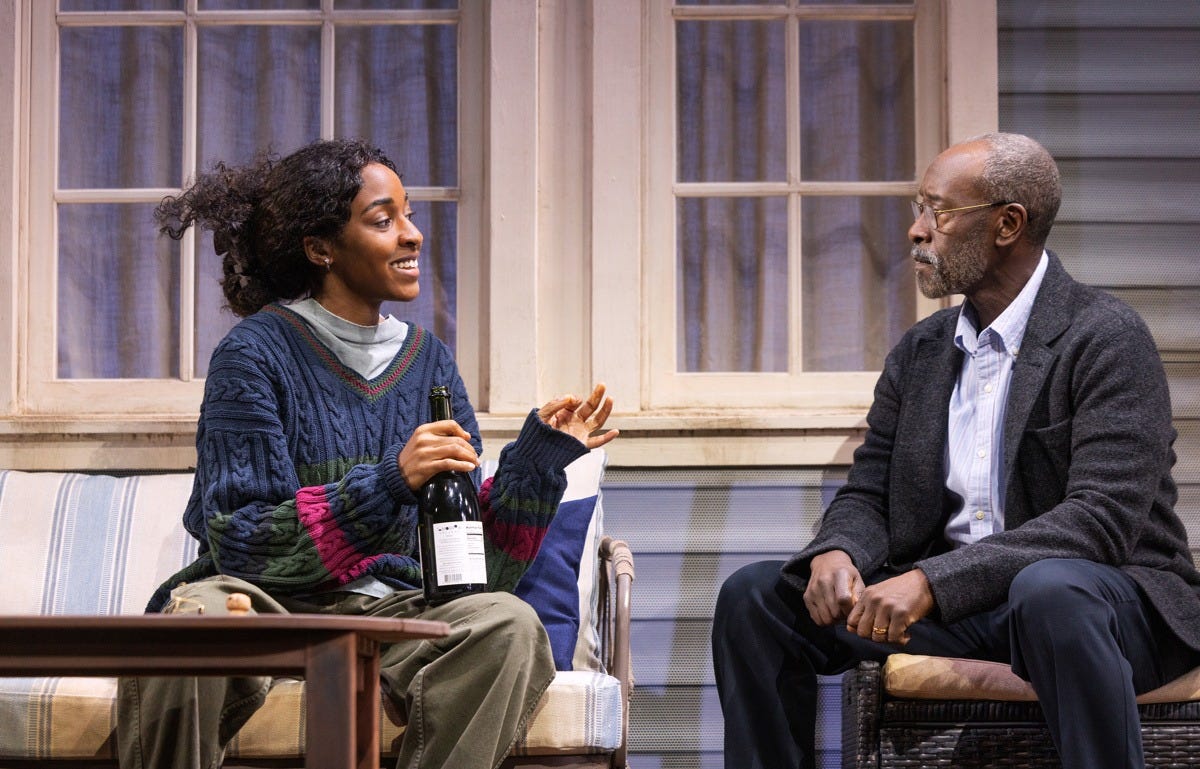
Undoubtedly, my expectations were influenced by that history as I walked into the Booth Theater, where it is receiving its first Broadway revival. They were further compounded by the pedigree of this production, which stars Emmy winner Ayo Edebiri as Catherine, a young woman questioning her own stability after years of caring for her mentally ill father, a renowned mathematician played by Oscar and 11 time Emmy nominee Don Cheadle; two time Tony winner Kara Young as her domineering sister Claire; and Grammy nominee Jin Ha as her suitor Hal—all overseen by Tony and Emmy winning director Thomas Kail. Even its incidental music, despite being…you know…incidental, is written by an Oscar and Emmy winner (Kris Bowers).
I did not, however, sit down with my arms crossed, silently demanding the production to prove it was worthy of the piece or my time. On the contrary, I very badly wanted the production to be good—and I was confident that if for some reason it wasn’t, I could still enjoy David Auburn’s flawless piece of playwriting.
The sum of all these variables? Well, to quote Catherine, “It works…But all I can see are the compromises, the approximations, places where it’s stitched together. It’s lumpy.”
There are two major problems with the production. Firstly, Kail demonstrates no discernible point-of-view on the material, other than, “Let’s have these actors—who also happen to be people of color—do Proof.” I couldn’t help but wonder if more might have come from this approach if the director had also been a person of color. It also would’ve been interesting to see what a woman could have illuminated in the piece, being that it’s fundamentally a woman’s story. I’ve heard rumors that there might be some directors out there who are women AND people of color.
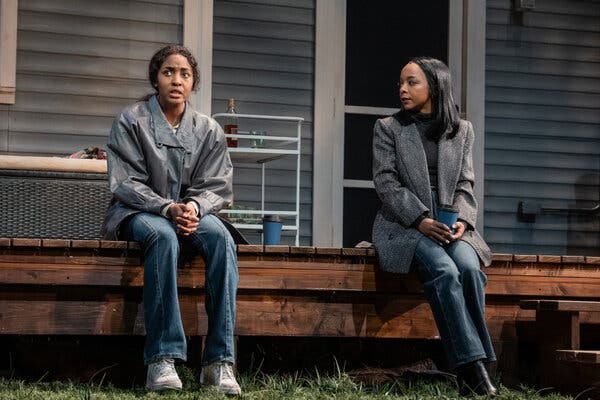
How might an artist whose experience overlaps more directly with Catherine’s have changed this iteration of Proof? We’ll never know. Instead, we get Kail’s unfussy and mild redux of Daniel Sullivan’s vastly superior staging of the original production. Kail doesn’t get in the way of the story, but he also doesn’t bring anything particularly exciting or different to it. In the rare instances when he does deviate from Sullivan’s blueprint, Kail’s choices still manage to feel recycled, as with Teresa L. Williams’s more abstract scenic design, which appears to be borrowed from a LORT B mounting of Next to Normal.
The second—and ultimately more damaging—problem with the revival is its uneven cast. In a play with only four characters, just one miscalculated performance can significantly subtract from its overall effectiveness. Sadly, this production has two of them.
Cheadle has been giving fantastic performances in film and television since I first became aware of him on The Golden Palace. (Yes, in 1992, he really was on the short-lived spinoff of The Golden Girls.) His work here is oddly tentative, presumably because it’s been 25 years since he was last on a New York stage. It’s as if he’s performing in fog: Cheadle proceeds with caution and the shape of his character can’t quite be made out, but there are occasional glimpses of the great talent we know him to be, mostly because he has solid chemistry with Edebiri.
I wish I could say the same of Ha, an actor whose momentum has somewhat surprised me. Ha has impressed me in more heightened vehicles like Here We Are, but in realistic settings, like Proof’s, he comes across as all technique and no humanity. The romantic sparks he was able to generate opposite Micaela Diamond in the dreamlike world of the former are completely absent from his interactions with Edebiri in the more ordinary world that Hal and Catherine inhabit. Worse, Ha never actually registers as a real person simply living his life as we happen to look in; instead, he always seems like an actor self-consciously reciting his lines and posing.
The artificiality of Ha’s performance is further accentuated by its juxtaposition with the throbbing honesty of Edebiri and Young’s. There’s a rawness to Edebiri that fits Catherine as beautifully as the black dress that Claire buys her. She nails her character’s spiky sense of humor without detracting from her vulnerability, which is written across her highly expressive face. Her arc doesn’t yet feel as dramatic as it should—perhaps an impossibility given that two of her three scene partners aren’t giving her much to work with—and a key moment in which Catherine shows frustration with herself feels a bit imposed, but it’s still an emotionally absorbing performance that elicits full investment in Catherine’s fate.
Finally, there’s Young, who turns the play’s most potentially thankless role into another remarkable entry in her streak of scene-stealers. As in Clyde’s, Cost of Living, Purlie Victorious, and Purpose, she demonstrates an uncanny ability to find laughs where no one else would think to look for them, but it speaks to her integrity as an actress that she never actually asks for them. She brings as much heart as humor to her role, anchoring Claire’s controlling behavior in compassion for Catherine. Young and Edebiri make the relationship between the sisters the most engrossing part of the play.
Is that enough to make Proof worth seeing? In combination with Auburn’s brilliant writing, I think so. After all, I laughed a lot. I even teared up. Nevertheless, it’s a shame that all the components of this revival don’t add up.
the not-a-bottom line
🌈🌈🌈 (out of five)
a guide to ticket-buying
A lot of action takes place on the far sides of the stage, so try to sit as close to center as possible.
Some of the juiciest scenes play out stage right/house left.