
Part III of a Pre-Tonys Ménage à Trois
Every year when Tony nominations are announced, it seems that a few omissions and losses sting the theatre community more than others. People frequently focus on actors, probably because they’re the most public-facing emissaries of a production. Some of the modern “snubs” that have triggered the loudest outcries include Aaron Tveit’s and Ann Harada’s for their respective performances in Next to Normal and Avenue Q. In certain circles, though, people—by which I mean gay men—are still lamenting Chita Rivera’s failure to get a nod all the way back in 1958 for originating Anita in West Side Story.
This year, however, the majority of theatre professionals with whom I spoke were not most upset by an actor’s exclusion; they were upset by the comparative lack of recognition for Real Women Have Curves (“Real Women”). An adaptation of Josefina López’s 1990 play and the 2002 HBO film that it inspired, the musical received nominations in two categories: Best Performance by an Actress in a Featured Role for Justina Machado, and Best Original Score Written for the Theatre, with both music and lyrics credited to Joy Huerta and Benjamin Velez. There was a lot of talk of its being a “feel good show” with a “big heart” that should have been a contender for Best Musical, especially over a jukebox musical like Buena Vista Social Club (though, arguably, whatever special consideration Real Women deserved for having an original score was honored by acknowledging Huerta and Velez’s work). Leading lady Tatianna Córdoba also had a considerable number of supporters, as did, albeit to a lesser extent, Sergio Trujillo’s choreography, and Lisa Loomer and Nell Benjamin’s book.
It's fair to say that this outpouring of affection, defensive as it may have been, raised my expectations when I went to see Real Women, which was after the Tony nominations had been announced but before the awards were actually distributed. They were also influenced by my distant familiarity with the movie, which I rented from my local Blockbuster when it was first released on home video. Did I recall its details? Absolutely not. However, I fondly remembered America Ferrera and Lupe Ontiveros’s perfectly pitched performances as Ana and Carmen Garcia, a first-generation Mexican-American teenager and her immigrant mother who are locked in intergenerational and cultural conflict while working at a family-owned dress factory. My memory was that Ferrera and the film itself shared a bittersweet duality, mixing optimism and melancholy.
The latter part of that combination is largely scrubbed from the adaptation, at least in terms of Ana’s story. This is the kind of aggressively cheerful, painted-in-broad-strokes musical that leads many to dismiss the genre as a serious art-form. It offers a tonal inversion of the film, shifting from a story about finding hope in the limiting circumstances that are often imposed on women and racial/ethnic minorities, to a story about challenges that cannot impede the inevitable success of an indomitably plucky spirit.
With lyrics like “Flying away, doing it all/if I can prove her wrong, maybe my dreams wouldn’t have to be small,” Ana’s “I want” song is so generic, it sounds like something AI churned out after being fed “The Wizard and I” from Wicked, “It Won’t Be Long Now” from In the Heights, and “Part of Your World” from The Little Mermaid. It didn’t help that Córdoba, while likeable and an assured singer, came across as a very green actress with more natural charm than gravitas. Her performance was more reminiscent of Marissa Jaret Winokur’s Tracy Turnblad than the three-dimensional teenager that Ferrera played.
When the musical does get serious, it’s not as directly about Ana as it is about immigration—an important and relevant subject that deserves substantive exploration. Unfortunately, it does not get it here. Despite being set in 1987, the action in Real Women unfolds with politics and plot developments that scream 2025. Essentially, Loomer and Benjamin cheated, ignoring the time in which their story takes place to try to speak to a contemporary crisis.
Their approach might have been justifiable if they had something insightful to say about that crisis; instead, their treatment of the topic plays out like torture porn, exploiting the brutality that migrants face to elicit a reaction from the audience. Worse, the desired response seems to be pity rather than empathy or a call to action. And yet even a subplot involving one factory worker’s deportation is forced to succumb to the adaptation’s unrelenting cheer as she nobly promises Ana that she’ll keep returning to America no matter how many times she’s deported. I couldn’t stop myself from thinking, “Girl, you deserve better…from a country and a storyline.”
Even with these detours, Real Women comes off less like the poignant dramedy that it was as a film and more like a twee and easy Hallmark movie. Accordingly, the musical works better when trafficking in that genre’s two most popular tropes—romance and female empowerment. Ana’s budding relationship with a boy at her newspaper internship (played at the performance I attended by the exceptional understudy Quincy Hampton) is hard not to root for and features some of the score’s most buoyant music. Loomer and Benjamin were wise to preserve the best line of dialogue from the film for the moment when they consummate their relationship, but Trujillo’s direction and Córdoba’s playing of it make Ana out to be some seductive, Samantha Jones-esque vamp rather than an insecure teenager taking a risk and making herself vulnerable.
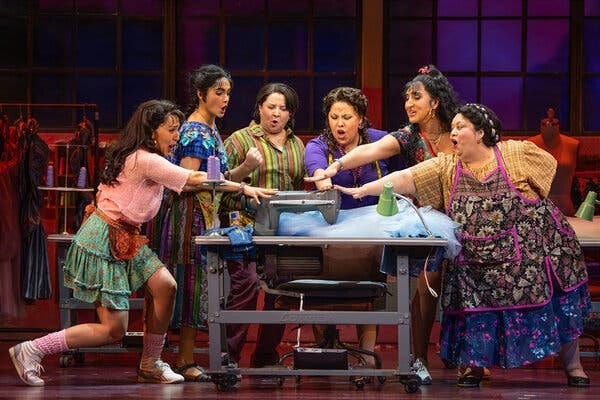
Real Women feels most truthful and most special when delving into the relationships between the women who work at the factory. Its infectious and genuinely empowering title song, during which the ladies combat both their insecurities and the heat in the factory by stripping down to their undergarments, is a bona fide showstopper. And it truly was a joy to see such a diversity of body types celebrated on a Broadway stage. In writing for the female ensemble, Huerta and Velez are at their most distinctive. They strike me as a promising team, especially as melodists, who didn’t have strong enough collaborators to push them to write sufficiently memorable and original material at this early point in their careers.
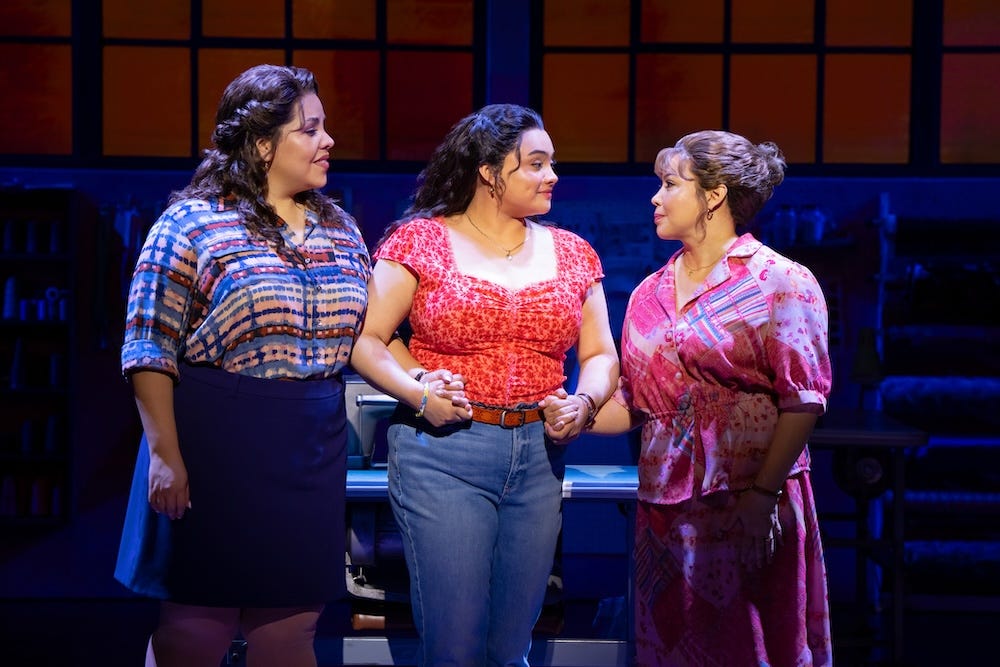
Ultimately, the individual who came off best in this newest iteration of Real Women was the lone actor who was also there for its earliest iteration: Justina Machado. Tony nominated for her performance as Carmen here (and, in my estimation, more deserving of the prize than eventual winner Natalie Venetia Belcon), Machado actually played Ana in the play’s 1993 world premiere. Perhaps her long history with the property allowed her to benefit from the theatrical equivalent of institutional knowledge: Machado’s characterization had a depth and groundedness that the other principals lacked. No aspect of the source material was more softened or simplified in the writing of the musical than Carmen, but Machado still managed to convey a rich and conflicted inner life. It’s a shame that the adaptation as a whole could not match her humanity and find more of the “real” in Real Women Have Curves.
the not-a-bottom line
🌈🌈½ (out of five)
a key to the pictures
The cast performed “Jugglin’” at the Tony Awards; a fan video is available, but the official video isn’t on YouTube (perhaps because it was marred by sound issues…but more realistically because Paramount Plus wants you to subscribe to their service to see it)
The cast performed a G-rated version of the title number on Good Morning America, but it too is marred by sound issues (and just doesn’t work as well without the women undressing)
The production’s “official music video” of “Flying Away,” which is basically just footage of Córdoba recording the original cast album
Theatermania posted rehearsal footage of the title song; “Already Know You,” a duet between Ana and her love interest (Mason Reeves); and “Make It Work”
An anal-retentive note from a former proofreader: the Broadway production of Real Women Have Curves closed on June 29; as a result, I have used the past tense to refer to its specific elements, which are no longer up and running, but the present tense to describe the musical itself, which continues to exist as a property and will undoubtedly be produced elsewhere.
Thanks for helping me picture myself in the audience, and for your insights. One of Globe/USD MFAs is in the show as ensemble, Christopher M Ramirez, and the dialect coach is a dear friend: Elisa Gonzales.