
Come and find me; hear my song…between reviews
I had planned to write a rather lengthy discussion of the Sunset Blvd. revival for my second post here, but was already running behind schedule ("You there! Why are you so late?") when the first reviews of Bill Condon's film adaptation of the Kiss of the Spider Woman ("KOTSW") musical started coming out of Sundance. Although it has since been corrected, in The Hollywood Reporter, David Rooney closed out the first paragraph of his critique by writing, "The show won six top Tony Awards and ran for just over a year, though critics and audiences were divided, and it's mostly considered a second-tier musical by the standards of Kander and Ebb, the celebrated team behind Cabaret and Chicago." And thus the rainbow lens through which I look at the world began to morph; I started seeing red. Small as the slight may seem, it felt indicative of the large disregard film and television insiders often demonstrate for the stage. Even some of his simplest facts were wrong…
While reviews are inherently subjective, time is decidedly objective, and it's a concrete fact that KOTSW ran well over two years, starting previews on April 19, 1993, and closing on July 1, 1995. It won Best Musical at the Tony Awards and Drama Desks. It spawned a year-and-a-half long tour, in which Broadway legend Chita Rivera recreated the performance that won her a second Tony, and then a non-Equity NETWorks tour. The duration of its run in New York is particularly significant as it marked the Broadway debut of Vanessa Williams. As Rivera's first replacement in the title role, Williams instantly legitimized herself as a theatre star. She garnered such acclaim that she not only managed to win a Theatre World Award (an honor typically bestowed only to actors who open productions), she actually got to preserve her performance on a new cast recording, an exceptionally rare feat for a replacement, especially when it's alongside the entire new company—as it thankfully was in Williams's case, because it also gave us a record of the sterling vocals that Howard McGillin and Brian at-that-time-no-Stokes Mitchell brought to their roles. Certainly, the accolades and commercial interest in producing a second CD speak to, if not a consensus, at least an overwhelmingly positive response from critics and audiences.
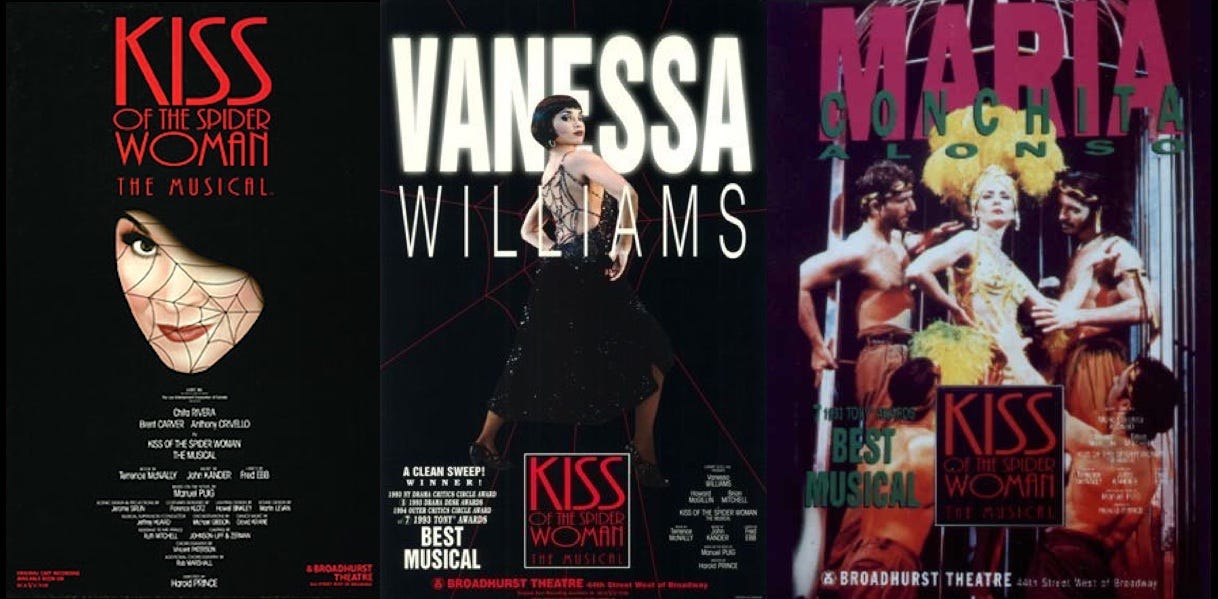
Trying to denigrate KOTSW by noting the superiority of Cabaret and Chicago is a bit of sophistry because the latter works are better than the vast majority of all musicals…and plays! In fact, I'd argue that Chicago is second only to Gypsy as the most perfectly written musical text we have. Regardless, I doubt any musical theatre aficionado would characterize KOTSW as a second-tier musical. Perhaps to make his point, Rooney omitted that, in addition to Best Musical, two of those "six top Tony Awards" were Best Book and Best Score, testaments to the strength of its writing. To see how tellingly those prizes can be split, look to the 2024 Tony Awards where The Outsiders won Best Musical, but both Book and Score went to Suffs.
Rather than characterizing KOTSW as the inferior progeny of Cabaret and Chicago, they should be seen as a special sort of triumvirate, groundbreaking both for (i) their structure and success as concept musicals and (ii) their exploration of topics that previously would have been seen as impossible or distasteful to musicalize. In math, we're taught that it takes three to make a pattern. KOTSW is the important third musical that establishes Kander and Ebb's pattern: a specialty for shrewdly using glitz, glamour, and all that jazz to inspire its audience to examine dark subject matter they might otherwise avoid.
But Rooney was not the sole target of my ire. As I read more reviews and features about the film, it became clear that Condon has jettisoned either all or most of the score's non-diegetic songs. In other words, the only pieces that he's retained are those from the musicals (or, now apparently, musical) within the musical. While frustrating, it shouldn't be a surprising revision given the public's ongoing discomfort with movie musicals—more on that soon—and Condon's own body-of-work. It's funny…there may be no single individual more responsible for the reinvigoration of the movie musical and simultaneously holding it back than Bill Condon. His credits in the subgenre symbolize how its recent evolution has involved two steps forward and one step back: Chicago (writer), Dreamgirls (writer and director), The Greatest Showman (writer), and Disney's live-action Beauty and the Beast (director).
On one hand, he's proven how musicals can still be critically acclaimed awards fodder and commercial blockbusters. On the other, he's normalized compromises that hurt the overall quality and integrity of movie musicals, such as the casting of non-singers in key musical roles, rewrites to focus projects on the roles of the biggest stars attached instead of the characters most central to the story, frenetic editing to disguise the limitations of actors cast more for their celebrity than their talent, and, maybe most damagingly, the avoidance of the device most integral to musicals: people bursting into song even when, within the reality of the narrative, they're not actually singing.
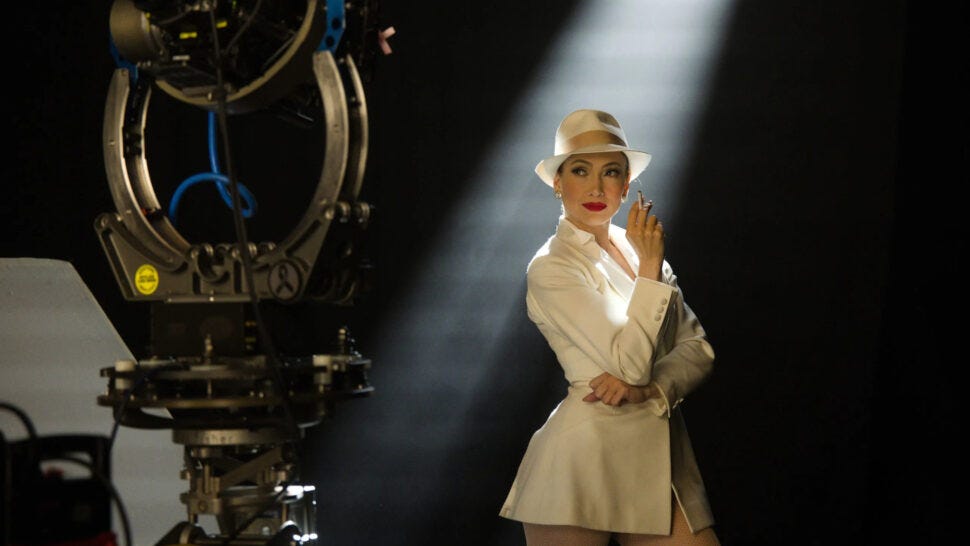
Don't get me wrong. In the film version of Chicago, placing the musical numbers in the imagination of its showbiz-obsessed, imprisoned leading lady was a stroke of brilliance (and very much seems inspired by KOTSW). But re-setting songs like "Family" and "And I'm Telling You" so they just happen to occur on stages in empty theaters, as if to dupe audiences into thinking they're watching a diegetic performance rather than a heightened reality—that's an act of dramaturgical cowardice. And, though it seems like some of the biggest non-diegetic songs from KOTSW may have found their way into film in new contexts, losing songs like "The Day After That," "You Could Never Shame Me," and "Mama, It's Me" feels like a disservice to the world Kander and Ebb so vividly created, the characters they so meticulously drew, and the themes they so bravely explored.
Some readers may think my frustration seems not only premature, but confusingly personal. To them, I say, it may be, and it is. Regarding the former, I desperately hope I'm wrong to be so skeptical of the changes Condon has made. There's actually a lot of good reason to be hopeful about his adaptation, from the early reviews to the way he and his Spider Woman, Jennifer Lopez, are discussing the property in the press. They genuinely seem to understand what makes it such a special musical. But I'm afraid they're tampering with something precious, or at least precious to me. I saw the matinee performance on KOTSW's closing day on Broadway. I promise I won't say this about every show I write about here, but, like Gypsy, it was life-changing. The depiction of its queer, diva-obsessed protagonist Molina was the first time I ever really saw myself represented in media. Sure, I had come across some effete male characters in film and television, but Molina wore his flamboyance like a badge-of-honor, not a punchline tattooed across his forehead in pink. Moreover, the way he spoke about Aurora, the performer he loved, made me realize I wasn't alone in what I would later discover is a common bond among gay men: deriving hope and strength from strong female performers who are central to our lives. To put it more succinctly, he taught me that there was such a thing as diva culture.
Most importantly, much to his and the audience's surprise, over the course of KOTSW, Molina transforms into a hero. I had absolutely never seen a big nelly queen save the day, which Molina does gloriously without sacrificing an iota of his flamboyance. Truthfully, despite nearly thirty years having passed and queer representation in the media having considerably increased, I'm not certain I've seen anything like that since. Molina's journey empowered me to believe I could be a hero without having to be anyone other than my fabulous, fey self.
Now, I hope you enjoyed that burst of positivity because I'm about to get kind of dark, maybe even vaguely paranoid, and sound like the love child of Seth Rudetsky and Camille Paglia.
Why is it that creators are so hesitant to let characters burst into song? Why are audiences so unwilling to accept it? Virtually no one seems to have a problem with Andrew Garfield scaling building as Spiderman, but equally few people showed up to see him in Tick, Tick Boom. Millions of moviegoers are perfectly fine believing that cars can fly and spin through the air without hurting their seemingly invincible drivers in the mystifyingly popular franchise of The Fast and the Furious, even though one of its stars died in an automobile accident in real life; furthermore, nearly everyone knows someone who's still seeing a chiropractor simply because they were rear-ended. There have literally been countless films that have been massive hits not just despite but because they are packed with incredulous stunts. When it comes to action and fantasy, directors and writers constantly make films without worrying if their viewers will go along for the ride, because, in fact, they usually do. Why is it different when it comes to singing and dancing?
(Please read these next three lines in the voice of Dana Carvey's "Church Lady" character from Saturday Night Live.)
Could it be…homophobia?
Could it be…misogyny?
Could it be…male fragility?
The general willingness of audiences to suspend disbelief in consuming action and violence, but resistance to do the same when it comes to singing and dancing, seems inseparable to me from their respective historically masculine and feminine connotations, and the value our society assigns to those qualities. It seems telling that three of the most profitable movie musicals of this century to rely on non-diegetic singing—Wicked, Mamma Mia, and Mean Girls—have distinctly female slants. I can't help but infer that part of the reason those movies were well attended, or even greenlit in the first place, is because folks felt comfortable with the idea of watching women engage in the "womanly" acts of song and dance…but they would be uncomfortable, or at least filmmakers suspect they would be, if they had to watch a bunch of men burst into song.
There's discomfort around watching men in musicals because there's still discomfort around, if not downright opposition to, men acting femininely. And why is that? Well, I could try to articulate it myself, but why bother when Madonna—one of the divas I've long adored with Molina-like idolatry—provided the perfect explanation, via a sample of Charlotte Gainsbourg's dialogue from the 1993 film The Cement Garden, as an introduction to her song "What It Feels Like for a Girl":
Girls can wear jeans
And cut their hair short
Wear shirts and boots
Cause it's okay to be a boy
But for a boy to look like a girl is degrading
'Cause you think being a girl is degrading.
The point here is that the profound homophobia in our country is rooted in its equally, or perhaps even more, profound misogyny. Mercifully, I'm going to wrap things up before I spin out entirely and start relating musical theatre scores to Kamala Harris and Hillary Clinton's presidential campaigns (though I wouldn't be the first to make the connection). However, I do want to be clear that I hope, and may even be cautiously optimistic, that the KOTSW film will be fantastic. Condon and his collaborators have compared the extent of his revisions to those that Fosse made in adapting Cabaret for the screen, which, sure, sounds like hubris, but is also a reasonable precedent for them to have kept in mind. Although they have not yet been brave enough to confront the perceived necessity for diegetic singing in movie musicals, they are still uniquely positioned to give us two things we desperately need.
More celebration of strong women.
More queer heroes.
a key to the pictures
Obviously, the film adaptation of the KOTSW musical has not yet received a wide release, but if the clips above whet your appetite, you might enjoy a decent quality slime tutorial of the original London cast—including Tony winners Chita Rivera, Brent Carver, and Anthony Crivello—on YouTube.
If you want more but need professionally shot video, you can also find the original press reel.
Last but not least, there is very little record of Broadway's last Spider Woman, Maria Conchita Alonso. She holds a special place in my heart because she's the leading lady I actually saw in the show. I recently came across this footage of her singing "Where You Are" at a Capitol Fourth broadcast on PBS. She doesn't have costumes or dancers, but it's particularly interesting to think that this appearance was likely booked as a promotional opportunity before the show posted its closing notice, but it was actually shot in the days immediately after the production shuttered.
Yes yes yes preach! 👏👏 Mysogony is how “gay” became a slur- because a society that upholds straight me thinks the worst thing men can be is effeminate, because they hate women! I haven’t see KOTSW since college so I’m really looking forward to the movie! Even though the clips of JLo singing it live… 😬
But... The Rink. ;)