
A critwink* from the Intelligent Showmosexual
In case you missed it, critwinks are smaller reviews turned out in a single draft.
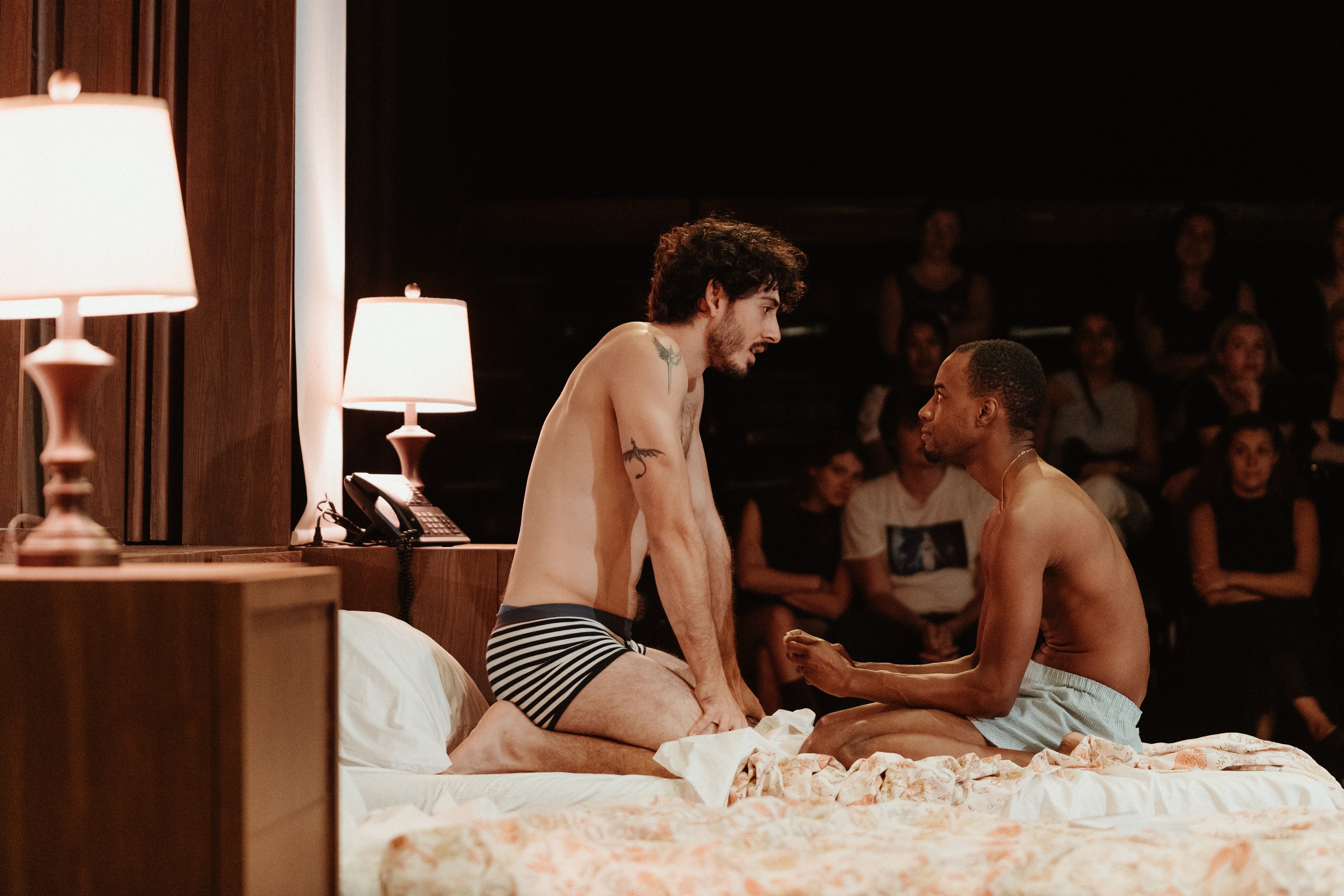
I have to admire John Donnelly's chutzpah for titling his play about queer identity and queer anxiety in professional sports The Pass. The moniker has multiple (fairly obvious) meanings, but it also makes the piece an easy target for snark: “Should you see The Pass? The answer is right in the title.” “Pass is exactly what you should do on The Pass.” “Whenever an opportunity arises to say something meaningful, Donnelly chooses to pass.” You get the idea.
Perhaps the play felt more original and insightful when it premiered in London in January 2014. Nine months earlier, Jason Collins had come out in Sports Illustrated, becoming the first openly gay player in America’s major leagues. Less than two weeks before The Pass began performances, Thomas Hitzlsperger, a veteran of three of England’s highest-profile football clubs, publicly came out as gay. The following month, rising NFL prospect Michael Sam announced that he was gay, which many believe downgraded his placement in the subsequent draft.
Opening in such a climate must have endowed The Pass with an exciting “ripped from the headlines” topicality it now lacks, although there is still extensive work to be done to address homophobia and queer representation in sports, especially men’s sports. The original production also featured direction from the frequently visionary John Tiffany (Once, Harry Potter and the Cursed Child, Broadway’s haunting 2014 revival of The Glass Menagerie) and a reported tour-de-force from Russell Tovey, who repeated his performance in a 2016 film adaptation. Now that The Pass is making its New York debut at La MaMa—but without the same social context, director, or star—it seems that the magical combination of those factors did more work than the play itself in generating strong reviews and sufficient interest to spawn a film version.
Max Hunter’s slick off-Broadway production is not bad; it’s just not good enough to camouflage the fundamental flaws in Donnelly’s writing. The Pass follows footballer Jason (Tovey’s role, here played by Matisse Ratron-Neal) from the rookie season he plays with fellow newbie Ade (Terry Bell) on to stardom. Over the course of several years, we see how Jason’s celebrity colors his initially casual relationships with everyone from a “table dancer” (Ino Badanjak) to his hotel’s bellhop (Oliver Rowland-Jones) and, inevitably, his reckoning with Ade.
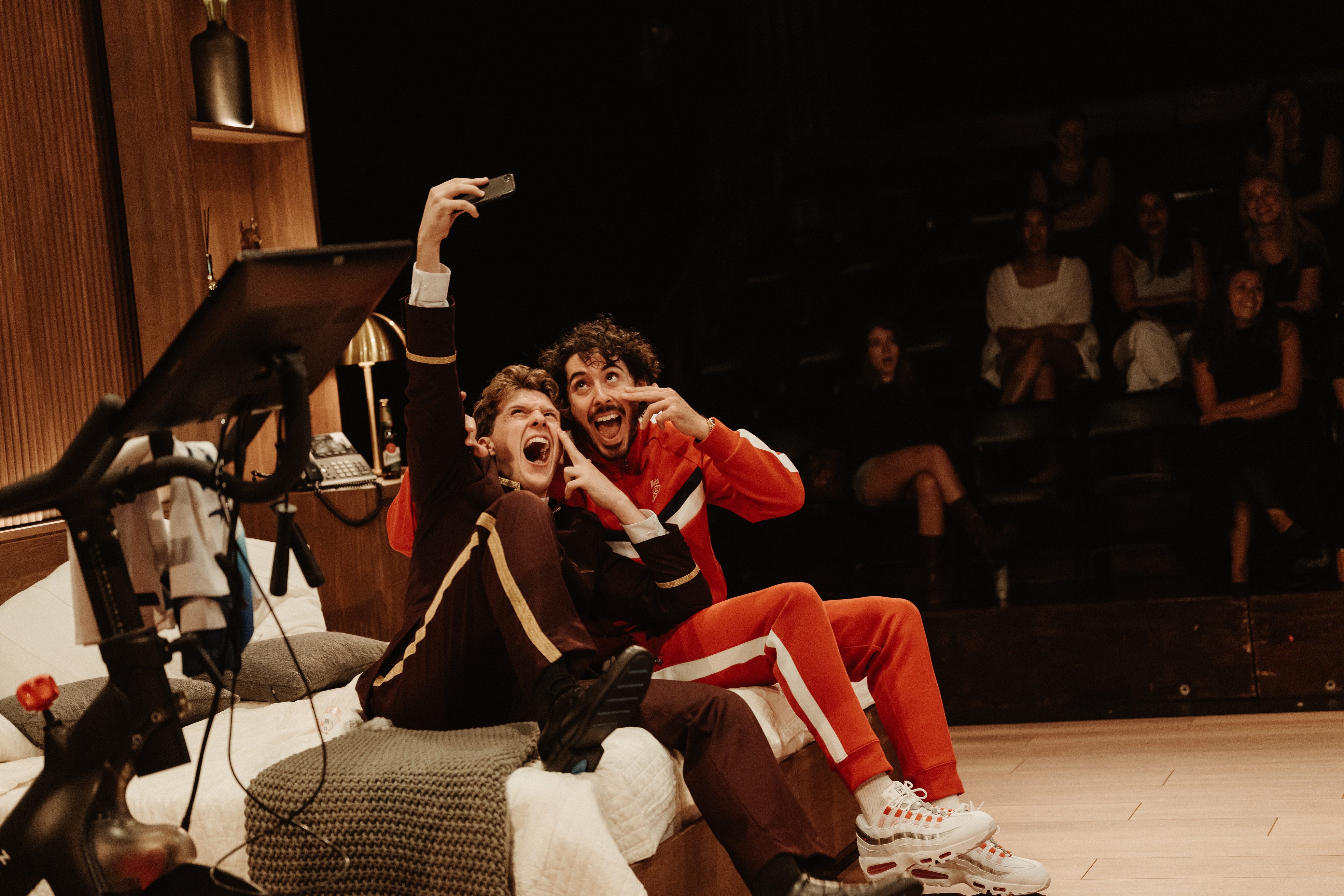
This is a drama that prioritizes character and theme over plot—again, not necessarily a bad thing, but a problem here because the characters are all familiar types (e.g., the harlot who reveals “unexpected” depth as she reveals more and more of her body), and Donnelly doesn’t actually have anything new or profound to say about fame or the closet. Each scene is structured to build to one or two “twists,” most of which the audience can see coming from a football field away. What I could not predict was that after nearly two repetitive hours of kitchen hotel–sink realism, the play, or at least this production, would culminate in a frustratingly abstract ending.
Ultimately, The Pass is a vehicle that doesn’t feel worthy of the clear talents possessed by its cast, Hunter, or his design team. In fact, Seth Byrum’s delightfully versatile set hides more surprises than the actual script. Ratron-Neal is charismatic and compelling, albeit a tad too green to make full sense of his character’s changing agenda. Badanjak breathes life into the stereotype she has to play with choices that are both believable and interesting, while Rowland-Jones finds laughs in the stereotype he has to play by acting with the utmost sincerity. Unfortunately, the miscast Bell does not rise to their levels: as Ade, he appears too slight to be a professional athlete, too detached from Jason to justify his choices, and too effortful to ground his most emotional moments.
In Bell’s defense, he is also hamstrung by some of Donnelly’s most forced and occasionally downright illogical writing. It’s easy to imagine that, back in 2014, these and other problems in the script felt insignificant compared to the creativity of an auteur director, an electric performance from a bona fide star, and urgent cultural relevance…none of which the current production can fully reproduce. So maybe Donnelly’s choice of title wasn’t chutzpah as much as it was hubris. Either way, if you’re presented with an opportunity to see The Pass, you know what to do.
the not-a-bottom line
🌈🌈 (out of five)
a guide to ticket-buying
Hunter uses a traverse configuration of LaMaMa’s Ellen Stewart Theatre, meaning the playing space is like a runway with audiences seated on both of the long sides.
Choose odd-numbered seats if you want:
Better views of Ratron-Neal’s partial nude scene (the play may only get two rainbows, but I’d give his tuchus five); and/or
A more direct route to the exit, so if you decide to leave during the show, you won’t have to navigate a curtained-off, semi-backstage area, as one woman did at the performance I attended.