
There is voluminous analysis as to why The Rocky Horror Picture Show has become the quintessential cult classic, like this HuffPost article and the documentary Strange Journey: The Story of Rocky Horror,1 both of which were released last fall in conjunction with the film’s 50th anniversary. One theory that appears in every think piece I’ve seen ties the movie’s popularity to an empowering hook in one of its final songs: “Don’t dream it, be it.” These five repeated words encapsulate the musical’s enduring appeal and its message. And to be sure you don’t somehow miss them in Roundabout Theatre Company’s current Broadway revival of the stage show on which the film was based, director Sam Pinkleton spells them out for you—literally spells them out…in a neon sign that descends as they’re sung.
The disappointing obviousness of that choice epitomizes the general lack of inventiveness that prevents the production from truly taking us on the strange journey it promises. Its overall blandness is doubly surprising because it’s not a quality one associates with Rocky Horror or Pinkleton. Over the last decade, he has led some of the boldest and most memorable productions in New York: as choreographer, Natasha, Pierre and the Great Comet of 1812, Soft Power, and Here We Are; and, as director, You Will Get Sick, ta-da!, Can I Be Frank? (which is being remounted at Soho Playhouse through Pride and you should ABSOLUTELY go see), and a little play you may have heard about called Oh, Mary!. Pinkleton’s work here feels so uncharacteristically safe, I found myself wondering if Roundabout somehow demanded restraint out of concern for their older subscriber base.
The members of Rocky Horror’s ensemble are referred to as “Phantoms,” and it would be unfair to Pinkleton and his company not to acknowledge that they are being haunted by some mighty phantoms of their own. The musical, a sendup of horror and sci-fi B–movies from the early to mid-20th century, chronicles the misadventures of newly engaged, virtuous and virginal Brad and Janet as they stumble upon the castle of Dr. Frank-N-Furter, a libidinous mad scientist and self-professed “sweet transvestite,” on the night his adonis-like version of Frankenstein’s monster, Rocky, is brought to life. The film is anchored by an indelible performance from Tim Curry, who is seductive, menacing, and perfectly camp as “Frank.” It’s made even more vibrant by the performances of Susan Sarandon, young and glowing with stardust as Janet; Barry Bostwick, a couple of years after originating Danny Zuko in Grease and still teeming with sexual charisma under Brad’s buttoned-up shirt; the equally beautiful and guileless Peter Hinwood as Rocky; and, in a variety of supporting roles, real-life rocker Meat Loaf and the delightfully eccentric original cast members Patricia Quinn, “Little” Nell Campbell, and Richard O’Brien, who also happens to be Rocky Horror’s composer, lyricist, and librettist. Each of their specters hovers over every production of the musical.
Which is not to say they can’t be exorcised. A sensational Broadway revival, respectively directed and choreographed with subversive glee by Christopher Ashley and Jerry Mitchell, opened in 2000.2 It featured a phenomenal cast who had no problem making the material their own: Tom Hewitt, spellbinding as Frank; Alice Ripley and Jarrod Emmick, perfect as Brad and Janet; Raúl Esparza, exploding with charisma and deploying daredevil vocals as butler Riff-Raff (O’Brien’s role); Daphne Rubin-Vega, effortlessly cool and strange as maid Magenta (Quinn’s role); Sebastian LaCause, hilarious and sex incarnate as Rocky; real-life rocker Joan Jett as minion Columbia (Campbell’s role); Lea DeLaria, gender-bending as Eddie (Meatloaf’s role); and Dick Cavett, as dry and elegant as the best Burgundian Pinot Noir in the role of the show’s narrator. Their collective success makes the job of the current cast even harder. This new group not only has to compete with memories of performers from the movie, they also can’t claim that living up to those memories is impossible when the first Broadway revival’s cast did so brilliantly.
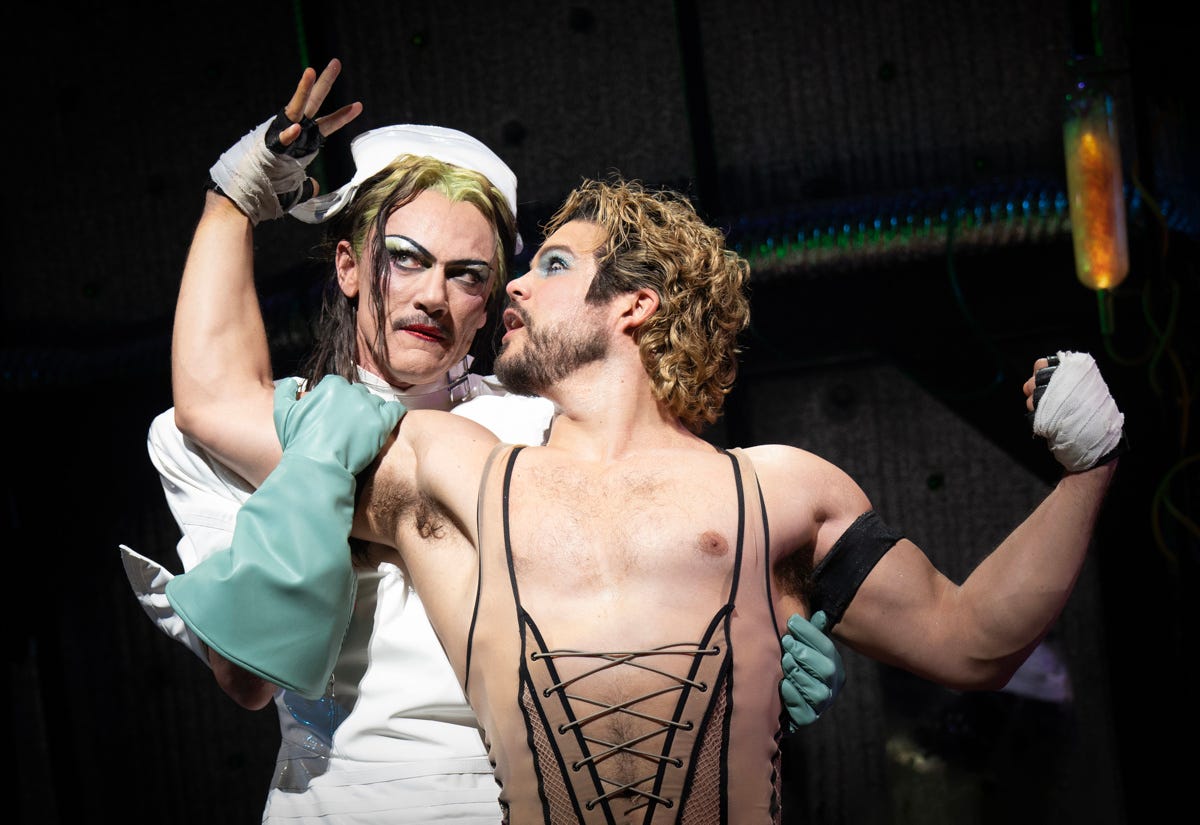
Ironically, the actor who comes off the best is the one with the highest heels to fill. Making his Broadway debut, Luke Evans is an electrifying Frank. He doesn’t resist borrowing from Curry, but he is nevertheless magnetic, threatening, sexy, and very funny—everything you want a Frank to be. The revival’s other MVQ3 represents the opposite approach. Playing the Narrator, Rachel Dratch is inspired casting and a clear departure from her predecessors in the role. Her expertise as an improviser uniquely qualifies her to banter with the audience during the callouts that have become a regular part of the Rocky Horror experience, even though the production’s stance on such participation is unhelpfully ambiguous. Moreover, Dratch is a wily comedienne who can adroitly gauge just how much to wink at the audience.
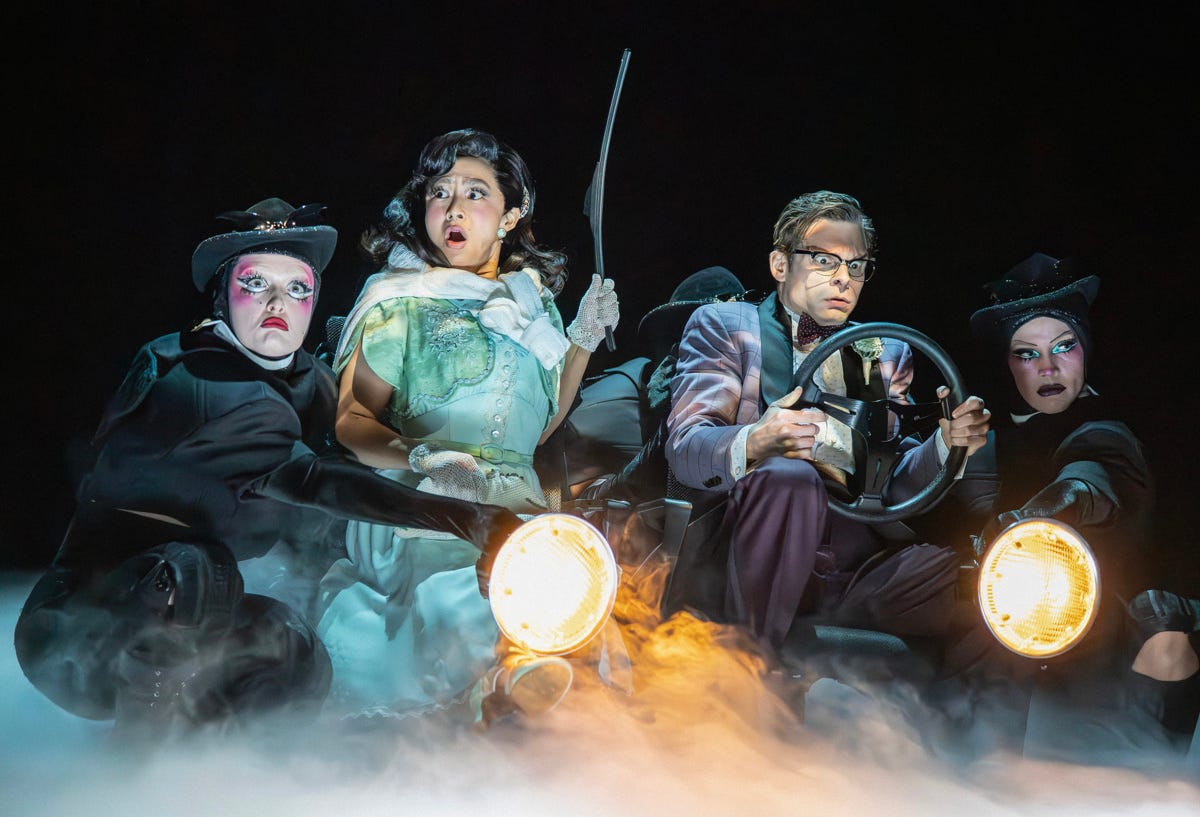
Stephanie Hsu, on the other hand, is far too “in on the joke” as Janet, depriving the character of an arc by being far too salty, far too soon. As Brad, Andrew Durand is about as lively as he was playing the title character in last season’s Dead Outlaw. Amber Gray and Michaela Jaé Rodriguez appear to have wandered in from an off-season “Spirit of Halloween” store, while Juliette Lewis (yes, that Juliette Lewis) is a puzzling Magenta, seemingly determined to make every choice as un-theatrical as possible. Plus, she can’t really sing. Harvey Guillén, who plays Eddie, was absent from the performance I attended, but Josh Rivera was a terrific Rocky, showing off a wackadoo comedic sensibility that he hasn’t been able to unleash with characters like Chino in Steven Spielberg’s West Side Story and Aaron Hernandez in Ryan Murphy’s American Sports Story.
The unevenness of the cast reflects the inconsistencies of the revival as a whole. Much of it, especially David I. Reynoso’s costumes, confuses ugly with edgy. Pinkleton weaves in a few directorial flourishes, like an adorable bit in the prologue and an uproariously racy moment between Frank and Brad, that recall the singular vision he has brought to his other work. In general, though, it’s not clear what he wanted to say or reveal in Rocky Horror. It also feels like a missed opportunity—one that might have created a more integrated point-of-view on the material—for him not to have handled the choreography, which was delegated instead to Ani Taj and feels underwhelming and unfocused.
The production being staged in Studio 54 is undoubtedly supposed to infuse it with the spirit of decadence and hedonism synonymous with the legendary site’s history. Sadly, this Rocky Horror does not effectively launch a time warp. It’s too safe. It lacks danger. It presents transgression without actually transgressing itself. In other words, it fails to take its own advice: “Don’t dream it, be it.” Still, thanks in large part to Evans, Dratch, and Rocky Horror’s beloved score of bangers, it’s not altogether a time wash either.
the not-a-bottom line
🌈🌈½ (out of five)
a guide to ticket-buying
The production is selling very well. After several failed attempts to score a cheaper ticket with TodayTix’s digital lottery, I succumbed to buying a slightly discounted ticket on the app: $211 (with fees) for front mezz. center.
Ideally, sit in the orchestra, but not under the mezzanine overhang. Then, opt for front mezz. Don’t do rear mezz at Studio 54, and if you sit in the orchestra under the overhang, you’ll miss that adorable bit I mentioned.
a key to the pictures
In chronological order…
The Rocky Horror Picture Show (the 1975 film) is available to stream with a subscription to BroadwayHD. It is also available to rent or buy through Amazon Video, Apple TV, and Fandango at Home.
Performances from the 2000 revival:
Slime tutorial of Daphne Rubin-Vega and Joan Jett performing “Science Fiction Double Feature”
“Time Warp” at the Tony Awards (with poor audio) and “Time Warp” on The Rosie O’Donnell Show (with poor video)
Avoid Kenny Ortega’s dull 2016 remake with Laverne Cox as Frank.
Performances from the current revival:
Luke Evans and company perform “Sweet Transvestite” on The Tonight Show
The cast performs “Time Warp” on Good Morning America
The documentary was directed by Linus O’Brien, son of Rocky Horror creator Richard O’Brien.
The revival yielded one of my all-time favorite cast recordings; if you’re a fan of the Rocky Horror score, I highly recommend checking it out.
IFYKYK
This seems to be redolent of the dull Kenny Ortega tv version, I recall Tweeting that if your Rocky Horror Show is tame enough to have Disney as one its advertisers, it has already failed.