
A critwink from the Intelligent Showmosexual
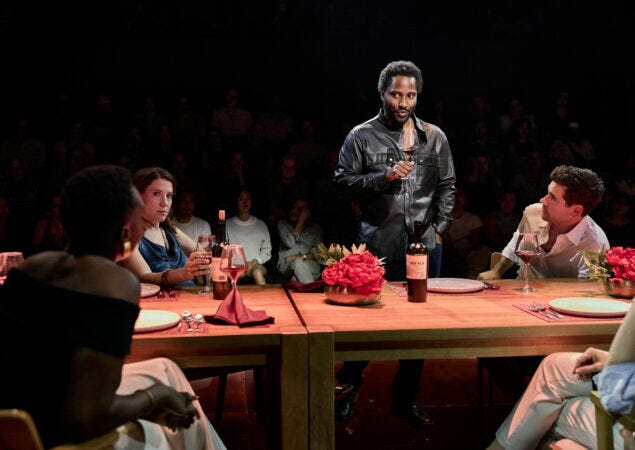
A play that premiered in London to fairly positive reviews a few years ago—at which point it may have felt somewhat prescient—is now receiving its off-Broadway debut with a cast, design team, and director who all deserve far better. And, no, I am not posting a second review of The Pass, though everything I’ve described could easily apply to it. I’m referring to Andrew Stein’s facile technology thriller (is it a thriller?) Disruption, playing at the Pershing Square Signature Center through October 4.
The disappointing similarity in the experience of watching these plays is what one character in Disruption might call a “curated coincidence.” It’s understandable why producers and directors seeking a hot property would look across the pond for ideas. It’s equally apparent why they’d be excited about plays exploring hot-button topics like homophobia among professional athletes, in the case of The Pass, or artificial intelligence, in the case of Disruption. What I find hard to fathom is that anyone would read either of these predictable and vacuous plays and, regardless of their commercial viability, deem them worthy of their creative energies.
Disruption tells the story of somewhat suave, somewhat smarmy tech bro Nick (John David Washington) who is preparing to launch his next big startup: an algorithm designed by his brilliant partner, Silicon Valley siren Raven (Emma Kikue), that works like “Waze…but for [someone’s] life.” Out of the generosity of his heart, or perhaps a more sinister need for capital because he’s not as successful as his reputation suggests, Nick offers his friends from college the opportunity to invest. That includes an altruistic surgeon (Jason Ralph) and his wife (Irene Sofia Lucio), whose personality consists of a strong libido, a desire to buy a brownstone in Brooklyn, and an inferiority complex about her overachieving sister; the sister herself (Elizabeth Stanley), who’s growing weary of having to be the grownup to her sleepless-in-the-suburbs husband (Joe Tippett); and a sensible-but-secretive professor (Conrad Ricamora) and his skeptical Cassandra of a wife (Shaunette Renée Wilson). Unbeknownst to all the couples, Nick and Raven—whose names show how gracelessly Stein handles symbolism—have been digitally spying on them for reasons that are best described as muddled.
When Stein tries for humor, the play feels like a second-rate multi-cam sitcom (think ‘Til Death) with endless jokes about shrewish wives and juvenile husbands. When he tries to get serious, it feels like a Shondaland series that Netflix rushed into production to capitalize on everyone’s fears about AI. In other words, every punchline and, worse, every observation about technology—in a play that is supposed to have something to say about technology—feels not only repackaged but basic, as if the script had actually been written by an AI program…that’s still in beta.
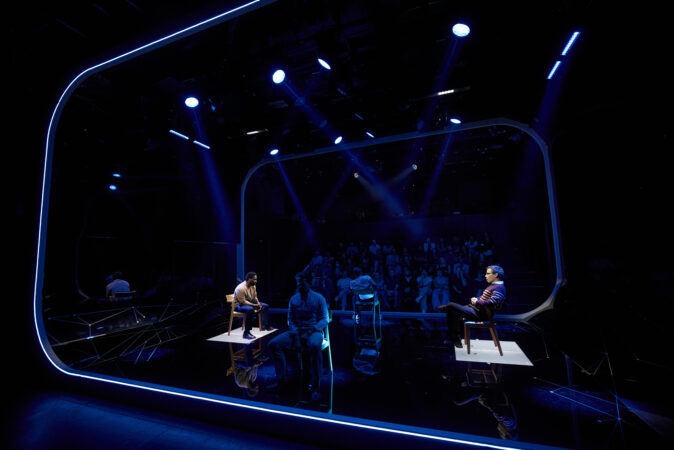
While the writing is stale and soulless, at least the production is sleek and stylish. Director Hersh Ellis clearly knows how to integrate a vision across his design team and cast. Zoë Hurwitz’s literally and figuratively glossy scenic design is arranged in a traverse configuration (another similarity with The Pass) that positions the audience to watch each other like reflections in a screen, quickly establishing the evening’s tone and bluntness. The set is often covered in Yana Biryukova’s eye-popping projections, which grow less effective with overuse. Hurwitz and Biryukova’s contributions are well complemented by Reza Behjat’s chilly lighting design. Ellis sustains the vibe they create by having the cast perform highly choreographed scene transitions, which often generate more tension than the text.
The large ensemble’s commitment to these interstitials exemplifies how often the actors elevate the material. Stanley and the irresistibly likable Tippett are so good that they somehow manage to make the walking clichés they play relatable and human. It’s particularly impressive how Stanley differentiates the supermom she plays here from the supermom she played in Jagged Little Pill, an important contrast since the latter character was…you know…a drug addict. During the play’s only emotionally stirring scene, a moment of connection between the sisters, she also brings out the best in Lucio, who elsewhere pitches everything on the same note.
Wilson gets to show off her excellent comic timing, but neither she nor the otherwise compelling Kikue can convincingly sell illogical changes of heart imposed on them by some “plot twists.” After his suitably gonzo turn in Oh, Mary!, Ricamora wisely reminds us of his range with a beautifully grounded performance. In the flashiest role, Washington mostly coasts on his (admittedly significant) charisma. However, it is Ralph who emerges as the production’s real find—the operative word being real because he’s so believable, he never appears to be acting.
Well, almost never. He and Washington gamely execute some painfully contrived blocking involving a football. Alas, despite all the talent involved, in this play, “painfully contrived” is the status quo and not a disruption.
the not-a-bottom line
🌈🌈½ (out of five)
a guide to ticket-buying
Tickets for Disruption are surprisingly expensive, but $48 rush tickets are sold on the TodayTix app.
a key to the pictures
I suspect Stanley signed on to Disruption to show that she can do more than musicals, which is absolutely true. However, her career in musicals has included some shining moments that are worth sharing.
At the height of the pandemic, some of Broadway’s best recorded performances in quarantine for Take Me to the World: A Sondheim 90th Birthday Celebration. From what appears to be her own home, Stanley delivered what may be my favorite rendition of “The Miller’s Son” from A Little Night Music.
The highlight of Stanley’s Tony-nominated turn in Jagged Little Pill was “Uninvited” where her exquisite singing was matched by Sidi Larbi Cherkaoui’s exquisite choreography, which was exquisitely danced by Annelise Baker.
Here’s Stanley headlining the first national tour of Xanadu with such sublime ridiculousness, I barely looked at Max von Essen in those short shorts.
OMG, has this turned into a love letter to Elizabeth Stanley?! Am I straight for Elizabeth Stanley?! Does there have to be a third thing?!? Yes, no, and yes.
I am SEATED for Elizabeth Stanley appreciation.