
Scroll past the second photo to skip to the song selections!
I’ve been temporarily sidelined from my regular schedule of theatergoing as I recover from surgery—the details of which aren’t important, but you should know that a doctor recently told me that I have “a very tight esophagus,” which will definitely be going on my Hinge profile.
This brief intermission between reviews struck me as the ideal opportunity to continue my ongoing thought experiment imagining the nominees and winners if there were a Tony Award for Best Song. In my last post for this series, covering the Broadway musicals of 2003-2013, I mentioned the importance of establishing criteria for what constitutes the best song. (“Is it the catchiest tune? The most memorable lyrics? The song that would work best out of context? The song that best deepens a character or drives the action? Or maybe the song that checks the most of these boxes?”) While looking at the Broadway musicals of 1992-2002, the need for such criteria was again clear, but I was also struck by how many full or small–ensemble numbers seemed worthy of consideration.
Comparing a song written for multiple voices to a song written for a soloist presents its own set of challenges. Do composers get extra “points” for the inclusion of beautiful harmonies or intricate countermelodies? What if those aspects of the score were actually the work of a musical arranger and not the composer? How do you weigh lyricists’ execution of the dramaturgical functions of large group numbers, which tends to focus on world-building or wide-reaching plot developments, against the purposes of arias, which need to be more character-specific?
Maybe, I reasoned, it’s not that different from comparing more intimate, semi-chamber musicals to more elaborate, large-scale spectacles. This year, for example, voters compared Two Strangers (Carry a Cake Across New York) and Schmigadoon!, and the latter, grander affair rightfully won. Last year, on the other hand, in the face-off between Maybe Happy Ending and Death Becomes Her, the former, more intimate affair deservedly took the major prizes. In both cases, the superior quality was evident, regardless of the size of its container. With individual songs, it’s not necessarily as apparent. So, as with the previous lists, I sometimes had to defer to my instincts. In other words, no matter how tight you are, trust yourself to know when size matters.
The nominees and winners for the Nonexistent Tony Award for Best Original Song in a Musical are…
(Winners linked and underlined)
The 56th Annual Tony Awards in 2002
“Gimme Gimme” from Thoroughly Modern Millie
“Only in New York” from Thoroughly Modern Millie
“What Do I Need With Love?” from Thoroughly Modern Millie
“Oh! Ain’t That Sweet” from Thou Shalt Not
“Run, Freedom, Run!” from Urinetown
Many theatre people have never warmed to Thoroughly Modern Millie’s score, turned off by its hodgepodge of new material by Jeanine Tesori, including the four songs listed above; music from the source film, such as the title song; seemingly random chestnuts, like “Mammy,” “Sweet Mystery of Life,” and “The Nutcracker Suite”; and even a Gilbert and Sullivan deep-cut for which Tesori wrote new lyrics. The consequence is that Tesori’s work, which effortlessly segues between pastiche charmers and Broadway barnburners, has never really gotten the respect it merits. “Gimme Gimme” is a genuine showstopper that solidified Sutton Foster’s stardom and worked its way into countless ingenues’ audition books, but I’d vote for the dark horse, “Not for the Life of Me,” a perfect introduction to both Millie Dillmount and the musical itself. Plus, as someone who’s from “a one-light town where the light is always red, an old ghost town where the ghost ain’t even dead,” I’ll be forever grateful to Tesori for giving me a catchy couplet to describe my hometown.
The 55th Annual Tony Awards in 2001
“Self Portrait” from A Class Act
“Jeanette’s Showbiz Number” from The Full Monty
“Man” from The Full Monty
“Scrap” from The Full Monty
“When You Got It, Flaunt It” from The Producers
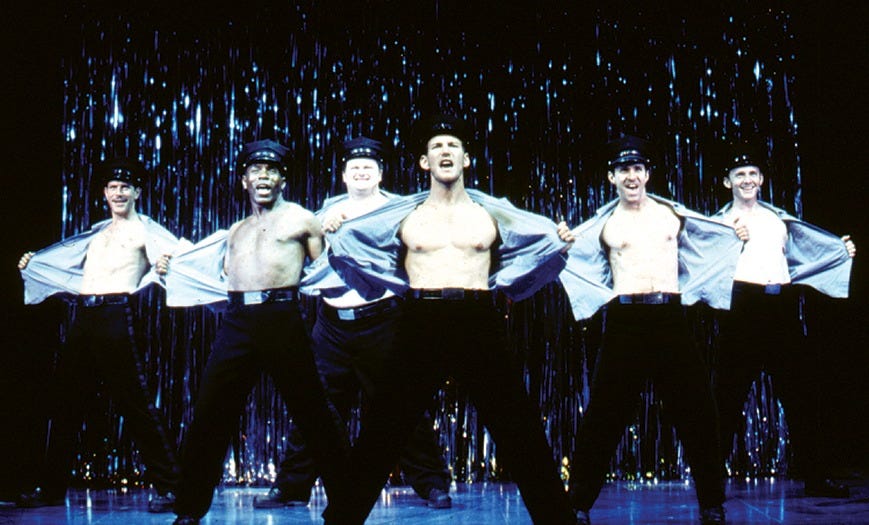
The Producers was the sort of sensation Broadway would not see again until Hamilton’s arrival in 2015. It easily and almost completely overshadowed all of the season’s other new musicals, even its closest competition, The Full Monty. With apologies to my Jewish mother, I believed then what many others have come to believe since: the vastly superior score belonged to The Full Monty, which marked the Broadway debut of David Yazbek (Dirty Rotten Scoundrels, The Band’s Visit, Dead Outlaw, Women on the Verge of a Nervous Breakdown). The score has what we would come to learn are Yazbek’s trademarks—pop culture references, irreverence, a variety of contemporary musical styles, a distinctly heterosexual male vibe, and a handful of surprisingly heartfelt songs that pack a considerable punch after all the showy cleverness. “You Walk With Me” is a gorgeous tearjerker that exemplifies the beauty and sincerity of which Yazbek is capable.
The 54th Annual Tony Awards in 2000
“Wake the Dead” from James Joyce’s The Dead
“Before the Morning” from Marie Christine
“Way Back to Paradise” from Marie Christine
“Best Friend” from The Wild Party
“When It Ends” from The Wild Party
The winner for Best Score in 2000 was Elton John and Tim Rice’s Aida—one of the most flagrant and indefensible examples of the Tonys making the wrong choice in my lifetime. Michael John LaChuisa’s scores for Marie Christine and The Wild Party are sophisticated and (especially in the former’s case) sometimes challenging, but their brilliance has become even more apparent over time. They’re also both stacked with examples of how difficult it can be to compare large choral numbers (e.g., “Before the Morning” and “Queenie Was a Blonde”) with duets and solos (e.g., “Way Back to Paradise” and “When It Ends”). This past spring offered some version of justice when Encores! revived The Wild Party and it was finally embraced by critics. That being said, Shaun Davey and Richard Nelson’s score for James Joyce’s The Dead is also full of gems, largely hidden from the wider audience it deserves because the musical’s only cast recording was a limited release made by the Pittsburgh Irish & Classical Theatre as a fundraiser. Despite this trio of scores being fairly esoteric, it’s hard for me to imagine a stronger roster of songs.
Note: the video I’ve linked above is a rather poor quality bootleg, but includes the whole song; this pro-shot is much more watchable, but rather frustratingly cuts off in the last few bars.
The 53rd Annual Tony Awards in 1999
“All the Wasted Time” from Parade
“Factory Girls/Come Up to My Office” from Parade
“It’s Hard to Speak My Heart” from Parade
“There Is a Fountain/It Don’t Make Sense” from Parade
“This Is Not Over Yet” from Parade
One of my favorite Substacks, 100 Showtunes, “use[s] a series of playlists to guide [readers] through 100 essential Broadway songs and their iconic musicals.” It includes an excellent breakdown of “The Old Red Hills of Home.”
The 52nd Annual Tony Awards in 1998
“Shadowlands” from The Lion King
“Wheels of a Dream” from Ragtime
“Your Daddy’s Son” from Ragtime
“You Should Be Loved” from Side Show
Oh, I know many of you are going to object to this choice, as well as my omission of other overwrought anthems from Ragtime like “Make Them Hear You” and “Back to Before.” Although I’ve detailed my distaste for Ragtime elsewhere, I haven’t really had occasion to expound on my love of Side Show. It’s an imperfect show with occasionally cringeworthy lyrics, but its exploration of normalcy as a construct is extremely unique in musical theatre, and Henry Krieger’s score is full of soaring melodies and haunting harmonies—all of which are epitomized in “Who Will Love Me As I Am?”
The 51st Annual Tony Awards in 1997
“People Magazine” from The Life
“Everybody’s Girl” from Steel Pier
“Lady’s Maid” from Titanic
“The Launching” from Titanic
It’s not entirely relevant to my fictional “Best Song” category, but I will die on the hill of The Life being a more deserving winner than Titanic of the 1997 Tony for Best Musical. The quasi-operatic score of the latter musical certainly induces some goosebumps, especially in “The Launching,” but “My Body” is a declaration of independence, sexual agency, and bodily autonomy that works brilliantly in and out of context.
The 50th Annual Tony Awards in 1996
“Stars, Stars, Stars” from Big
“Stop, Time” from Big
“Seasons of Love” from Rent
“Take Me for What I Am” from Rent
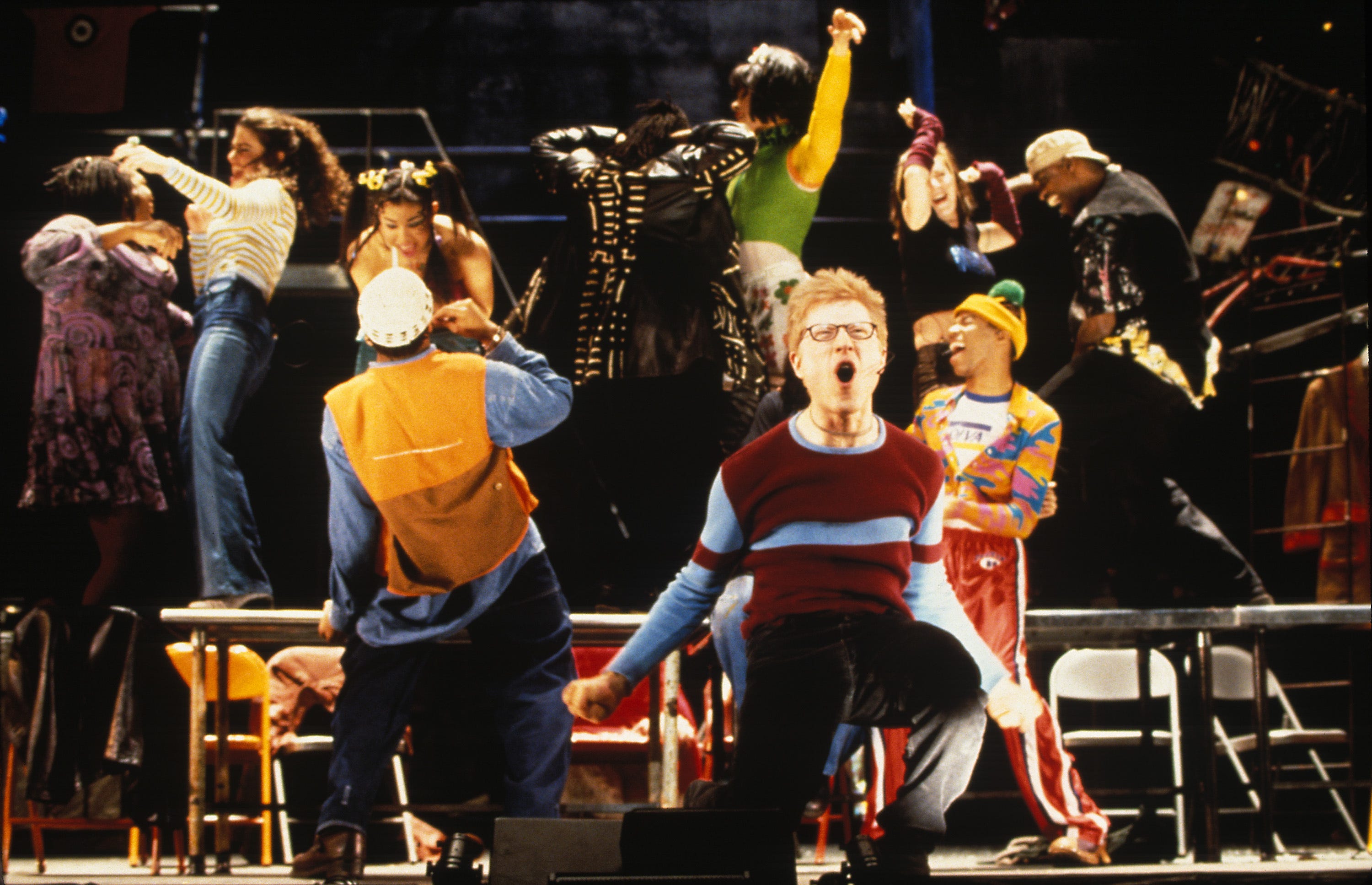
This is an interesting one. In 2026, it’s clear that the cultural imprint of “Seasons of Love” has been much vaster and longer lasting than any of the other songs listed here—maybe more than any other song in musical theatre since Hair. In 1996, however, unable to resist the orgiastic wit of its lyrics and an opening vamp that would make John Kander proud, I would’ve cast my vote for “La Vie Boheme.”
Big, a musical adaptation of the Tom Hanks film, came along in an overproduced, over-sponsored production at exactly the wrong moment. Its score is nowhere near the achievement that Rent’s is, but it is worth of reconsideration.
Somehow, the producers of State Fair successfully lobbied the Tonys nominating committee to be eligible as a new score, even though it consisted entirely of preexisting Rodgers and Hammerstein material. I could not bring myself to make the same judgement call and omitted standards like “It Might as Well Be Spring” and “It’s a Grand Night for Singing” from consideration.
The 49th Annual Tony Awards in 1995
“By This Time Next Year” from Sunset Boulevard
“The Greatest Star of All” from Sunset Boulevard
“Sunset Boulevard” from Sunset Boulevard
“With One Look” from Sunset Boulevard
In 1995, Sunset Boulevard was the only new musical eligible for Best Score, giving Andrew Lloyd Webber a Tony win with an asterisk, much like Aaron Tveit’s for Moulin Rouge! The Musical. (For the record, I would’ve elected to give out no award for Best Actor in a musical rather than vote for Tveit.) Given its power as a showstopper and its respectable crossover success, “As If We Never Said Goodbye” is the obvious choice here, but I also have a soft spot in my heart for “By This Time Next Year,” which flawlessly captures the hope, excitement, and mundane indignities of being a young creative.
The 48th Annual Tony Awards in 1994
“Home” from Beauty and the Beast
“If I Can’t Love Her” from Beauty and the Beast
“Flashback” from Passion
“Loving You” from Passion
“No One Has Ever Loved Me” from Passion
A perfect song perfectly interpreted by Donna Murphy in one of the most perfect musical theatre performances of all time
The 47th Annual Tony Awards in 1993
“Bright New Day” from Blood Brothers
“Elliot Garfield Grant” from The Goodbye Girl
“The Day After That” from Kiss of the Spider Woman
“Only in the Movies” from Kiss of the Spider Woman
“Where You Are” from Kiss of the Spider Woman
When Kiss of the Spider Woman’s (highly underrated) film adaptation was released last year, it hurt my heart to see a couple of reviews refer to it as “second-tier Kander and Ebb.” I believe it’s one of our great contemporary musicals. Audiences who know its score probably remember it for its splashy production numbers, like “Where You Are,” or its power ballads, like “The Day After That,” but the tender quartet “Dear One” is more than just a heartbreaker: it’s a testament to Kander being a far more versatile composer than those who equate him with showbiz razzle dazzle might think.
If you haven’t already read them, check out my previous posts in this series for the Broadway musicals of 2014-2025 and 2003-2013.
But, most importantly, share your thoughts below (and stop DM-ing me about Ragtime!). Do you agree or disagree with my choices? Did I leave out one of your favorites? Did I include something you hate? Be like the nuns in Sister Act and “raise your voice.”
You know I’m a huge fan of The Life, but the idea that anything in that score can compete with the Titanic is antithetical to my being. But the rest of this is all correct! Although I’ve never listened to passion!!!
"People Magazine" :-)